Research
Are Research Peptides EU Legal? A Clear Guide
Are research peptides EU legal? Learn how EU rules, research-only labeling, product presentation, and supplier documentation shape purchases across Europe.
FutureCell Research Team · 7 min read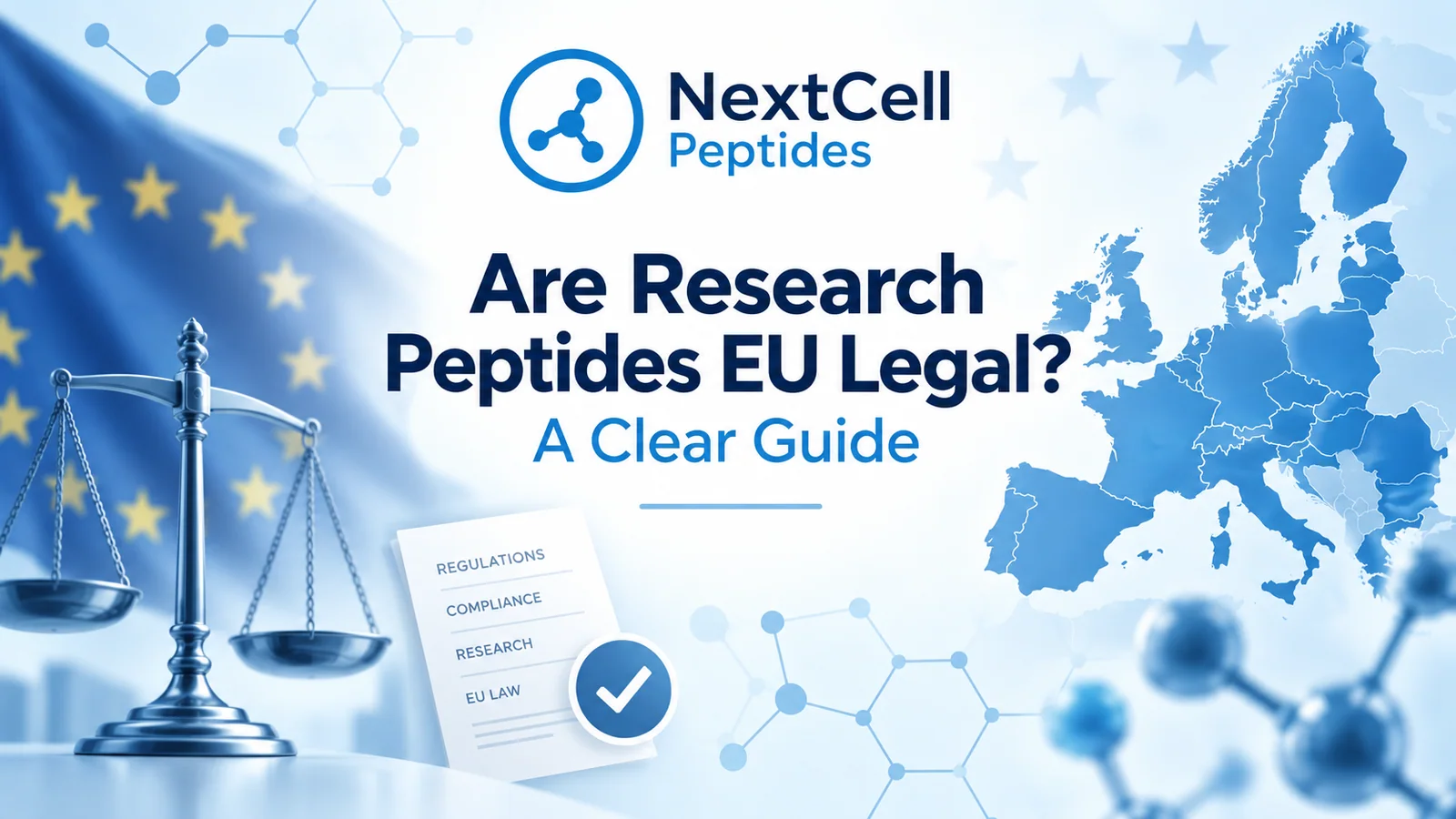
A vial can be marketed for laboratory research, sold by an EU-based supplier, and still require careful legal consideration before purchase. The question, are research peptides EU legal, does not have one universal yes-or-no answer. Legality depends on the specific compound, how it is presented and supplied, its intended purpose, and the rules applied in the destination country.
For private customers comparing research compounds online, the practical point is straightforward: research-only status is meaningful, but it is not a blanket legal category that overrides every EU or national rule. Responsible purchasing starts with understanding what the product is, what documentation supports it, and what claims are - and are not - being made.
Are research peptides EU legal across every member state?
Not automatically. The European Union has shared regulatory frameworks, but member states retain important authority over product enforcement, medicines rules, chemical controls, customs procedures, and consumer-market requirements. A compound that can be sold for legitimate research purposes in one setting may receive different scrutiny in another country depending on its classification and presentation.
Research peptides are generally supplied as materials intended for laboratory, analytical, or scientific research. They are not automatically authorized medicinal products simply because they are available for sale. They also should not be represented as products intended to diagnose, treat, prevent, or alter a condition in people.
That distinction matters because product presentation can influence regulatory interpretation. A supplier that uses research-focused labeling, avoids human-use claims, and provides clear technical specifications is operating very differently from one that markets the same material with treatment language or usage directions.
Why the legal answer depends on product presentation
In EU regulatory practice, authorities often assess more than the chemical name on a label. They may consider the complete presentation of a product: website copy, packaging, instructions, advertising, stated intended use, and the context in which it is sold.
A product described as a research compound, professionally labeled for research purposes, and accompanied by analytical documentation has a clearer research-oriented position. By contrast, claims about outcomes in people, directions for administration, or references that position a compound as a substitute for approved medical care can create a very different regulatory issue.
This is why responsible research peptide suppliers keep product information precise. Useful information includes peptide identity, net quantity, storage specifications where applicable, lot or batch identification, analytical method, purity result, and a Certificate of Analysis. These details help a buyer evaluate material quality without turning a research listing into a human-use product claim.
Research-only labeling is necessary, but not a universal exemption
The phrase “for research use only” is not a legal shield by itself. It should accurately reflect the product's intended market position and be supported by the supplier's wider conduct. If a listing, advertisement, or support message contradicts that position, the label alone may carry little weight.
For buyers, research-only labeling should be viewed as one part of a larger quality and compliance picture. Look for consistency across the product page, vial label, batch records, and Certificate of Analysis. The stated compound, concentration or quantity, and lot details should align rather than appear as disconnected marketing elements.
It is also sensible to distinguish between a product being available to purchase and a product being approved for a particular use. Availability through an online store does not establish regulatory authorization for any non-research application. Those are separate questions, and treating them as the same is where many misunderstandings begin.
What EU buyers should check before purchasing
The most useful checks are practical rather than speculative. Start by confirming the compound's status under the rules that apply where the order will be delivered. National authorities, customs rules, and controlled-substance or medicines frameworks can differ, particularly for compounds that attract greater regulatory attention.
Then assess the supplier's documentation and product presentation. A credible listing should make it possible to identify exactly what is being offered and how it was evaluated. This is especially relevant for compounds frequently searched by EU customers, including BPC-157, GHK-Cu, MOTS-c, TB-500, Semax, Epitalon, Pinealon, Thymosin Alpha-1, CJC-1295 with Ipamorelin, Retatrutide, and NAD+.
Before placing an order, review these four points:
Destination-country rules: Confirm that local requirements do not restrict the compound or its import, possession, or research supply.
Intended purpose: Purchase only where the product's research designation matches the intended use and no prohibited use is involved.
Product documentation: Check whether a current Certificate of Analysis identifies the lot, analytical method, and reported purity.
Supplier transparency: Look for clear contact details, professional labeling, defined fulfillment practices, and consistent research-focused product information.
These checks do not replace professional legal advice for a specific situation. They do, however, help buyers avoid relying on vague claims such as “EU legal” when the real answer depends on a compound and a country.
The role of quality documentation in lawful research purchasing
A Certificate of Analysis does not determine whether a compound is legal. Its role is different and still highly valuable: it provides evidence about the identity and quality characteristics of the material being offered. For research products, that evidence is central to informed supplier comparison.
HPLC testing is commonly used to assess chromatographic purity and profile consistency. Depending on the product and testing plan, additional analytical work may support identity confirmation, residual-solvent assessment, moisture measurement, or other relevant specifications. No single test answers every quality question, which is why the best documentation identifies the method used and ties results to a specific batch.
Independent third-party testing adds another layer of confidence when it is available. It helps demonstrate that quality claims are supported outside a supplier's own internal process. Buyers should still read documents carefully: a COA should identify the product and lot clearly, provide a date, and state measurable results rather than relying on a generic purity statement.
For a research buyer, this is more than paperwork. A well-documented lot is easier to compare, record, and assess for research suitability than an unlabeled or poorly specified product.
EU fulfillment changes logistics, not the legal assessment
EU-based fulfillment can make ordering simpler from a logistics perspective. When products are dispatched from within the European Union, customers may benefit from a more direct delivery process compared with shipments entering from outside the bloc. It can also make supplier communication, documentation review, and order tracking more straightforward.
However, fulfillment from the Netherlands or another EU location does not make every compound universally permitted in every member state. National rules and enforcement priorities still matter. Buyers should avoid assuming that an EU warehouse alone settles the legal question.
The better standard is transparency. A supplier should be clear about research-only positioning, product specifications, testing practices, and shipping scope, while customers should verify the requirements that apply to their destination and intended research context.
When additional caution is warranted
Extra care is appropriate when a compound has a complex regulatory profile, when a listing lacks clear analytical records, or when the marketing language seems inconsistent with a research-only designation. The same is true if a buyer cannot determine whether a product is restricted under local law.
In those cases, pause rather than infer permission from online availability. Consult the relevant national authority or a qualified legal professional familiar with the destination country's rules. This is particularly appropriate for commercial projects, cross-border resale, or circumstances involving regulated laboratories and institutions.
For private customers, the clearest path is usually to choose transparent research materials from suppliers that state their purpose plainly and publish batch-specific quality information. FutureCell Peptides supports this approach with research-focused product specifications, professionally labeled materials, and Certificates of Analysis for applicable batches.
A careful purchase begins with a better question than “is it sold online?” Ask whether the compound, product presentation, documentation, and destination-country requirements all align. That is the standard that supports more responsible research purchasing across the EU.