

Guides
BPC-157 5 mg vs 10 mg: A Complete Buyer's Guide (2026)
Compare BPC-157 5 mg and 10 mg research peptides. Learn the key differences in product presentation, labeling, documentation, storage and supplier transparency to make a more informed purchasing decision.
FutureCell Research Team · 15 min read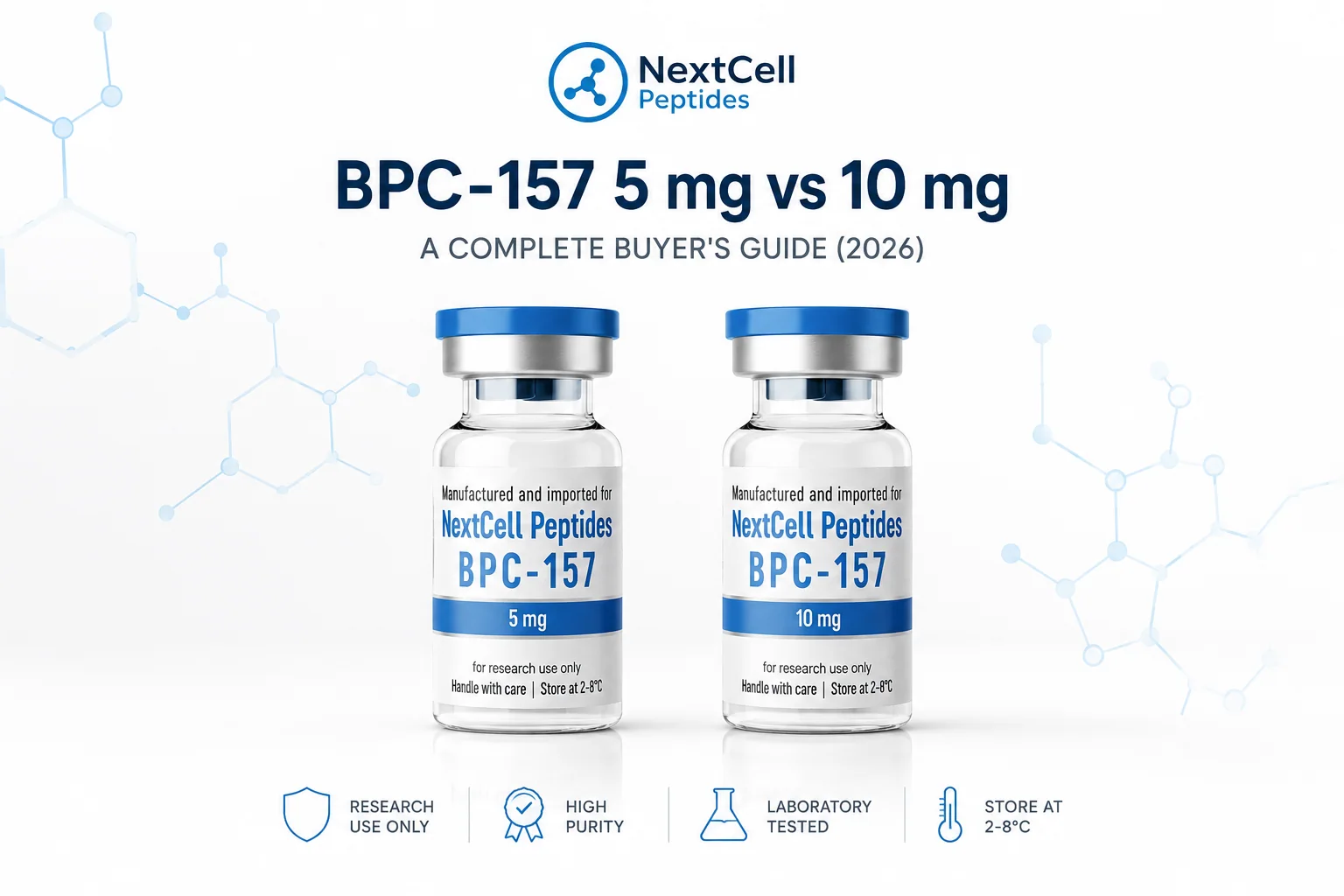
Introduction
Choosing between a 5 mg and 10 mg BPC-157 research peptide may seem straightforward, but many buyers quickly realize that the amount printed on the vial is only one part of a much larger evaluation.
Both presentations are widely available from research peptide suppliers and are typically supplied as lyophilized powder in sterile laboratory vials. While the products often look similar, differences in documentation, product presentation, labeling, storage guidance and supplier transparency can significantly influence the overall purchasing experience.
For first-time buyers, it is common to focus primarily on the quantity displayed on the label. More experienced buyers, however, usually take a broader approach. They evaluate the professionalism of the supplier, the consistency of the product range and the quality of the information provided before making a purchasing decision.
This guide explains the practical differences between BPC-157 5 mg and BPC-157 10 mg research peptides from a buyer's perspective.
Rather than making recommendations about how either product should be used, this guide focuses on how to evaluate both product formats objectively. By understanding what professional suppliers provide—and what experienced buyers typically look for—you can compare products with greater confidence.
Whether you are purchasing your first research peptide or comparing multiple suppliers, this guide is designed to help you identify the quality indicators that matter most.
Table of Contents
Understanding BPC-157 Vial Sizes
What Does 5 mg or 10 mg Actually Mean?
Why Suppliers Offer Multiple Product Sizes
Product Presentation: 5 mg vs 10 mg
Packaging and Labeling
Understanding Product Documentation
Storage Before Reconstitution
Storage After Reconstitution
Comparing Professional Suppliers
Common Buying Mistakes
Frequently Asked Questions
Related Guides
Summary
Understanding BPC-157 Vial Sizes
One of the first specifications buyers notice when browsing research peptides is the amount displayed on the product label.
Among the most common options available, 5 mg and 10 mg are frequently offered by research peptide suppliers worldwide.
The value printed on the vial represents the amount of lyophilized peptide contained within the vial before reconstitution. It is a product specification that allows buyers to distinguish between different presentations of the same peptide.
Although the numerical difference appears simple, it is important to understand that vial size alone does not determine product quality.
Professional suppliers apply the same manufacturing standards, analytical testing procedures and quality control processes regardless of whether the product is supplied as a 5 mg or 10 mg presentation.
For this reason, experienced buyers compare far more than the amount displayed on the label.
What Does 5 mg or 10 mg Actually Mean?
The amount printed on a research peptide vial identifies the quantity of lyophilized peptide contained within that specific product presentation.
It does not describe the manufacturing quality, analytical purity or overall professionalism of the supplier.
This distinction is important because many first-time buyers mistakenly assume that larger vial sizes represent higher-quality products.
In reality, both 5 mg and 10 mg products can be manufactured using the same production standards, analytical testing methods and quality management procedures.
Understanding this difference helps buyers evaluate products based on objective quality indicators rather than assumptions.
Why Suppliers Offer Multiple Product Sizes
Professional research peptide suppliers often offer multiple vial sizes to provide flexibility across different purchasing requirements.
Offering several product presentations allows buyers to select the format that best aligns with their purchasing preferences while maintaining consistent manufacturing and quality standards across the entire product range.
Regardless of vial size, professional suppliers should present each product with the same level of transparency.
This includes:
Clear product specifications.
Consistent product labeling.
Professional packaging.
Storage recommendations.
Educational resources.
Supporting analytical documentation where appropriate.
Consistency across different product presentations is often a stronger indicator of professionalism than the vial size itself.
Why Quantity Alone Should Never Determine Your Decision
One of the most common mistakes made by first-time buyers is assuming that the numerical amount displayed on the vial should be the primary factor influencing a purchasing decision.
Experienced buyers rarely evaluate products this way.
Instead, they compare the supplier as a whole.
Questions that experienced buyers commonly ask include:
Does the supplier clearly explain the product?
Are storage recommendations available before purchase?
Is documentation easy to understand?
Are product labels professionally designed?
Is the product presentation consistent throughout the website?
Does the supplier invest in educational resources?
These factors provide a much broader understanding of product quality than the quantity displayed on the vial alone.
Buyer Insight
The most informed purchasing decisions are rarely based on a single specification.
Professional buyers evaluate products within the context of a complete quality system that includes documentation, transparency, product presentation, analytical testing and supplier consistency.
Understanding this broader perspective makes it easier to compare BPC-157 products objectively while avoiding many of the assumptions commonly associated with different vial sizes.
Product Presentation: Is There Any Difference Between 5 mg and 10 mg?
At first glance, BPC-157 5 mg and 10 mg research peptides often appear nearly identical.
Both products are typically supplied as sterile laboratory vials containing lyophilized peptide, with similar packaging, labeling and storage recommendations. For many buyers, the most obvious distinction is simply the amount displayed on the label.
However, experienced buyers understand that product presentation extends beyond the vial itself.
A professionally presented research peptide should communicate important information clearly and consistently across every stage of the purchasing journey—from the product page to the packaging received after delivery.
When comparing two vial sizes from the same supplier, buyers should expect the same standards of professionalism regardless of the quantity offered.
Consistency is often a stronger indicator of quality than the vial size itself.
Comparing Product Labels
A product label serves as more than a product identifier.
It is one of the first opportunities for a supplier to demonstrate professionalism, accuracy and attention to detail.
Whether purchasing a 5 mg or 10 mg presentation, buyers should expect labels to include clear and consistent information such as:
Product name
Peptide quantity
Batch or lot identification (where applicable)
Storage recommendations
Research Use Only statement
Supplier branding
Professional labeling helps reduce confusion while improving traceability across different batches and product sizes.
Poorly designed labels, inconsistent terminology or missing information may indicate a lack of quality control in product presentation.
Packaging Should Reflect Professional Standards
Packaging cannot determine the quality of the peptide itself, but it often reflects the supplier's overall approach to quality management.
Professional suppliers typically maintain consistent packaging standards across their entire product range.
Characteristics commonly associated with professional presentation include:
Secure protective packaging.
Consistent branding.
Clean label application.
Clearly identifiable products.
Packaging designed to protect the contents during transport.
When multiple vial sizes are available, the overall presentation should remain consistent regardless of whether the buyer selects a 5 mg or 10 mg product.
Why Consistency Across Product Sizes Matters
One of the strongest indicators of a well-organized supplier is consistency.
If a company offers BPC-157 in multiple vial sizes, buyers should expect the same level of documentation, branding and quality information across every variation.
This includes:
Consistent product photography.
Matching label design.
Uniform product descriptions.
Similar storage guidance.
Comparable educational resources.
Equivalent documentation standards.
Large differences between product pages or packaging for different vial sizes may create unnecessary uncertainty.
Professional suppliers aim to provide a consistent purchasing experience regardless of the product presentation selected.
Documentation Is More Important Than Quantity
Many buyers initially compare products by looking only at the amount printed on the label.
Experienced buyers typically place greater importance on the documentation supporting that product.
Useful documentation may include:
Product specifications.
Storage recommendations.
Certificates of Analysis (where available).
Information about analytical testing.
Educational guides explaining technical concepts.
Clear explanations of product presentation.
Comprehensive documentation helps buyers evaluate products objectively rather than relying on assumptions or marketing language.
Questions Experienced Buyers Often Ask
When comparing BPC-157 5 mg and 10 mg products, experienced buyers often ask questions such as:
Is product information complete?
Are storage recommendations clearly explained?
Does the supplier publish educational resources?
Is supporting documentation available?
Is branding consistent across the product range?
Are product images accurate and professionally presented?
Does the supplier explain quality indicators in an understandable way?
These questions provide a broader perspective than simply comparing vial sizes.
Buyer Checklist: Comparing 5 mg and 10 mg Products
Before comparing BPC-157 5 mg and 10 mg research peptides, experienced buyers typically evaluate much more than the quantity printed on the vial.
Rather than focusing on a single specification, they review several quality indicators that provide a broader understanding of the supplier and the overall purchasing experience.
When comparing products, consider the following questions:
Is the product label clear, consistent and professionally designed?
Well-presented labeling improves product identification and reflects attention to detail.Are the product specifications complete and easy to understand?
Comprehensive product information allows buyers to compare products using consistent and objective criteria.Are storage recommendations provided before purchase?
Clear storage guidance demonstrates transparency and helps buyers understand how the product should be handled.Is supporting documentation available where appropriate?
Product specifications, analytical documentation and educational resources contribute to a more informed purchasing decision.Is the packaging consistent across different product sizes?
Consistent presentation reflects an organized approach to product quality and branding.Does the supplier maintain professional and consistent branding?
Uniform branding across products, documentation and educational resources demonstrates attention to detail and professionalism.Are educational resources available?
Buying guides and explanations of quality indicators help buyers understand technical concepts before making a purchasing decision.Does the supplier prioritize transparency?
Clear explanations, accessible documentation and objective information provide greater confidence than promotional language alone.
Looking beyond the numerical quantity printed on the vial allows buyers to compare BPC-157 5 mg and 10 mg products using objective quality indicators rather than assumptions. By evaluating the complete purchasing experience—including documentation, storage guidance, product presentation and supplier transparency—buyers can make more informed and balanced comparisons.
Key Takeaway
The difference between BPC-157 5 mg and 10 mg is not simply a question of quantity.
Professional buyers evaluate the complete purchasing experience, including product presentation, documentation, labeling, storage guidance and supplier transparency.
When these elements remain consistent across different vial sizes, buyers can compare products with greater confidence and focus on the factors that genuinely contribute to a professional research peptide purchasing experience.
Understanding Product Documentation
One of the most overlooked aspects when comparing BPC-157 research peptides is the documentation that accompanies the product.
While many buyers initially focus on the vial size, experienced purchasers often place greater emphasis on the information provided before an order is placed.
Professional suppliers understand that transparency extends beyond the product itself. Clear documentation helps buyers evaluate products objectively, understand quality standards and compare suppliers using measurable criteria rather than marketing claims.
Depending on the supplier, useful documentation may include:
Product specifications
Storage recommendations
Certificates of Analysis (COAs)
Information about analytical testing
Product images
Educational resources
Frequently Asked Questions
The availability and clarity of this information often say more about the supplier than the product quantity printed on the vial.
Why Certificates of Analysis Matter
A Certificate of Analysis (COA) is one of the most valuable documents a research peptide supplier can provide.
Rather than serving as a marketing document, a COA summarizes analytical information for a specific production batch and helps buyers understand how product quality has been evaluated.
Depending on the testing laboratory, a COA may include information such as:
Product identification
Batch number
Date of analysis
Analytical method
Reported purity
Laboratory information
A professional supplier should present Certificates of Analysis in a way that is easy to understand, rather than expecting buyers to interpret technical documentation without explanation.
For this reason, educational resources explaining how to read a COA can be just as valuable as the document itself.
Understanding HPLC Reports
High-Performance Liquid Chromatography (HPLC) is one of the most commonly used analytical techniques for evaluating research peptides.
Many suppliers reference HPLC testing, but not all explain what the results actually mean.
An HPLC report is designed to provide analytical information about a product sample. Depending on the laboratory, it may include chromatograms, retention times, peak areas and reported purity values.
For buyers, understanding these reports helps place analytical data into context.
Rather than focusing on a single percentage, experienced buyers evaluate analytical documentation as one part of a broader quality assessment that also includes manufacturing standards, storage guidance and supplier transparency.
Why Transparency Is More Valuable Than Marketing Claims
Research peptide buyers are often presented with bold quality claims that can be difficult to verify.
Professional suppliers take a different approach.
Instead of relying on promotional language, they provide information that allows buyers to evaluate products independently.
Examples include:
Comprehensive product descriptions.
Clear storage recommendations.
Educational buying guides.
Supporting documentation.
Transparent explanations of analytical methods.
Consistent product presentation.
Providing information rather than relying on marketing language builds long-term trust and allows buyers to make more informed purchasing decisions.
Common Buying Mistakes
When comparing BPC-157 5 mg and 10 mg products, several common mistakes can lead to unnecessary uncertainty.
Understanding these pitfalls helps buyers evaluate suppliers more objectively.
Common mistakes include:
Comparing products based only on vial size.
Assuming higher quantity indicates higher quality.
Ignoring available documentation.
Overlooking storage recommendations.
Focusing only on purity percentages.
Comparing prices without evaluating supplier transparency.
Choosing suppliers with limited educational resources.
Experienced buyers recognize that product quality is best assessed using multiple quality indicators rather than a single specification.
Professional Suppliers Help Buyers Understand the Product
The role of a professional supplier extends beyond making products available.
Educational content plays an important role in helping buyers understand technical concepts that may otherwise be difficult to interpret.
Rather than assuming every customer is familiar with laboratory terminology, professional suppliers explain topics such as:
What a Certificate of Analysis includes.
How HPLC testing works.
Why storage recommendations matter.
How to interpret product labels.
The purpose of batch identification.
The importance of analytical documentation.
By reducing uncertainty through education, suppliers make it easier for buyers to compare products using objective information rather than assumptions.
Buyer Checklist: Documentation Review
Before purchasing a BPC-157 research peptide, take the time to review the documentation provided by the supplier.
Experienced buyers understand that product documentation offers valuable insight into how transparently a supplier presents its products. Rather than relying on marketing claims, they evaluate whether important information is readily available, clearly explained and consistent throughout the purchasing experience.
When reviewing supplier documentation, consider the following questions:
Are the product specifications clearly presented?
Complete and accurate specifications help buyers identify the correct product and compare different suppliers using consistent information.Are storage recommendations available before purchase?
Clear storage guidance demonstrates attention to proper product handling and allows buyers to understand storage requirements before placing an order.Is analytical documentation available where appropriate?
Certificates of Analysis (COAs), analytical testing information and supporting documentation contribute to greater transparency and help buyers evaluate products more objectively.Does the supplier explain technical terminology?
Clear explanations of laboratory concepts and documentation make technical information easier to understand, particularly for buyers who are new to research peptides.Are educational resources available?
Comprehensive buying guides, technical articles and supporting educational content help buyers make more informed purchasing decisions.Is branding consistent across documentation and product pages?
Consistent presentation, terminology and visual branding reflect professionalism and attention to detail throughout the purchasing experience.
Reviewing these areas provides a more balanced understanding of product quality than comparing product specifications alone. Suppliers that combine clear documentation with educational resources and transparent communication make it easier for buyers to evaluate research peptides using objective information rather than assumptions.
Key Takeaway
When comparing BPC-157 5 mg and 10 mg research peptides, the documentation supporting the product is often just as important as the product itself.
Certificates of Analysis, HPLC reports, storage guidance and educational resources all contribute to a more transparent purchasing experience.
Rather than relying on marketing claims, experienced buyers use these resources to evaluate suppliers objectively and compare products with greater confidence.
Frequently Asked Questions
What is the main difference between BPC-157 5 mg and 10 mg?
The primary difference is the amount of lyophilized peptide contained within the vial before reconstitution.
The vial size itself does not indicate product quality, manufacturing standards or analytical purity. Professional suppliers should apply the same quality standards, documentation and presentation regardless of the product size offered.
Does a 10 mg vial indicate higher quality than a 5 mg vial?
No.
The quantity displayed on the label reflects the product presentation rather than the manufacturing quality.
When comparing products, buyers should focus on transparency, documentation, storage guidance and supplier consistency instead of assuming that a larger vial represents a higher-quality product.
Why do research peptide suppliers offer multiple vial sizes?
Professional suppliers often provide multiple vial sizes to offer flexibility across different purchasing preferences.
Regardless of the vial size selected, buyers should expect the same level of documentation, product presentation, labeling and educational resources.
What should a professional BPC-157 product page include?
A professional product page should provide enough information for buyers to evaluate the product objectively before making a purchasing decision.
Examples include:
Product specifications.
Clear storage recommendations.
Product images.
Educational resources.
Information about analytical documentation.
Frequently Asked Questions.
Consistent product presentation.
Transparent product pages reduce uncertainty and make supplier comparisons easier.
Why is a Certificate of Analysis important?
A Certificate of Analysis (COA) provides analytical information relating to a specific production batch.
While the exact contents vary between laboratories, a COA often includes product identification, analytical methods and reported test results.
Professional suppliers help buyers understand what a COA represents rather than simply making the document available.
What is an HPLC report?
High-Performance Liquid Chromatography (HPLC) is an analytical technique commonly used to evaluate research peptides.
An HPLC report provides information generated during laboratory analysis and should be interpreted alongside other documentation rather than viewed as the only indicator of product quality.
What should buyers compare besides vial size?
Experienced buyers often evaluate:
Product labeling.
Product specifications.
Storage recommendations.
Analytical documentation.
Educational resources.
Supplier transparency.
Packaging consistency.
Overall professionalism.
Comparing several quality indicators provides a more balanced assessment than focusing on vial size alone.
Does packaging matter?
Packaging alone cannot determine product quality.
However, consistent packaging, professional labeling and clear product identification often reflect an organized quality management process and attention to detail throughout the purchasing experience.
How can buyers compare suppliers objectively?
Rather than relying on marketing claims, buyers should evaluate measurable quality indicators such as documentation, transparency, storage guidance, educational resources and consistency across the supplier's website.
This approach provides a more objective basis for comparison.
Where can I learn more about BPC-157?
Understanding BPC-157 becomes easier when viewed alongside related educational resources covering peptide quality, documentation, storage and supplier evaluation.
Exploring these topics provides additional context and helps buyers make more informed purchasing decisions.
Related Guides
To better understand research peptide quality and supplier transparency, the following guides provide additional educational information:
Together, these resources provide a broader understanding of how research peptides are presented, documented and evaluated before purchase.
Explore Our BPC-157 Research Peptide
Interested in learning more?
Explore our BPC-157 10 mg Research Peptide to view detailed product specifications, storage recommendations and product information.
→ View the BPC-157 10 mg product page
Summary
At first glance, comparing BPC-157 5 mg and 10 mg research peptides may seem as simple as comparing the amount displayed on the vial. However, experienced buyers understand that evaluating research peptides involves much more than product quantity alone.
Professional suppliers distinguish themselves through consistent product presentation, transparent documentation, clear storage recommendations and educational resources that help buyers understand the information provided.
When comparing suppliers, the most valuable approach is to evaluate the complete purchasing experience rather than focusing on a single specification.
Product labeling, analytical documentation, Certificates of Analysis, HPLC reports and supplier transparency all contribute to a more informed purchasing decision.
By taking the time to compare these quality indicators, buyers can move beyond marketing claims and assess research peptide products using objective information.
Ultimately, the most reliable purchasing decisions are built on transparency, consistency and education. Suppliers that invest in helping buyers understand their products before purchase create greater confidence and make it easier to evaluate quality using evidence rather than assumptions.
Whether you are comparing BPC-157 5 mg and 10 mg for the first time or reviewing multiple suppliers, understanding the broader factors that influence product quality will help you make better-informed decisions and identify suppliers committed to professionalism and transparency.