
Guides
BPC-157 Price Guide (2026): What Determines the Cost of High-Quality Research Peptides?
Learn what determines the cost of high-quality BPC-157 research peptides and how experienced buyers evaluate value using documentation, analytical testing and supplier transparency rather than price alone.
FutureCell Research Team · 16 min read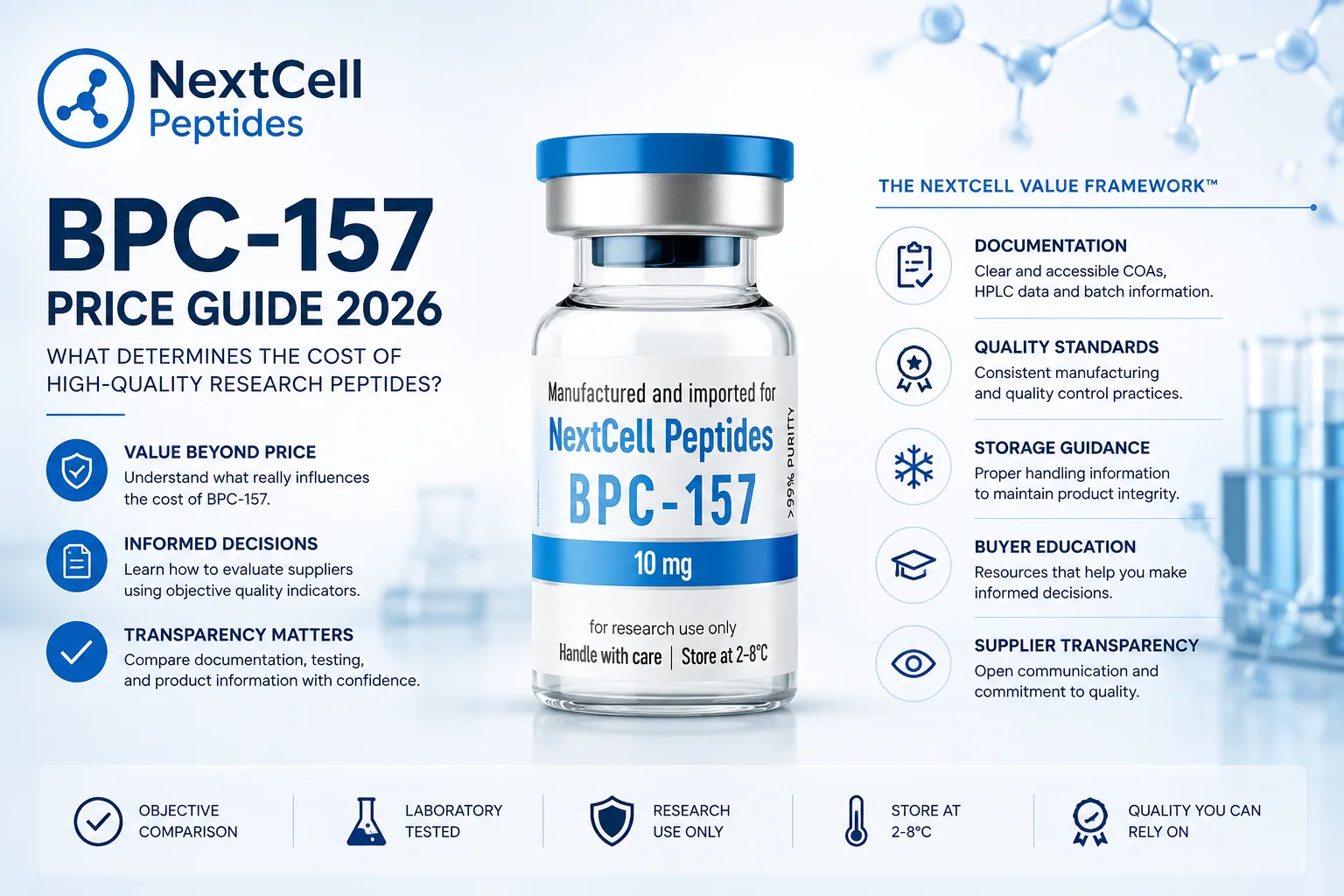
Introduction
The price of BPC-157 research peptides can vary considerably between suppliers.
At first glance, two products may appear nearly identical. They may display the same peptide name, the same amount per vial and similar product images, yet differ significantly in price.
For buyers researching BPC-157 for the first time, these differences can be confusing.
Does a higher price indicate better quality?
Is a lower-priced product necessarily a poor choice?
Or are there other factors that experienced buyers evaluate before making a purchasing decision?
The answer is rarely as simple as comparing the number printed on the product page.
Professional buyers understand that price and value are not the same thing.
Rather than evaluating products solely by cost, they consider the complete purchasing experience, including documentation, analytical transparency, product presentation, storage guidance and the supplier's commitment to educating customers.
This guide explains the factors that commonly influence the price of BPC-157 research peptides and provides a structured framework for evaluating value using objective quality indicators instead of assumptions.
Whether you are comparing suppliers for the first time or refining your purchasing process, understanding these factors can help you make more informed decisions.
Table of Contents
Why Does the Price of BPC-157 Vary?
Price vs Value: Understanding the Difference
What Are You Actually Paying For?
The FutureCell Value Framework™
Hidden Costs of Choosing the Lowest Price
Questions Every Buyer Should Ask
Professional Buyer's Checklist
Frequently Asked Questions
Related Guides
Summary
Why Does the Price of BPC-157 Vary?
One of the most common questions buyers ask is why the price of seemingly similar BPC-157 products can differ between suppliers.
Although products may share the same peptide name and nominal quantity, they often differ in many other areas that are not immediately visible.
Price differences may reflect variations in:
Manufacturing standards
Product presentation
Analytical documentation
Batch traceability
Packaging quality
Educational resources
Customer support
Supplier transparency
Quality management processes
For this reason, comparing products using price alone rarely provides a complete picture.
Instead, experienced buyers evaluate the information surrounding the product as carefully as the product itself.
Price and Value Are Not the Same Thing
One of the biggest misconceptions in the research peptide market is that the lowest price automatically represents the best value.
In reality, value is determined by the amount of useful information, transparency and consistency that accompanies a product—not simply its purchase price.
A supplier that invests in detailed documentation, professional labeling, educational content and clear product specifications may require greater operational resources than one offering only a brief product description.
For buyers, these additional resources reduce uncertainty before purchase and make it easier to compare products objectively.
This is why experienced buyers focus on overall value, not just cost.
What Are You Actually Paying For?
When evaluating BPC-157 research peptides, the purchase price reflects more than the physical product itself.
Professional suppliers often invest in systems and resources that improve the buying experience and help customers understand exactly what they are purchasing.
These investments may include:
Comprehensive product documentation.
Professionally designed product labels.
Batch identification and traceability.
Educational buying guides.
Analytical documentation where appropriate.
Storage recommendations.
High-quality product photography.
Consistent product presentation.
Responsive customer support.
Ongoing educational content.
While these factors may not always be visible in a product comparison table, they contribute to the overall value buyers receive.
Expert Insight
Experienced buyers rarely begin by asking:
"Which BPC-157 product is the cheapest?"
Instead, they ask:
"Which supplier provides the most information to support an informed purchasing decision?"
Price is only one variable.
The availability of documentation, the clarity of educational resources and the supplier's overall transparency often provide a more meaningful basis for comparison than cost alone.
A lower price may appear attractive initially, but without sufficient information it can be difficult to evaluate whether products are being compared on equal terms.
Professional buyers therefore consider price within the broader context of documentation, consistency and transparency rather than as an isolated metric.
The FutureCell Value Framework™
When comparing BPC-157 research peptides, focusing solely on price often provides an incomplete picture.
Experienced buyers evaluate the overall value proposition, considering the information, documentation and transparency that accompany the product.
The FutureCell Value Framework™ is a structured approach designed to help buyers compare suppliers using objective quality indicators rather than cost alone.
Instead of asking "Which product is the cheapest?", the framework encourages buyers to ask:
"Which supplier provides the most complete information to support an informed purchasing decision?"
Comparing Price vs Value
When comparing BPC-157 research peptides, it is important to distinguish between price and overall value. Although these concepts are often used interchangeably, they represent very different aspects of the purchasing process.
A price-focused evaluation typically concentrates on the initial purchase cost, the quantity of peptide in the vial or other immediately visible characteristics. While these factors are relevant, they provide only a limited perspective and may not reflect the overall purchasing experience.
A value-focused evaluation, on the other hand, considers a broader range of objective quality indicators. Experienced buyers often assess the completeness of product documentation, the availability of analytical information, the transparency of the supplier and the educational resources provided before making a purchasing decision.
Rather than relying on marketing claims or product images alone, professional buyers look for comprehensive product information that supports objective comparison. Clear documentation, consistent product presentation and transparent communication all contribute to a better understanding of what is being offered.
Value should also be considered from a long-term perspective. Suppliers that invest in buyer education, detailed product specifications and accessible technical information help reduce uncertainty and make future product comparisons more straightforward.
This comparison does not suggest that a higher-priced product is automatically superior or that a lower-priced product represents poorer quality. Instead, it highlights that price alone rarely provides sufficient information for evaluating research peptides objectively. A more balanced assessment considers both the product itself and the quality of the information that accompanies it.
What Contributes to Overall Value?
Professional suppliers often invest in areas that are not immediately visible when comparing products side by side.
Examples include:
Detailed product specifications.
Consistent product labeling.
Batch traceability.
Educational buying guides.
Laboratory documentation where appropriate.
Clear storage recommendations.
Professionally presented product photography.
Website consistency.
Customer education.
Ongoing quality communication.
Although these investments may not directly change the listed price of a product, they improve the buyer's ability to evaluate products with confidence.
Understanding the Cost Behind Professional Presentation
Developing a transparent research peptide business involves more than sourcing products.
Professional suppliers often dedicate significant resources to maintaining consistent product presentation and educational support.
Examples may include:
Producing educational buying guides.
Creating product-specific documentation.
Designing professional product labels.
Maintaining detailed product pages.
Providing storage guidance.
Answering customer questions.
Organizing laboratory documentation.
Updating educational resources as new information becomes available.
These activities require ongoing investment but contribute to a purchasing experience that is easier for buyers to evaluate.
The Hidden Costs of Choosing the Lowest Price
A lower purchase price may initially appear attractive.
However, buyers should also consider the information that may be absent when comparing suppliers.
For example, lower-priced products may provide less information regarding:
Product documentation.
Storage recommendations.
Product labeling.
Batch information.
Educational resources.
Analytical testing explanations.
Supplier transparency.
This does not automatically indicate lower product quality.
Rather, it means buyers may have fewer objective criteria available for making an informed comparison.
Professional Buyers Compare More Than Cost
Experienced buyers often compare suppliers using multiple categories simultaneously.
Instead of evaluating a single specification, they ask questions such as:
Is the product information complete?
Is documentation available and explained?
Are storage recommendations easy to locate?
Does the supplier provide educational resources?
Is product presentation consistent?
Are technical terms clearly defined?
Does the supplier prioritize transparency?
This broader approach reduces uncertainty and supports more objective purchasing decisions.
Comparison Matrix: Evaluating Overall Value
When evaluating BPC-157 research peptides, no single factor determines overall value.
Experienced buyers understand that meaningful comparisons require looking at multiple aspects of both the product and the supplier rather than focusing on a single specification such as price or purity.
Product specifications provide the foundation for comparison. Accurate and complete specifications make it easier to understand what is being offered and allow buyers to evaluate products on equal terms.
Product documentation is another essential consideration. Clear documentation helps buyers understand available information and supports informed purchasing decisions.
Analytical information, including explanations of laboratory testing where appropriate, improves transparency and helps buyers better understand how product quality is evaluated.
Product labeling also contributes to overall value by supporting product identification, consistency and traceability across different batches and products.
Storage recommendations demonstrate attention to proper product handling and provide buyers with practical guidance before and after purchase.
Professional suppliers also invest in educational resources that explain technical terminology, laboratory documentation and quality concepts in a clear and accessible way. These resources reduce uncertainty and help buyers make objective comparisons.
Another important indicator is supplier transparency. Companies that openly explain their quality processes, documentation standards and educational approach make it easier for buyers to evaluate products based on reliable information rather than assumptions.
Finally, website consistency and customer support contribute to the overall purchasing experience. Well-organized product pages, consistent presentation and responsive communication reflect professionalism and provide buyers with additional confidence throughout the evaluation process.
No single category determines overall value. Instead, experienced buyers consider these factors together to develop a more complete understanding of both the supplier and the product before making a purchasing decision.
Expert Insight
One of the most common mistakes buyers make is assuming that products with identical names and quantities should have identical value.
In practice, two suppliers may present very different purchasing experiences.
Documentation, educational content, storage guidance, product consistency and analytical transparency all contribute to how easily buyers can evaluate a product before making a decision.
Experienced buyers therefore compare the quality of the information surrounding the product as carefully as they compare the product itself.
Questions Every Buyer Should Ask Before Comparing Prices
Before comparing the price of two BPC-157 research peptides, it is helpful to compare the information that accompanies each product.
Experienced buyers often ask questions that extend beyond the price displayed on the product page.
These questions help establish whether products are being compared on equal terms.
Consider asking:
Are both products described with the same level of detail?
Is documentation available and easy to understand?
Does each supplier explain analytical testing?
Are storage recommendations provided before purchase?
Are product labels professionally presented?
Is educational content available to explain technical terminology?
Does the supplier appear transparent about its quality processes?
Answering these questions provides valuable context that price alone cannot.
A Structured Approach to Comparing Suppliers
Professional buyers rarely evaluate suppliers using a single factor.
Instead, they compare multiple quality indicators together before making a purchasing decision.
A structured comparison might follow this process:
Step 1 — Review Product Information
Is the product page complete, accurate and consistent?
↓
Step 2 — Evaluate Documentation
Does the supplier provide supporting documentation and explain its purpose?
↓
Step 3 — Assess Transparency
Are manufacturing, storage and quality-related topics explained clearly?
↓
Step 4 — Compare Educational Resources
Does the supplier invest in helping buyers understand research peptides?
↓
Step 5 — Consider Overall Value
Evaluate the complete purchasing experience rather than focusing solely on the listed price.
This approach encourages objective comparisons while reducing the influence of marketing claims.
Decision Matrix: Which Supplier Provides Greater Value?
Rather than asking which supplier offers the lowest price, experienced buyers evaluate products using a broader framework that considers the overall purchasing experience.
One of the first areas to examine is product specifications. Complete, accurate and consistent specifications allow buyers to compare products more effectively and understand exactly what is being offered.
The availability of clear documentation is equally important. Suppliers that explain laboratory documentation and technical information help buyers interpret product details with greater confidence.
Storage recommendations also play an important role. Clear handling guidance demonstrates attention to product integrity and provides buyers with practical information before purchase.
Professional suppliers typically invest in educational resources that explain technical concepts, analytical documentation and product terminology. These resources reduce uncertainty and support more informed purchasing decisions.
Another valuable indicator is product presentation. Consistent labeling, professional product photography and well-organized product pages reflect attention to detail and make products easier to identify and compare.
Finally, buyers should consider supplier transparency. Companies that openly explain their quality processes, documentation and educational resources make it easier to evaluate products objectively rather than relying on marketing claims.
Looking at these factors together provides a far more balanced assessment than comparing prices alone. Rather than searching for the lowest price, experienced buyers focus on identifying suppliers that combine transparency, consistency, documentation and educational support to create greater overall value.
Common Mistakes Buyers Make
When comparing BPC-157 research peptides, several common mistakes can make products appear more similar—or more different—than they actually are.
Examples include:
Comparing Price Without Reviewing Documentation
A lower price may appear attractive, but without supporting information it can be difficult to determine whether products are truly comparable.
Assuming Similar Products Offer Similar Value
Two products may display the same peptide name and quantity while differing significantly in documentation, educational resources and overall transparency.
Ignoring Product Presentation
Professional labeling, consistent branding and clearly written product information help buyers identify products and understand what they are purchasing.
Focusing Only on One Specification
Purity, packaging or price should not be viewed in isolation.
A balanced evaluation considers multiple quality indicators together.
Professional Buyer's Checklist
Before purchasing a BPC-157 research peptide, experienced buyers often review the following checklist:
✓ Product specifications are complete and consistent.
✓ Storage recommendations are clearly provided.
✓ Documentation is available where appropriate.
✓ Technical terminology is explained.
✓ Product labels are professional and easy to understand.
✓ Educational resources support informed purchasing decisions.
✓ Website information is consistent across products.
✓ Supplier communication emphasizes transparency.
✓ The purchasing experience reduces uncertainty.
✓ Overall value—not simply price—has been evaluated.
Completing this checklist helps buyers compare suppliers using objective information rather than assumptions.
Expert Insight
The most informed purchasing decisions are rarely based on price alone.
Instead, they result from comparing documentation, educational resources, product presentation and supplier transparency together.
When these factors are evaluated as part of a structured framework, buyers are better equipped to identify suppliers that prioritize clarity, consistency and objective information throughout the purchasing journey.
Key Takeaway
Price is an important consideration, but it should never be the only one.
Experienced buyers recognize that overall value is determined by the quality of the information surrounding the product as much as the product itself.
By comparing documentation, educational resources, product presentation and supplier transparency alongside price, buyers can make more informed decisions and reduce uncertainty before purchasing.
Frequently Asked Questions
Why do BPC-157 prices vary between suppliers?
Prices can vary for many reasons, including differences in product presentation, documentation, educational resources, packaging, customer support and overall supplier transparency.
Rather than assuming that price alone reflects quality, buyers should evaluate the complete purchasing experience and the information available before making a decision.
Does a higher price always mean higher quality?
No.
A higher price does not automatically indicate higher quality, just as a lower price does not necessarily indicate lower quality.
Experienced buyers compare objective quality indicators such as documentation, analytical information, storage guidance and supplier transparency rather than relying on price alone.
What contributes to the overall value of a research peptide?
Overall value extends beyond the physical product itself.
Factors that may contribute include:
Comprehensive product specifications.
Educational resources.
Storage recommendations.
Product labeling.
Analytical documentation where appropriate.
Consistent product presentation.
Supplier transparency.
These elements help buyers evaluate products more objectively.
Should price be the first factor buyers compare?
For experienced buyers, price is usually one of several considerations rather than the starting point.
Most begin by reviewing product information, documentation and supplier transparency before comparing costs.
This approach reduces uncertainty and makes it easier to compare products on equal terms.
What information should professional suppliers provide?
Professional suppliers typically provide:
Product specifications.
Storage recommendations.
Product images.
Educational resources.
Frequently Asked Questions.
Information about laboratory documentation where appropriate.
Providing clear information before purchase supports informed decision-making.
How can buyers compare suppliers objectively?
Rather than relying on promotional language, buyers should evaluate:
Documentation.
Product presentation.
Educational content.
Storage guidance.
Analytical transparency.
Website consistency.
Overall clarity of information.
Reviewing these factors together provides a more balanced comparison than price alone.
Why is educational content important?
Educational resources help buyers understand technical concepts that may otherwise be difficult to interpret.
Guides explaining laboratory documentation, storage recommendations and product labeling allow buyers to evaluate products using objective information instead of assumptions.
Related Guides
To gain a broader understanding of BPC-157 research peptides and supplier evaluation, explore these related resources:
BPC-157: The Complete Research Peptide Buyer's Guide (2026) – A comprehensive overview of BPC-157 research peptides and buyer considerations.
BPC-157 5 mg vs 10 mg: A Complete Buyer's Guide – Compare common vial sizes and understand what buyers should evaluate beyond quantity.
How to Identify High-Quality BPC-157: A Buyer's Checklist – Learn how experienced buyers compare suppliers using objective quality indicators.
What Is a Certificate of Analysis (COA)? – Understand the role of analytical documentation.
How to Read an HPLC Chromatogram – Learn how laboratory testing supports product transparency.
Understanding Research Peptide Purity – Explore what purity measurements represent and how they fit into a broader quality assessment.
How to Read a Research Peptide Label – Learn which product details help buyers evaluate research peptides.
How to Store Lyophilized Research Peptides – Best practices for handling freeze-dried research peptides.
How to Store Reconstituted Research Peptides – Practical storage guidance following reconstitution.
Together, these educational resources form a structured knowledge base designed to help buyers compare research peptides using transparency, documentation and objective evaluation criteria.
Explore Our BPC-157 Research Peptide
If you'd like to learn more about our BPC-157 10 mg Research Peptide, visit the product page for detailed specifications, storage recommendations and additional educational resources.
→ View the BPC-157 10 mg Research Peptide
For a broader overview of BPC-157, we also recommend reading our Complete BPC-157 Buyer's Guide, which explores manufacturing, documentation, product presentation and supplier evaluation in greater detail.
Summary
Comparing the price of BPC-157 research peptides involves much more than identifying the lowest listed cost.
Experienced buyers understand that meaningful comparisons require a broader evaluation of the information supporting the product. Documentation, analytical transparency, product presentation, storage guidance and educational resources all contribute to the overall purchasing experience and help reduce uncertainty before an order is placed.
Rather than treating price as a standalone indicator of quality or value, professional buyers evaluate products within the context of the supplier's overall commitment to transparency. Clear product specifications, accessible educational content and consistent documentation allow buyers to compare research peptides using objective criteria rather than assumptions or marketing claims.
The FutureCell Value Framework™ presented in this guide provides a practical method for comparing suppliers by considering multiple quality indicators together. This structured approach encourages buyers to look beyond individual specifications and develop a more balanced understanding of what contributes to overall value.
Ultimately, the best purchasing decisions are informed decisions. Suppliers that invest in transparency, documentation and buyer education make it easier to understand their products before purchase and create greater confidence throughout the evaluation process.
Whether you are comparing BPC-157 research peptides for the first time or refining your purchasing criteria, focusing on value rather than price alone provides a stronger foundation for objective supplier comparison and long-term purchasing confidence.