

Research
How to Evaluate Research Compounds With COAs
Learn how to assess research compounds with COAs, from batch identity and HPLC purity to independent testing, documentation, and supplier transparency.
FutureCell Research Team · 7 min read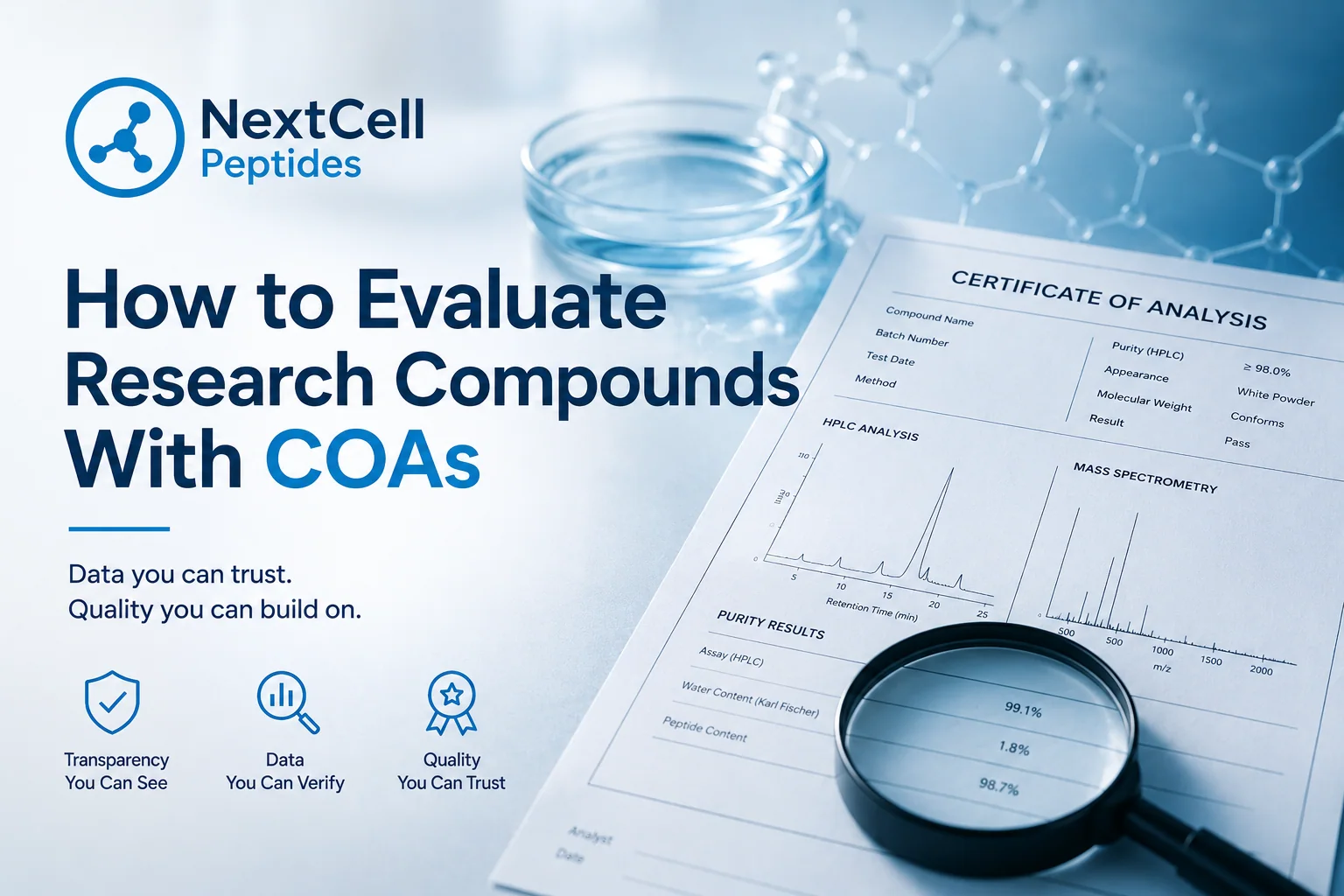
A vial label can tell you the compound name and stated quantity. A Certificate of Analysis can tell you whether the documentation behind that label is specific, traceable, and useful for evaluating the material. For customers comparing research compounds with COAs, that difference is often where a confident purchase decision begins.
A COA is not merely a document to display beside a product listing. When it is prepared for the actual batch being sold and supported by appropriate analytical work, it provides a practical record of identity, purity, and quality-control review. It also gives researchers a clearer basis for comparing products that may otherwise look similar at first glance.
What a Certificate of Analysis Should Establish
A Certificate of Analysis is a batch-specific quality document that reports selected test results for a product. The exact format can vary by compound and laboratory, but a useful COA should establish a direct connection between the physical item and the analytical data presented.
Start with product identity. The compound name should be clear and consistent with the product label and listing. For peptides, this may include the peptide name, sequence or molecular information, and a stated form such as lyophilized powder. For other research materials, the report may include a chemical name, molecular formula, or catalog reference.
The batch or lot number is equally important. This number connects the COA to a defined production batch. A generic purity report without a matching lot number may describe a material, but it does not reliably document the specific vial or batch being considered.
A well-organized document typically also includes the test date, report date, quantity or sample description, testing method, result, specification, and an approval or authorization field. Not every report will look identical, but these details make it easier to assess whether the document is a meaningful quality record rather than a broad marketing statement.
Research Compounds With COAs Need Batch Traceability
Batch traceability is the practical foundation of a credible COA. It means the product label, supplier inventory, and certificate all point to the same identifiable lot. Without that connection, even an impressive-looking chromatogram has limited value for a buyer evaluating a current product.
When comparing research compounds with COAs, check whether the lot number on the document is visible and whether it matches the batch information supplied with the product. The compound name, stated quantity, and physical form should also align. Small naming differences can be legitimate, particularly where a laboratory uses an internal sample code, but they should be understandable and documented.
Date information deserves a closer look as well. A historical report is not automatically invalid, especially for a clearly identified batch with appropriate storage and inventory controls. Still, a report should not be presented as proof for a different or later batch simply because the compound name is the same. Quality documentation is strongest when it follows the actual material through the supply chain.
For customers purchasing within the European Union, EU-based fulfillment can add practical value here. It can support clearer handling of inventory batches and help ensure that the documentation made available corresponds to the product dispatched, rather than an unrelated overseas stock image or archived report.
Reading HPLC Results Beyond the Purity Percentage
High-performance liquid chromatography, or HPLC, is one of the most common analytical methods used to evaluate peptide purity. It separates components in a sample and produces a chromatogram with peaks representing detected material under the conditions of the test.
The stated purity percentage is useful, but it is not the only figure that matters. A report should identify HPLC as the method and ideally indicate the reported purity result alongside an acceptance specification. For example, a supplier may state a product is tested to a defined purity threshold, then provide the batch result measured by HPLC.
The chromatogram itself can add context. A primary peak consistent with the expected material and limited secondary peaks can support the reported result. However, chromatograms should be interpreted carefully. Peak area is method-dependent, and a clean-looking plot alone does not establish full molecular identity, sterility, suitability for any particular application, or long-term stability.
This is why it is better to view HPLC as one part of a quality system rather than a stand-alone badge. For research peptides such as BPC-157, GHK-Cu, MOTS-c, TB-500, Semax, Epitalon, or CJC-1295 with Ipamorelin, HPLC data is particularly relevant to purity assessment, while additional methods may be needed to support identity and other specifications.
Identity Testing Complements Purity Testing
Mass spectrometry is commonly used to help confirm molecular mass and identity. Depending on the compound, a COA may list an expected mass, observed mass, and the method used. This adds an important second layer to the evaluation because a high HPLC purity percentage does not, by itself, confirm that the principal peak is the intended compound.
For more complex products, the appropriate analytical package depends on the material and the supplier's stated specifications. A thoughtful supplier should be able to distinguish between what has been tested, what the result means, and what the documentation does not claim to establish.
Independent Testing and Supplier Documentation
Independent third-party testing can strengthen confidence because the analytical work is conducted outside the supplier's own production environment. It is not a guarantee of every possible quality attribute, but it is a meaningful signal when the report is batch-specific and the laboratory information is clear.
Look for transparent identification of the testing laboratory or analytical provider, the methods used, and the batch tested. A document that simply says “lab tested” without a method, result, or traceable lot provides far less information than a report containing actual analytical data.
There is also a useful distinction between an internal quality-control certificate and an independent laboratory report. Internal testing may be part of a legitimate release process, while third-party analysis provides an added degree of external verification. The best choice depends on the compound, available documentation, and the level of traceability a buyer requires. What matters is that the supplier represents the evidence accurately.
FutureCell Peptides emphasizes batch documentation and independent laboratory verification where applicable, giving customers a clearer way to compare research materials on specifications rather than claims alone.
A Practical COA Review Before You Buy
A short review can prevent most documentation mistakes. First, confirm that the compound name and lot number match the product. Next, identify the method used and determine what the reported result actually measures. HPLC generally addresses purity; mass spectrometry can support identity; other tests may apply depending on the product category.
Then review the specification against the result. A purity result is more useful when it is paired with a defined target or acceptance criterion. Finally, consider whether the report is current enough and specific enough to the inventory batch available for purchase.
Be cautious with documents that lack a lot number, use vague phrases instead of results, show only a generic sample image, or provide a purity claim without a named analytical method. None of these issues automatically prove a product is unsuitable, but each reduces the information available for a careful comparison.
Documentation Is Part of Product Quality
The strongest purchasing decision is rarely based on a single percentage printed on a listing. It is based on the connection between the labeled product, the lot number, the method, the measured result, and the supplier's willingness to present those details clearly.
For research customers, that level of documentation supports better comparison, better recordkeeping, and a more disciplined approach to selecting materials. A COA should make the product easier to evaluate, not harder to question.