

Guides
GHK-Cu: The Complete Research Peptide Buyer's Guide (2026)
Discover everything researchers should know about GHK-Cu, from peptide structure and manufacturing to HPLC testing, Certificates of Analysis (COAs), purity, storage and supplier transparency. Learn how to evaluate GHK-Cu research peptides using objective quality indicators rather than marketing claims.
FutureCell Research Team · 25 min read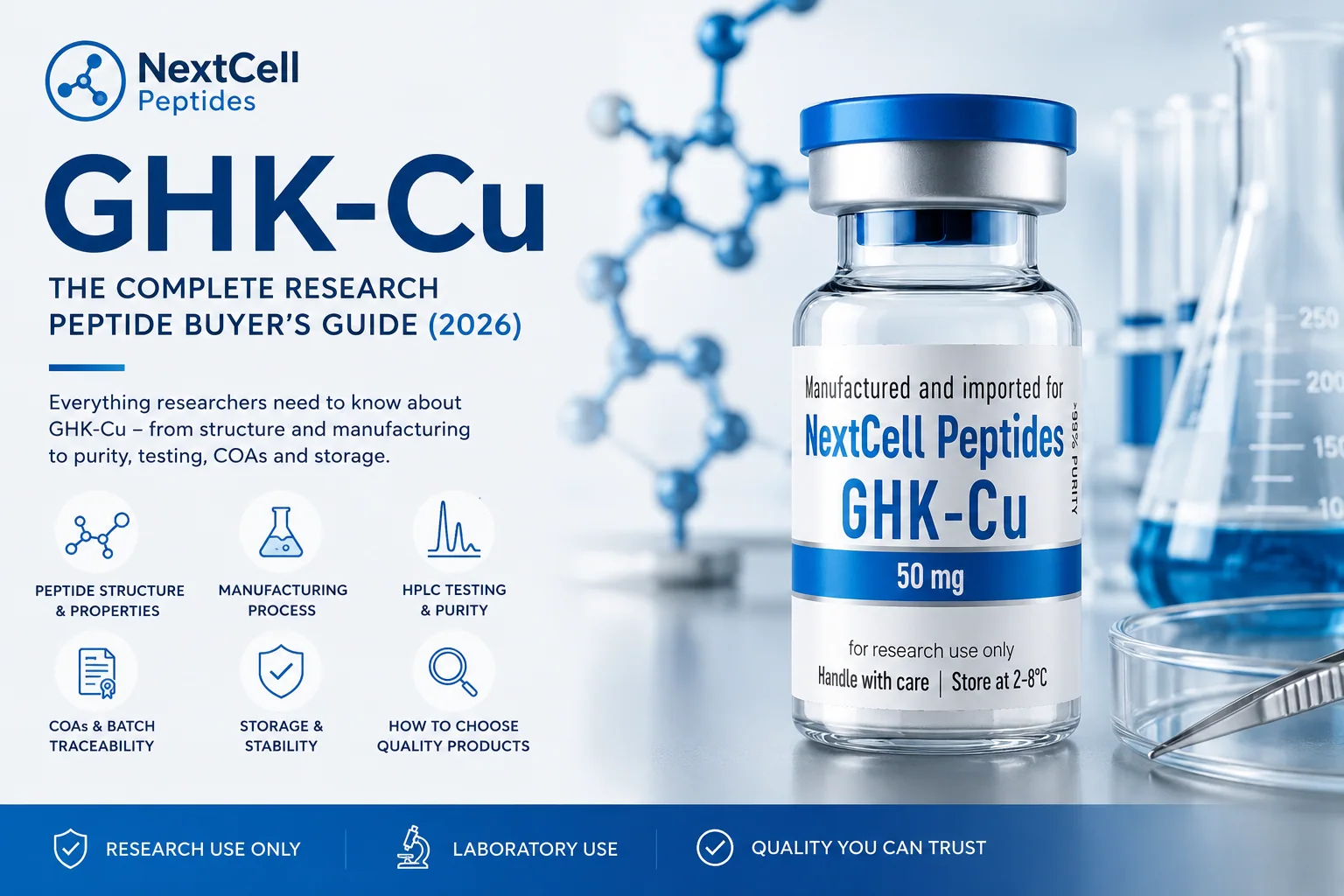
Introduction
GHK-Cu is one of the most extensively studied copper-binding peptides in laboratory research. Since its discovery, researchers have investigated its biochemical properties, structural characteristics and interactions within various experimental models. As interest in research peptides continues to grow, buyers increasingly seek reliable information about product quality, analytical documentation and supplier transparency before selecting a product.
Unlike many short product descriptions, a complete evaluation of a GHK-Cu research peptide involves far more than reviewing the product name or concentration. Understanding laboratory documentation, Certificates of Analysis (COAs), High-Performance Liquid Chromatography (HPLC) testing, storage recommendations and manufacturing consistency provides a much broader picture of product quality.
This guide has been created as a comprehensive educational resource for laboratories, researchers and buyers who want to better understand how GHK-Cu research peptides are presented, documented and evaluated. Rather than relying on marketing claims, the guide focuses on objective quality indicators and practical evaluation methods that support informed purchasing decisions.
Table of Contents
What Is GHK-Cu?
Why Is GHK-Cu Used in Research?
Understanding Copper Peptides
How GHK-Cu Is Manufactured
Lyophilization Explained
Product Specifications
Understanding Purity
HPLC Testing
Certificates of Analysis (COAs)
Storage Recommendations
Product Labels Explained
Batch Identification
Evaluating Supplier Transparency
Common Buyer Mistakes
Frequently Asked Questions
Related Research Guides
Summary
What Is GHK-Cu?
GHK-Cu (Glycyl-L-Histidyl-L-Lysine Copper) is a naturally occurring tripeptide complex in which the peptide GHK is bound to a copper(II) ion. The peptide was originally identified in human plasma and has since become widely studied in biochemical and molecular biology research.
In research settings, GHK-Cu is valued because it combines a short peptide sequence with a biologically relevant metal ion. This unique structure has led researchers to investigate its chemical stability, binding characteristics and interactions within various laboratory models.
Commercially available GHK-Cu research peptides are typically supplied as lyophilized (freeze-dried) powders intended exclusively for laboratory and research applications.
Why Is GHK-Cu Studied?
Researchers have investigated GHK-Cu across a wide range of experimental fields due to its distinctive chemical properties.
Areas of laboratory interest include:
Copper peptide chemistry
Cell signaling research
Extracellular matrix studies
Protein interaction research
Tissue remodeling models
Biomaterial compatibility
Peptide stability research
Analytical chemistry
Molecular biology
The specific objectives of individual studies vary considerably, making standardized product documentation and analytical testing particularly important when comparing research materials.
Understanding Copper Peptides
Copper peptides are molecules in which a peptide sequence binds to a copper ion through a stable coordination complex.
GHK-Cu is among the best-known examples of this class of compounds.
The presence of copper influences several physical and chemical properties, including molecular weight, stability characteristics and analytical identification. For this reason, laboratory documentation for GHK-Cu often differs slightly from documentation prepared for peptides that do not contain metal ions.
Understanding these differences helps researchers interpret Certificates of Analysis and analytical reports more accurately.
How Is GHK-Cu Manufactured?
Understanding how GHK-Cu research peptides are manufactured helps buyers interpret product documentation and evaluate supplier quality more effectively.
Although individual manufacturing methods vary between facilities, reputable manufacturers generally follow a standardized production workflow designed to ensure consistency, purity and traceability.
The process typically includes:
Solid-phase peptide synthesis (SPPS)
Peptide cleavage from the resin
Purification using High-Performance Liquid Chromatography (HPLC)
Copper complex formation
Analytical identity testing
Lyophilization (freeze-drying)
Sterile filling into research vials
Batch documentation and quality control
Each production stage contributes to the overall consistency of the finished research material.
Rather than evaluating only the final purity percentage, experienced buyers often consider the complete manufacturing process when assessing product quality.
What Is Lyophilization?
Most GHK-Cu research peptides are supplied as a lyophilized powder rather than as a liquid solution.
Lyophilization—commonly known as freeze-drying—is a preservation process in which water is removed under low temperature and vacuum conditions. The resulting dry powder generally offers improved stability during storage and transportation compared with pre-mixed solutions.
The process typically involves three stages:
Freezing
The peptide solution is frozen under carefully controlled conditions.
Primary Drying
Ice is removed through sublimation under vacuum without passing through the liquid phase.
Secondary Drying
Residual moisture is further reduced to improve long-term storage stability.
The final product is a dry powder intended for laboratory research.
Understanding Product Specifications
Product specifications provide the technical information researchers need to identify, compare and evaluate research peptides consistently. Rather than relying on marketing descriptions, complete specifications allow buyers to assess products using objective and standardized information.
A well-documented specification sheet typically includes the product name, ensuring the peptide is clearly identified, along with the peptide sequence, which confirms its molecular composition. The molecular weight provides additional analytical reference information, while the reported purity reflects the analytical purity determined through laboratory testing.
Product specifications should also describe the appearance of the peptide, which for GHK-Cu is typically a lyophilized powder intended for laboratory research. The listed quantity per vial allows accurate product comparison, and clearly stated storage recommendations help support proper handling before and after delivery. Finally, a batch number enables product traceability and links the vial to its associated manufacturing and analytical documentation.
Comprehensive product specifications reduce uncertainty, improve transparency and make it easier for researchers to compare products using objective technical information rather than assumptions or promotional claims.
Understanding Purity
Purity is one of the most frequently discussed characteristics of research peptides, yet it is also one of the most misunderstood.
When a supplier reports a purity value, it generally refers to the proportion of the desired peptide relative to detectable impurities under the analytical method used.
Importantly, purity alone does not provide a complete assessment of product quality.
Additional considerations include:
Identity confirmation
Analytical methodology
Batch consistency
Manufacturing controls
Storage recommendations
Documentation quality
For this reason, experienced buyers evaluate purity alongside the supporting analytical documentation rather than relying on a single percentage.
How Is Purity Measured?
Analytical purity is commonly measured using High-Performance Liquid Chromatography (HPLC).
During HPLC analysis, compounds within a sample are separated based on their chemical interactions with the chromatography system. This produces a chromatogram that displays individual peaks corresponding to different components.
The primary peak generally represents the target peptide, while additional peaks may indicate impurities or related compounds.
Purity calculations are typically based on the relative area of these peaks.
Understanding this process helps buyers interpret laboratory reports more accurately rather than focusing solely on the reported percentage.
Why HPLC Testing Matters
High-Performance Liquid Chromatography is considered one of the most widely used analytical techniques for evaluating research peptides.
HPLC testing provides valuable information regarding:
Analytical purity
Batch consistency
Peak distribution
Separation quality
Reproducibility
Laboratory documentation
While HPLC does not independently confirm every characteristic of a peptide, it provides an important component of a broader quality assessment when combined with additional analytical information.
Expert Insight
One of the most common misconceptions is that two GHK-Cu products reporting the same purity percentage must therefore be identical.
In reality, products with similar reported purity may differ in documentation quality, manufacturing consistency, batch traceability and supplier transparency.
Professional buyers therefore evaluate the complete quality package—including analytical reports, specifications, storage guidance and educational resources—rather than relying on a single numerical value.
Key Takeaways
GHK-Cu research peptides are commonly manufactured using solid-phase peptide synthesis followed by HPLC purification.
Lyophilization improves stability for storage and transportation.
Product specifications provide standardized technical information for objective comparison.
Purity should always be interpreted together with analytical documentation.
HPLC testing is an important quality indicator but represents only one part of a comprehensive product evaluation.
Experienced buyers assess manufacturing quality, documentation and supplier transparency alongside laboratory testing results.
Understanding Certificates of Analysis (COAs)
A Certificate of Analysis (COA) is one of the most important documents associated with research peptides. It provides laboratory-generated information about a specific production batch and helps researchers evaluate whether a product has undergone analytical testing.
While the exact format varies between laboratories, a well-prepared COA typically includes the product name, batch number, date of analysis, analytical method, and the corresponding test results. Many reports also include chromatograms, purity measurements and information identifying the laboratory that performed the analysis.
It is important to understand that a COA should always correspond to the specific batch being supplied. Matching batch numbers on both the product label and the analytical documentation improves traceability and allows researchers to verify that the reported results apply to the product they have received.
Although a Certificate of Analysis is an important quality indicator, it should not be evaluated in isolation. Experienced buyers review COAs alongside product specifications, HPLC chromatograms, storage recommendations and supplier transparency to build a more complete understanding of overall product quality.
Complete and clearly presented analytical documentation reduces uncertainty and supports more informed comparisons between research peptide suppliers.
Understanding Batch Traceability
Batch traceability refers to the ability to connect a specific research peptide vial with its corresponding manufacturing and analytical documentation.
Each production batch is typically assigned a unique batch number, which appears on the product label and should also be referenced within the associated Certificate of Analysis and other quality documentation. This connection helps ensure that analytical results can be traced back to the correct production lot.
Strong batch traceability supports greater transparency throughout the manufacturing process. It allows researchers to verify documentation more efficiently, identify the correct analytical reports and distinguish between different production batches when products are manufactured over time.
Professional suppliers generally maintain consistent batch identification across product labels, analytical documentation and internal quality records. This consistency makes product verification easier and demonstrates an organized approach to quality management.
Rather than viewing batch numbers as simple inventory codes, experienced buyers recognize them as an important part of documentation, traceability and overall supplier transparency.
Why Documentation Matters
High-quality research peptides are supported by more than laboratory testing alone. Clear, accurate and consistent documentation helps researchers understand the product before making a purchasing decision.
Comprehensive documentation often includes product specifications, Certificates of Analysis, HPLC chromatograms, storage recommendations and educational resources that explain technical concepts in accessible language. Together, these materials provide greater context than any single document alone.
Well-organized documentation also reflects consistency throughout the supplier's quality process. When product labels, batch numbers, analytical reports and technical information align with one another, researchers can evaluate products with greater confidence and fewer assumptions.
For this reason, experienced buyers rarely rely on purity values or marketing claims alone. Instead, they assess the completeness, clarity and transparency of the supporting documentation as part of a broader evaluation of product quality.
Expert Insight
One of the clearest differences between suppliers is often not found in the peptide itself, but in the quality of the information provided alongside it.
Comprehensive documentation—including product specifications, batch identification, Certificates of Analysis and educational resources—helps researchers evaluate products objectively and understand how analytical results relate to the specific batch being supplied.
This documentation-first approach promotes transparency, reduces uncertainty and provides a stronger foundation for comparing research peptides than relying solely on promotional claims or individual specifications.
How to Evaluate GHK-Cu Research Peptides
Comparing GHK-Cu research peptides involves more than reviewing a single specification such as purity or price. Experienced buyers typically evaluate several quality indicators together to gain a more complete understanding of the product and the supplier.
The following areas are commonly considered during the evaluation process:
Product Specifications
Complete and accurate product specifications provide a standardized description of the research peptide. Clear information regarding peptide sequence, molecular weight, quantity, appearance and storage recommendations makes objective product comparison significantly easier.
Analytical Documentation
Supporting analytical documentation, including Certificates of Analysis and HPLC reports where appropriate, provides valuable insight into laboratory testing and product transparency. Documentation should be clearly presented and correspond to the correct production batch.
Batch Traceability
Consistent batch identification across product labels and analytical documentation allows researchers to verify that laboratory reports relate to the supplied product. Strong traceability reflects an organized quality management process.
Storage Information
Clear storage recommendations demonstrate attention to product stability throughout transportation and laboratory storage. Easy access to handling information reduces uncertainty before purchase.
Educational Resources
Suppliers that provide educational articles explaining manufacturing, analytical testing, documentation and storage help buyers understand technical information without relying solely on marketing material.
Supplier Transparency
Transparency is demonstrated through clear explanations, accessible documentation and consistent technical information rather than promotional claims. Comprehensive educational content often reflects a commitment to helping buyers make informed decisions.
Common Mistakes When Comparing GHK-Cu Products
Researchers comparing GHK-Cu products sometimes focus on a single specification while overlooking the broader quality picture.
Common examples include:
Assuming identical purity percentages indicate identical products.
Comparing products based only on price.
Ignoring batch traceability and supporting documentation.
Overlooking storage recommendations.
Confusing marketing language with technical information.
Failing to review Certificates of Analysis or analytical reports where available.
Evaluating multiple quality indicators together provides a more balanced and objective comparison.
Frequently Asked Questions
What is GHK-Cu?
GHK-Cu is a copper-binding peptide widely studied in laboratory research. It consists of the naturally occurring tripeptide GHK combined with a copper ion to form a stable complex for research applications.
Why is GHK-Cu commonly supplied as a lyophilized powder?
Lyophilization removes water from the peptide under controlled conditions, helping improve storage stability and facilitating transportation before laboratory use.
What information should a Certificate of Analysis contain?
A Certificate of Analysis commonly includes the product name, batch number, analytical method, test results, date of analysis and information identifying the testing laboratory.
Does a higher purity percentage always indicate a better product?
Not necessarily. Purity is only one aspect of product evaluation. Documentation quality, analytical transparency, manufacturing consistency, batch traceability and storage guidance are also important considerations.
Why is batch traceability important?
Batch traceability connects each product vial to its corresponding manufacturing and analytical documentation, improving transparency and allowing researchers to verify laboratory reports.
Related Guides
Readers interested in learning more about research peptide quality may also find these guides helpful:
Explore Our GHK-Cu Research Peptide
If you would like to explore the product discussed throughout this guide, visit our GHK-Cu 50 mg Research Peptide page.
There you'll find complete product specifications, peptide sequence, molecular weight, storage recommendations and additional educational resources designed to help researchers evaluate products using objective technical information.
Whether you're comparing research peptides, reviewing analytical documentation or learning more about supplier transparency, the product page complements the information presented in this guide.
→ Explore the GHK-Cu 50 mg Research Peptide
Summary
Understanding GHK-Cu research peptides requires more than comparing purity percentages or product pricing. Manufacturing methods, analytical testing, Certificates of Analysis, batch traceability, storage recommendations and supplier transparency all contribute to a more complete evaluation.
By reviewing these factors together, researchers can compare products using objective technical information rather than assumptions or marketing claims. A documentation-first approach supports better-informed purchasing decisions and promotes greater confidence when evaluating research peptide suppliers.