
Guides
GHK-Cu Price Guide (2026): What Determines the Cost of High-Quality Research Peptides?
Learn what determines the cost of high-quality GHK-Cu research peptides. Compare manufacturing standards, HPLC testing, Certificates of Analysis (COAs), product specifications and supplier transparency to evaluate value with confidence.
FutureCell Research Team · 16 min read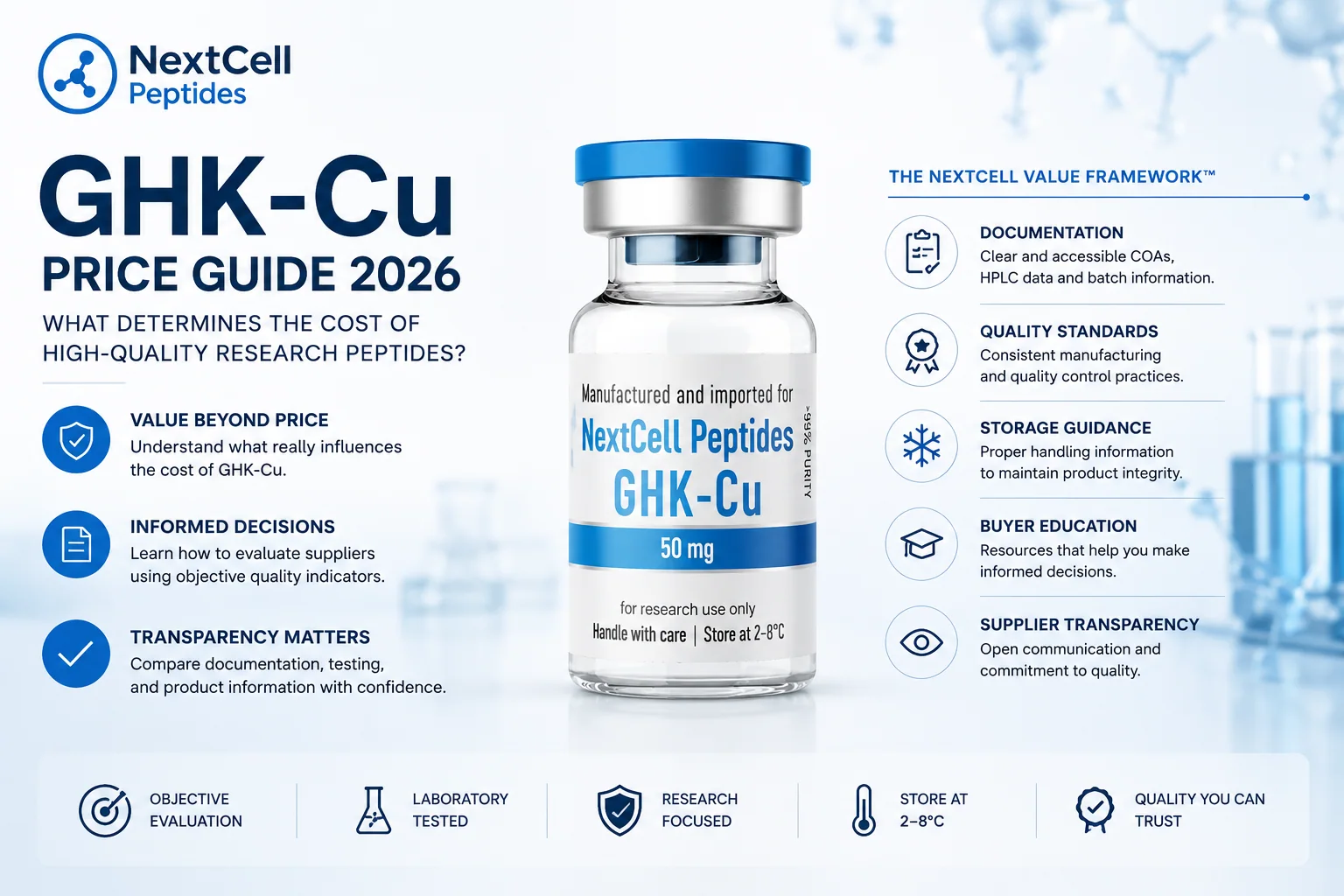
Introduction
The price of GHK-Cu research peptides can vary significantly between suppliers, even when products appear similar at first glance. While it may be tempting to compare products based on price alone, cost is only one part of evaluating overall value.
A higher price does not automatically indicate superior quality, just as a lower price does not necessarily mean a product is substandard. The true value of a research peptide depends on multiple factors, including manufacturing standards, analytical testing, documentation, product specifications, packaging quality and supplier transparency.
This guide explains what contributes to the price of high-quality GHK-Cu research peptides and provides a practical framework for comparing suppliers using objective quality indicators rather than marketing claims.
Whether you are purchasing GHK-Cu for laboratory research or evaluating different suppliers, understanding these cost factors can help you make more informed purchasing decisions.
Table of Contents
Why Does the Price of GHK-Cu Vary?
Does a Higher Price Mean Higher Quality?
Manufacturing Standards and Production Costs
Why Analytical Testing Matters
Documentation and Batch Traceability
Packaging, Storage and Product Presentation
The FutureCell GHK-Cu Value Assessment Framework
Comparing Suppliers Beyond Price
Frequently Asked Questions
Related Research Guides
Explore Our GHK-Cu Research Peptide
Summary
Why Does the Price of GHK-Cu Vary?
Several factors influence the cost of manufacturing and supplying research-grade GHK-Cu. While raw material costs contribute to pricing, they represent only one component of the overall value offered by a supplier.
Some of the most significant factors include:
Manufacturing quality standards
Peptide synthesis and purification methods
Lyophilization processes
Analytical testing and quality control
Certificate of Analysis (COA) availability
HPLC purity verification
Batch identification and traceability
Packaging quality
Storage recommendations
Supplier transparency
Customer support and educational resources
Suppliers that invest in comprehensive documentation, consistent quality assurance and transparent product information generally incur higher operational costs than those providing only basic product listings.
For this reason, evaluating overall value is often more informative than comparing prices alone.
Quick Buyer Summary
When comparing GHK-Cu suppliers, consider more than the listed price.
Evaluate whether the supplier provides:
✓ Complete product specifications
✓ Batch-specific documentation
✓ HPLC purity information
✓ Certificate of Analysis (COA)
✓ Storage recommendations
✓ Clear product labeling
✓ Transparent quality standards
✓ Educational resources supporting informed purchasing decisions
Does a Higher Price Mean Higher Quality?
One of the most common misconceptions in the research peptide market is that a higher price automatically reflects higher quality. In reality, price alone provides very little information about the manufacturing standards, analytical testing or documentation supporting a product.
Similarly, the lowest-priced option is not always the best value. A lower price may reflect reduced quality assurance, limited product information or fewer quality control procedures, but price itself cannot confirm these factors.
Instead of focusing solely on cost, experienced buyers evaluate the complete package of quality indicators provided by the supplier.
A research peptide should be assessed using objective technical information rather than assumptions based on price.
The FutureCell GHK-Cu Value Assessment Framework
To compare suppliers consistently, it is helpful to evaluate products across several measurable quality categories rather than relying on a single factor.
The framework below provides a structured approach for assessing the overall value of a GHK-Cu research peptide.
Key Evaluation Factors
Manufacturing Standards
Consistent peptide synthesis, purification and quality control help reduce batch variability and improve production consistency.
Analytical Testing
Independent HPLC analysis provides objective laboratory data that helps verify analytical purity.
Certificate of Analysis (COA)
A batch-specific COA documents laboratory results, testing methods and key product specifications.
Product Specifications
Clear information regarding peptide sequence, molecular weight, purity, appearance and quantity improves product transparency.
Batch Traceability
Batch numbers allow products to be traced back to a specific production run and analytical report.
Storage Information
Proper storage recommendations help preserve peptide stability during storage and handling.
Product Labeling
Professional labeling improves identification, handling and consistency across product batches.
Supplier Transparency
Comprehensive documentation and openly available technical information reduce uncertainty when comparing suppliers.
Educational Resources
High-quality educational guides help researchers understand quality indicators and make more informed purchasing decisions.
No single category determines overall value on its own. Instead, experienced buyers evaluate all of these factors together to build a complete picture of a supplier's quality standards and overall value proposition.
Why Documentation Adds Value
Comprehensive documentation requires significant investment from the supplier.
Preparing batch-specific Certificates of Analysis, maintaining analytical records, providing technical specifications and producing educational resources all require additional quality assurance processes beyond basic product manufacturing.
While these efforts may increase operational costs, they also improve transparency and make it easier for researchers to evaluate products objectively.
For this reason, documentation should be viewed as part of the overall value offered by a supplier rather than as a standalone feature.
Expert Insight
When comparing two GHK-Cu products with similar purity values, consider the supporting documentation instead of focusing exclusively on price.
Questions worth asking include:
Is batch-specific analytical documentation available?
Are product specifications complete and easy to verify?
Does the supplier explain storage recommendations?
Is HPLC purity supported by professional laboratory documentation?
Are educational resources available to explain technical terminology?
These factors often provide a more reliable basis for comparison than price alone.
Manufacturing Standards Influence Price
The manufacturing process is one of the largest contributors to the cost of a high-quality GHK-Cu research peptide. Producing research-grade peptides requires multiple controlled stages, each designed to improve product consistency and analytical quality.
These stages typically include:
Peptide synthesis
Purification
Lyophilization (freeze-drying)
Batch quality control
Packaging
Storage before distribution
Each step requires specialized equipment, validated procedures and ongoing quality assurance.
Manufacturers that invest in robust production standards generally incur higher operating costs than facilities focused primarily on minimizing production expenses.
For this reason, manufacturing quality should be considered alongside analytical documentation when comparing suppliers.
Why Analytical Testing Matters
Analytical testing provides objective laboratory data about a research peptide.
One of the most widely used analytical techniques is High-Performance Liquid Chromatography (HPLC), which is commonly used to evaluate analytical purity.
Rather than relying on descriptive claims, HPLC generates measurable laboratory data that can help verify whether a product meets its stated purity specification.
Analytical testing supports:
Batch consistency
Purity verification
Manufacturing quality control
Documentation transparency
While HPLC represents an important quality indicator, it should always be interpreted alongside additional documentation rather than in isolation.
Certificates of Analysis Add Transparency
A Certificate of Analysis (COA) summarizes the analytical information for a specific production batch and is one of the most valuable documents when evaluating a research peptide.
A professionally prepared COA typically includes:
Product name to confirm the identity of the peptide.
Batch number for complete production traceability.
Analytical method describing how the laboratory testing was performed.
Purity result based on analytical testing such as HPLC.
Appearance describing the physical characteristics of the lyophilized powder.
Storage recommendations to support proper handling and long-term stability.
A COA allows researchers to verify objective laboratory data rather than relying solely on product descriptions or marketing claims. When combined with HPLC analysis, product specifications and batch traceability, it provides a more complete picture of the quality assurance process behind a research peptide.
Packaging and Product Presentation
Packaging contributes to overall product value for reasons beyond appearance.
Professional packaging helps protect products during storage and transport while improving product identification and reducing handling errors.
Examples of quality-focused packaging include:
Clearly printed product labels
Batch identification
Storage instructions
Secure vial packaging
Consistent branding
Legible technical information
Although packaging alone cannot determine product quality, it reflects the supplier's attention to detail and commitment to presenting technical information clearly.
Comparing Low-Cost and High-Value Suppliers
Price differences often become easier to understand when the supporting quality indicators are compared rather than the price alone.
Lower-Cost Suppliers
Lower-priced products may offer good value, but buyers should verify whether the supplier provides:
Complete product specifications
Batch-specific Certificates of Analysis (COAs)
HPLC purity documentation
Batch traceability
Clear storage recommendations
Professional product labeling
Educational resources explaining technical terminology
If this information is unavailable, it can be more difficult to compare products objectively.
High-Value Suppliers
Suppliers positioned in the premium segment often invest more heavily in transparency and documentation.
This may include:
Comprehensive product specifications
Batch-specific COAs
Clearly presented HPLC analytical data
Complete peptide sequence and molecular weight information
Batch identification for improved traceability
Professional packaging and labeling
Detailed storage guidance
Educational buying guides and technical resources
These additional quality indicators do not automatically make a product superior, but they provide researchers with more objective information for evaluating overall value.
Rather than assuming that a higher price always reflects higher quality, buyers should compare the documentation, analytical testing and supplier transparency supporting each product. Price should be considered alongside these objective quality indicators rather than viewed in isolation.
How to Decide Whether a GHK-Cu Research Peptide Offers Good Value
Evaluating the value of a GHK-Cu research peptide requires looking beyond the listed price. While cost is an important consideration, experienced buyers typically assess the overall quality package provided by the supplier.
A product that includes comprehensive technical documentation, analytical testing information and clear product specifications may provide greater long-term value than a lower-priced alternative with limited supporting information.
The goal is not to identify the cheapest product, but to determine whether the supplier demonstrates consistency, transparency and attention to quality throughout the entire purchasing experience.
Buyer Checklist Before Comparing Prices
Before making a purchasing decision, consider the following questions:
✓ Are complete product specifications available?
✓ Is the peptide sequence clearly stated?
✓ Is molecular weight provided?
✓ Is analytical purity supported by HPLC documentation?
✓ Is a Certificate of Analysis (COA) available?
✓ Are storage recommendations clearly explained?
✓ Does the supplier provide batch identification?
✓ Is technical terminology explained through educational resources?
✓ Does the supplier maintain consistent product presentation across the website?
✓ Is pricing supported by transparent quality information rather than marketing claims?
Using a structured evaluation process helps reduce uncertainty and allows products to be compared using objective criteria.
Frequently Asked Questions
Why is GHK-Cu sometimes more expensive than other research peptides?
The cost of GHK-Cu may be influenced by manufacturing processes, purification methods, analytical testing, documentation, packaging and supplier quality assurance procedures. Price alone does not indicate product quality.
Does higher purity always justify a higher price?
Not necessarily. Purity should be evaluated together with batch documentation, HPLC analysis, Certificates of Analysis and supplier transparency. No single metric provides a complete assessment of product quality.
Should I compare products using price alone?
No. Comparing documentation, analytical testing, product specifications and storage guidance generally provides a more reliable basis for evaluating overall value.
Related Research Guides
For a more complete understanding of research peptide quality, you may also find these guides useful:
Together, these resources explain how manufacturing standards, analytical testing and documentation contribute to evaluating research peptides objectively.
Explore Our GHK-Cu Research Peptide
If you would like to see these evaluation principles applied in practice, explore our GHK-Cu 50 mg Research Peptide product page.
The product page includes comprehensive technical specifications, peptide sequence, molecular weight, storage recommendations and professionally presented product information designed to help researchers compare products with greater confidence.
Whether you are reviewing documentation or comparing suppliers, it provides a practical example of the quality indicators discussed throughout this guide.
Summary
The price of a GHK-Cu research peptide reflects far more than the cost of the peptide itself. Manufacturing standards, analytical testing, Certificates of Analysis, product specifications, packaging quality and supplier transparency all contribute to the overall value offered by a supplier.
Rather than assuming that the lowest or highest price represents the best option, researchers should evaluate products using objective technical information and consistent quality indicators.
By combining pricing with documentation, analytical data and transparent product information, buyers can make more informed purchasing decisions while reducing uncertainty throughout the evaluation process.