

Guides
How to Choose High-Quality MOTS-c: A Complete Buyer's Guide (2026)
Looking to buy high-quality MOTS-c? Learn how experienced research buyers compare MOTS-c suppliers using peptide purity, HPLC testing, Certificates of Analysis (COAs), batch traceability, manufacturing standards and analytical documentation before making a purchasing decision.
FutureCell Research Team · 25 min read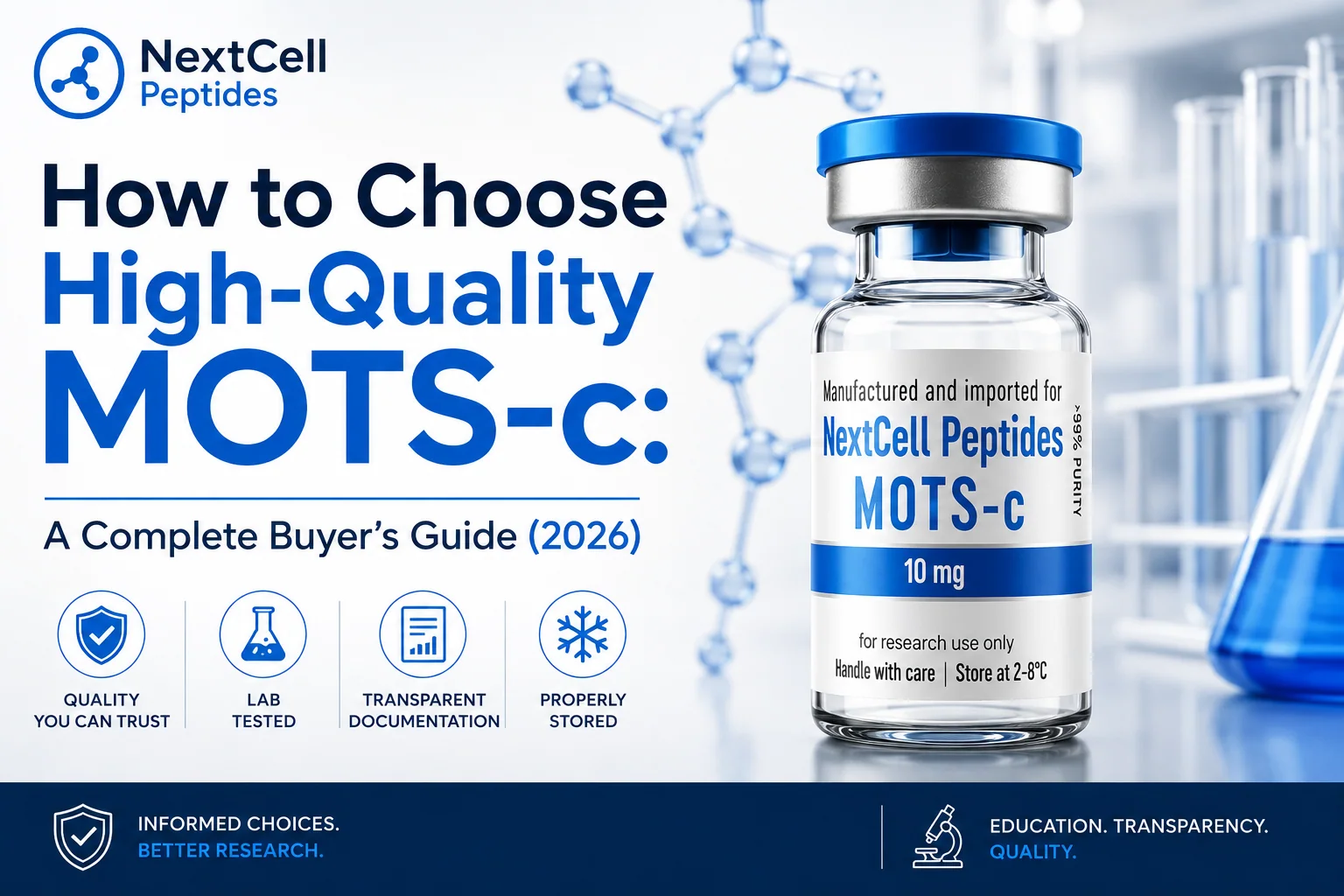
Introduction
Looking for a High-Quality MOTS-c Research Product?
If you're comparing MOTS-c suppliers or looking to buy high-quality MOTS-c for research, you can also explore our MOTS-c 10 mg research peptide. The product page includes detailed specifications, storage guidance, batch information and supporting analytical documentation, allowing you to evaluate it using the same quality framework explained throughout this guide.
MOTS-c has rapidly become one of the most discussed mitochondrial research peptides, attracting growing interest from researchers and buyers looking to evaluate products from an increasing number of suppliers. As demand has expanded, so has the number of companies offering MOTS-c, making it more important than ever to understand how product quality should be assessed before making a purchasing decision.
At first glance, many MOTS-c products appear remarkably similar. Product labels often advertise high purity, professional packaging and comparable specifications. However, the quality of a research peptide extends far beyond what is printed on the vial.
Differences in peptide synthesis, purification methods, analytical verification, manufacturing consistency and supplier transparency can all influence how confidently a product can be evaluated. Understanding these factors allows buyers to compare research peptides using objective information rather than relying solely on marketing claims.
One of the most common mistakes buyers make is assuming that a reported purity percentage tells the complete story. In reality, What Is Peptide Purity? Everything Buyers Should Know explains why purity is only one part of a much broader quality assessment that also includes manufacturing standards, analytical documentation, batch traceability and proper storage.
Likewise, a supplier claiming that every product is "research grade" or "high purity" provides very little meaningful information unless those claims are supported by verifiable documentation such as What Is a Certificate of Analysis (COA)? Everything Research Peptide Buyers Should Know and How to Read an HPLC Chromatogram: The Complete Guide for Research Peptide Buyers.
This guide explains how experienced research buyers evaluate MOTS-c before selecting a supplier. Rather than focusing on promotional language or unsupported claims, it examines the objective quality indicators that can be independently reviewed and understood.
Whether you're purchasing MOTS-c for the first time or comparing suppliers for your next research project, understanding how to assess manufacturing quality, analytical testing and supplier transparency can help you make a more informed decision.
By the end of this guide, you'll understand how manufacturing quality, peptide purity, analytical documentation and batch traceability work together to distinguish well-documented MOTS-c products from those supported by limited evidence.
Table of Contents
What Is MOTS-c?
Why Quality Matters More Than Price
How MOTS-c Is Manufactured
Understanding Peptide Purity
Why HPLC Testing Matters
How to Read a Certificate of Analysis (COA)
Packaging, Storage and Stability
The FutureCell MOTS-c Quality Evaluation Framework™
What to Look for Before Buying MOTS-c
Frequently Asked Questions
Summary
What Is MOTS-c?
MOTS-c is a mitochondrial-derived peptide (MDP), a class of naturally occurring peptides encoded within mitochondrial DNA rather than the nuclear genome. Unlike most peptides studied in biomedical research, mitochondrial-derived peptides originate from the mitochondria—the structures within cells responsible for producing much of the energy required for normal cellular function.
Since its discovery, MOTS-c has attracted considerable scientific interest because of its unique biological origin and its role in laboratory research exploring cellular metabolism and mitochondrial signalling. As research activity has expanded, demand for research-grade MOTS-c has also increased, leading to a growing number of suppliers offering the peptide worldwide.
For buyers, this growing availability creates both opportunity and challenge. While more suppliers provide greater choice, it also makes it increasingly important to understand how to distinguish well-documented research products from those supported primarily by marketing claims.
Unlike consumer products, research peptides should be evaluated using objective quality indicators rather than advertising language alone. Factors such as manufacturing consistency, analytical testing, batch-specific documentation and supplier transparency provide far more meaningful information than generic claims about product quality.
It is also important to distinguish between the peptide itself and the quality of the product being purchased.
Two MOTS-c products may appear almost identical based on their labels, reported purity or packaging. However, differences in manufacturing standards, purification processes, analytical verification and documentation can result in very different levels of transparency for buyers.
For this reason, experienced buyers rarely compare MOTS-c products using a single specification.
Instead, they evaluate a combination of factors including:
Manufacturing quality.
Batch traceability.
Packaging and storage recommendations.
Supplier transparency.
Understanding how these elements work together forms the foundation for comparing MOTS-c products objectively.
Throughout the remainder of this guide, we'll explore each of these quality indicators in detail and explain how they can help buyers make more informed purchasing decisions when comparing MOTS-c suppliers.
Why Quality Matters More Than Price
When comparing MOTS-c products, price is often one of the first factors buyers notice. While cost naturally plays a role in any purchasing decision, it provides very little information about the overall quality of a research peptide.
Research peptides that appear nearly identical online can differ significantly in manufacturing standards, analytical testing, purification methods and the documentation available to support their stated specifications. These differences are not always visible from a product page alone, making it essential to evaluate more than price before choosing a supplier.
A lower-priced product is not necessarily lower quality, just as a higher-priced product does not automatically indicate superior manufacturing or analytical standards. Instead, experienced buyers typically focus on the evidence available to support a supplier's quality claims.
One useful way to approach supplier comparisons is to separate price from quality.
Price reflects what a supplier charges.
Quality reflects how thoroughly a supplier can document, verify and explain the product being offered.
For example, two MOTS-c products may both advertise the same peptide content and report similar purity values. However, if one supplier provides batch-specific analytical documentation while another offers only limited product information, the amount of evidence available for evaluating each product differs considerably.
This is why experienced research buyers rarely compare peptides using price alone.
Instead, they review multiple quality indicators together.
Some of the most important questions include:
Is the product supported by analytical testing?
Does the supplier explain how MOTS-c is manufactured? How Research Peptides Are Manufactured
Is the reported purity supported by laboratory documentation? What Is Peptide Purity? Everything Buyers Should Know
Is a batch-specific Certificate of Analysis (COA) available?
Can the analytical results be reviewed through an HPLC chromatogram?
Are storage recommendations clearly provided? How to Store Lyophilized Peptides Correctly
Is batch traceability explained?
Does the supplier provide transparent quality information rather than relying solely on marketing language?
Evaluating these factors together provides a much more complete understanding of product quality than relying on price or a reported purity percentage alone.
Why Documentation Matters
One of the clearest differences between research peptide suppliers is the amount of documentation they provide.
Transparent suppliers generally support their products with analytical reports and manufacturing information that allow buyers to independently review the available evidence.
This documentation often includes:
Batch-specific analytical reports.
Certificates of Analysis.
HPLC chromatograms.
Batch identification.
Storage recommendations.
Product specifications.
Rather than asking customers to rely solely on promotional claims, suppliers that provide detailed documentation enable buyers to evaluate products using objective information.
Transparency Builds Confidence
Transparency has become one of the most valuable quality indicators within the research peptide market.
Reliable suppliers typically explain:
How products are manufactured.
Which analytical methods are used.
What documentation accompanies each batch.
How products should be stored.
How quality control is performed before release.
This level of openness allows buyers to compare suppliers using documented evidence rather than assumptions.
By contrast, suppliers that provide very little technical information make it more difficult to evaluate product quality before purchasing.
Why Experienced Buyers Look Beyond Marketing Claims
Product descriptions often contain phrases such as:
"Research Grade"
"High Purity"
"Premium Quality"
While these statements may describe a product, they provide little practical value unless they are supported by evidence.
Experienced buyers generally place greater emphasis on:
Manufacturing consistency.
Analytical verification.
Documentation quality.
Batch traceability.
Supplier transparency.
These factors provide a stronger foundation for evaluating a research peptide than marketing terminology alone.
Expert Insight
When comparing MOTS-c suppliers, one of the most useful questions is not:
"Which supplier makes the biggest claims?"
Instead, ask:
Can those claims be verified?
Is analytical documentation available?
Does the supplier explain its manufacturing process?
Are quality control procedures clearly described?
Can the available documentation be linked to the specific batch being sold?
Answering these questions provides a much stronger basis for evaluating product quality than comparing prices or promotional language alone.
Key Takeaway
Price is an important consideration, but it should never be the only factor when comparing MOTS-c research peptides.
Manufacturing quality, analytical testing, documentation, batch traceability and supplier transparency all contribute to understanding how thoroughly a product has been produced and verified.
Buyers who evaluate these factors together are often better equipped to compare suppliers objectively and make informed purchasing decisions based on evidence rather than assumptions.
How MOTS-c Is Manufactured
The quality of a MOTS-c research peptide begins long before it reaches a laboratory. Every stage of the manufacturing process contributes to the consistency, purity and overall quality of the finished product.
Like many modern research peptides, MOTS-c is produced using advanced peptide synthesis techniques followed by multiple quality control procedures designed to verify that the finished material meets the manufacturer's specifications.
Understanding how MOTS-c is manufactured provides valuable context when comparing suppliers. While buyers are not expected to understand every technical aspect of peptide chemistry, knowing the major production stages makes it much easier to evaluate product documentation and compare suppliers objectively.
For readers interested in the complete manufacturing process, our guide on How Research Peptides Are Manufactured: From Peptide Synthesis to Lyophilization explores every stage in greater detail.
Step 1: Peptide Synthesis
Manufacturing begins with peptide synthesis, during which individual amino acids are assembled into the correct sequence using automated laboratory equipment.
Most commercial peptide manufacturers use Solid-Phase Peptide Synthesis (SPPS), a well-established method that enables peptides to be produced with a high degree of precision and consistency.
Throughout synthesis, amino acids are added sequentially until the complete peptide chain has been assembled according to the intended molecular design.
Although peptide synthesis is highly controlled, the resulting material still contains unwanted by-products and incomplete peptide fragments. For this reason, additional manufacturing stages are required before the product is suitable for analytical testing.
Step 2: Purification
Following synthesis, the crude peptide undergoes purification.
The purpose of purification is to separate the desired peptide from residual synthesis-related impurities, incomplete peptide chains and other unwanted materials generated during production.
The effectiveness of this stage has a direct influence on the overall quality of the finished product.
Although buyers often focus on the reported purity percentage, the purification process itself is what makes those analytical results possible.
A well-controlled purification process helps produce a cleaner, more consistent research peptide before analytical verification begins.
Readers interested in how purification relates to analytical quality can learn more in What Is Peptide Purity? Everything Buyers Should Know.
Step 3: Identity Verification
After purification, manufacturers verify that the finished material corresponds to the intended peptide.
Identity verification confirms that the product being analysed matches the expected molecular structure before additional analytical testing is performed.
For complex research peptides such as MOTS-c, this step represents an important part of the overall quality assurance process.
Identity testing is typically performed alongside other analytical procedures before a manufacturing batch is released.
Step 4: Lyophilization
Once the peptide has been purified and verified, it is commonly converted into a lyophilized powder through freeze-drying.
During lyophilization, water is removed under carefully controlled conditions, producing a dry powder that is generally more stable during storage and transportation than a prepared solution.
This process also helps protect the peptide until it is reconstituted for laboratory research.
Because MOTS-c is typically supplied as a lyophilized peptide, understanding appropriate storage conditions is an important part of maintaining product quality.
For additional information, see How to Store Lyophilized Peptides Correctly and Lyophilized vs Reconstituted Peptides: What's the Difference?.
Step 5: Analytical Testing
Before a production batch is released, manufacturers perform analytical testing to verify that the finished product meets its stated specifications.
Depending on the manufacturer, this testing may include:
Peptide purity analysis.
Identity verification.
Chromatographic analysis.
Batch documentation.
Quality review.
The analytical results generated during this stage provide the foundation for the documentation that accompanies many research peptides.
We'll examine these analytical methods in greater detail throughout the following sections on HPLC testing and Certificates of Analysis (COAs).
Step 6: Final Quality Review
The final manufacturing stage involves reviewing the available production records, analytical results and quality documentation before a batch is approved for release.
This review helps ensure that manufacturing information, analytical reports and product documentation remain consistent throughout the quality assurance process.
Depending on the supplier, documentation may include:
Batch identification.
Analytical purity.
Testing methods.
Product specifications.
Storage recommendations.
Certificate of Analysis.
The availability of this documentation allows buyers to evaluate objective information rather than relying solely on product descriptions.
Why Manufacturing Matters
Every manufacturing stage contributes to the final quality profile of a MOTS-c research peptide.
From peptide synthesis and purification to lyophilization and analytical testing, each step plays a role in producing a consistent product supported by transparent documentation.
For buyers, understanding these manufacturing principles provides valuable context when comparing suppliers and reviewing the documentation available for a particular product.
Rather than viewing manufacturing as a purely technical process, experienced buyers often see it as the foundation upon which analytical testing, documentation and supplier transparency are built.
Key Takeaway
Manufacturing quality cannot be judged by a product label alone.
Understanding how MOTS-c is synthesised, purified, tested and documented provides buyers with a stronger foundation for evaluating research peptides objectively.
In the next section, we'll explore one of the most frequently discussed specifications when comparing research peptides: Peptide Purity—what it actually means, how it is measured and why it should always be interpreted alongside supporting analytical documentation.
Understanding Peptide Purity
When comparing MOTS-c products, one of the first specifications buyers encounter is the reported purity percentage. Although purity is an important quality indicator, it is also one of the most misunderstood aspects of research peptides.
Many buyers naturally assume that a higher purity percentage always indicates a better product. In reality, purity should never be evaluated in isolation. Instead, it should be considered alongside manufacturing quality, analytical testing, batch documentation and supplier transparency.
If you'd like a more detailed explanation of analytical purity, our guide on What Is Peptide Purity? Everything Buyers Should Know explores the topic in greater depth.
What Does Peptide Purity Mean?
Peptide purity refers to the proportion of a sample that consists of the intended peptide molecule compared with other detectable components that may remain following manufacturing.
During peptide synthesis, small amounts of incomplete peptide chains and other manufacturing by-products can be produced alongside the target peptide. Purification is designed to remove as much of this unwanted material as possible before analytical testing takes place.
The reported purity percentage reflects the outcome of this purification process.
However, it does not describe every aspect of product quality.
A purity result should always be interpreted within the broader context of manufacturing standards and supporting analytical documentation.
Why Purity Alone Doesn't Tell the Whole Story
Purity is an important analytical measurement, but it cannot answer every question a buyer should ask before purchasing MOTS-c.
For example, a reported purity value does not explain:
How the peptide was manufactured.
Whether the result is specific to the production batch.
Which analytical methods were used.
Whether the testing can be independently reviewed.
How consistently the supplier manufactures different batches.
This is why experienced buyers rarely compare research peptides using purity alone.
Instead, purity becomes one part of a broader quality assessment that also considers documentation, manufacturing consistency and supplier transparency.
Understanding Reported Purity Values
It is entirely possible for two suppliers to report identical purity values while providing very different levels of supporting documentation.
For example, two MOTS-c products may both advertise a purity of 99%.
One supplier may also provide:
Batch-specific analytical reports.
Detailed testing methods.
Batch identification.
Storage recommendations.
Another supplier may provide only a reported purity percentage with little or no supporting documentation.
Although the reported purity appears identical, the evidence supporting that result is very different.
For many buyers, transparency surrounding purity testing is just as important as the purity value itself.
How Is Peptide Purity Measured?
Peptide purity is evaluated using analytical laboratory techniques that separate and measure the different components present within a sample.
One of the most widely used techniques is High-Performance Liquid Chromatography (HPLC).
Rather than producing a simple purity percentage, HPLC generates analytical data that helps demonstrate how the reported result was obtained.
Understanding this analytical process allows buyers to evaluate supporting documentation rather than relying solely on numerical specifications.
Common Misconceptions About Purity
As MOTS-c has become increasingly available through research peptide suppliers, several misconceptions about purity have become widespread.
"The highest purity always means the highest quality."
Not necessarily.
A reported purity value is meaningful only when it is supported by reliable analytical documentation.
Without supporting evidence, buyers have limited information for evaluating how that result was obtained.
"Every supplier measures purity in the same way."
Analytical methods, reporting standards and quality documentation can vary between manufacturers.
For this reason, reviewing supporting documentation often provides more insight than comparing purity percentages alone.
"Purity tells you everything about the product."
Purity represents one important quality indicator, but it should always be considered alongside:
Manufacturing standards.
Analytical verification.
Batch traceability.
Product documentation.
Supplier transparency.
Taken together, these factors provide a much more complete understanding of overall product quality.
What Experienced Buyers Look For
Rather than focusing exclusively on a reported purity percentage, experienced buyers often evaluate several related quality indicators together.
These include:
Is the reported purity supported by analytical documentation?
Is a batch-specific Certificate of Analysis (COA) available?
Can the HPLC chromatogram be reviewed?
Does the supplier explain how MOTS-c is manufactured? How Research Peptides Are Manufactured
Is batch identification clearly documented?
Are storage recommendations provided? How to Store Lyophilized Peptides Correctly
Looking at these factors together provides a much more reliable basis for comparing suppliers than purity alone.
Expert Insight
One of the most common mistakes buyers make is comparing research peptides based solely on a reported purity percentage.
Experienced buyers take a different approach.
Instead of asking "Which supplier reports the highest purity?", they ask:
How was the purity measured?
Can the analytical documentation be reviewed?
Is the documentation batch-specific?
Does the reported purity align with the rest of the available quality information?
These questions often provide more meaningful insight than the purity value itself.
Key Takeaway
Peptide purity remains one of the most important analytical specifications when evaluating MOTS-c.
However, it should never be interpreted without considering the evidence supporting that result.
Manufacturing quality, analytical documentation, batch traceability and supplier transparency all contribute to understanding the overall quality of a research peptide.
In the next section, we'll examine why HPLC testing has become one of the most widely used analytical techniques for evaluating research peptides and how buyers can use chromatograms to better understand product documentation.
Why HPLC Testing Matters
When evaluating the quality of a MOTS-c research peptide, few analytical techniques are referenced as frequently as High-Performance Liquid Chromatography (HPLC). Although many product pages mention HPLC testing, relatively few explain what it actually measures or why it plays such an important role in peptide quality assessment.
For experienced research buyers, HPLC is valuable because it provides analytical evidence rather than relying solely on reported specifications. Instead of simply stating a purity percentage, HPLC generates laboratory data that helps demonstrate how that result was obtained.
If you're unfamiliar with chromatograms, our guide on How to Read an HPLC Chromatogram: The Complete Guide for Research Peptide Buyers explains every component in detail.
What Is HPLC?
High-Performance Liquid Chromatography is an analytical laboratory technique used to separate and analyse the different components present within a sample.
For research peptides such as MOTS-c, HPLC is commonly used to evaluate analytical purity by separating the target peptide from any remaining detectable impurities generated during manufacturing.
The analytical results are displayed as a chromatogram—a graph showing how the sample was separated during testing.
Rather than providing a simple pass-or-fail result, HPLC offers a visual representation of the sample that supports the reported analytical findings.
Why Is HPLC Important?
One of the biggest advantages of HPLC is that it provides objective analytical evidence.
A supplier can report a purity percentage on a product page, but an HPLC chromatogram provides supporting laboratory data showing how that value was determined.
This additional transparency allows buyers to evaluate documentation instead of relying exclusively on marketing statements.
For research peptides like MOTS-c, HPLC has therefore become one of the most widely used analytical methods for supporting reported purity values.
What Can HPLC Tell You?
Depending on the analytical method used, an HPLC report may provide information about:
The primary peptide peak.
Additional detectable components.
Reported analytical purity.
Batch-specific analytical results.
Overall consistency of the analysed sample.
Although HPLC is an extremely valuable analytical tool, it is important to understand what it does—and what it does not do.
HPLC evaluates analytical purity.
It does not independently verify every aspect of manufacturing quality, packaging, storage or supplier reliability.
Those factors should always be considered alongside the analytical data.
Why Batch-Specific HPLC Reports Matter
Not every chromatogram provides the same level of value.
Experienced buyers generally prefer documentation that is linked to the specific production batch associated with the product being purchased.
A batch-specific HPLC report demonstrates that analytical testing was performed on the same manufacturing batch referenced throughout the accompanying documentation.
When reviewing supplier documentation, consider asking:
Is the chromatogram batch-specific?
Does the batch number match the Certificate of Analysis (COA)?
Does the product label reference the same batch?
Is the analytical report complete?
Does the supplier explain the testing process?
The more consistently these details align, the easier it becomes to evaluate the documentation objectively.
HPLC Works Best Alongside Other Quality Indicators
Although HPLC is one of the most important analytical techniques used in peptide manufacturing, it should never be viewed in isolation.
Experienced buyers typically evaluate HPLC together with:
Manufacturing transparency How Research Peptides Are Manufactured
Batch traceability.
Storage recommendations How to Store Lyophilized Peptides Correctly
Supplier transparency.
Considering all of these factors together provides a much more complete understanding of product quality than relying on any single analytical result.
Common Misconceptions About HPLC
"An HPLC report guarantees product quality."
Not entirely.
An HPLC chromatogram provides valuable analytical information about the tested sample, but it should always be interpreted alongside manufacturing standards, documentation and quality control procedures.
"Every HPLC report contains the same information."
Analytical reports may differ depending on the laboratory, testing method and reporting format.
Some reports provide considerably more information than others, making transparency an important part of supplier evaluation.
"Only scientists benefit from HPLC documentation."
While laboratory professionals may interpret chromatograms in greater detail, buyers also benefit from knowing that analytical documentation exists and corresponds to the product they are purchasing.
Transparency itself is an important quality indicator.
Expert Insight
When comparing MOTS-c suppliers, don't simply ask:
"Does the supplier mention HPLC?"
Instead ask:
Is an HPLC chromatogram available?
Is the chromatogram batch-specific?
Does it support the reported purity?
Is it consistent with the Certificate of Analysis?
Does the supplier explain its analytical testing process?
These questions provide far greater insight than simply knowing HPLC was performed.
Key Takeaway
HPLC has become one of the most widely used analytical techniques for evaluating research peptide purity because it provides laboratory-generated evidence supporting reported specifications.
For buyers, the greatest value of HPLC lies not in the graph itself, but in the transparency it provides.
Suppliers willing to share batch-specific chromatograms allow customers to evaluate objective analytical documentation rather than relying solely on marketing claims.
In the next section, we'll examine another essential piece of quality documentation: the Certificate of Analysis (COA) and how buyers can use it to compare MOTS-c suppliers more confidently.
How to Read a Certificate of Analysis (COA)
A Certificate of Analysis (COA) is one of the most valuable documents a research peptide supplier can provide. Rather than relying solely on product descriptions or marketing claims, a COA offers documented analytical information for a specific production batch.
For buyers comparing MOTS-c suppliers, understanding how to review a Certificate of Analysis provides a much stronger basis for evaluating product quality than simply comparing product pages.
If you're new to Certificates of Analysis, our detailed guide on What Is a Certificate of Analysis (COA)? Everything Research Peptide Buyers Should Know explains every section in greater detail.
What Is a Certificate of Analysis?
A Certificate of Analysis is an analytical document prepared following laboratory testing of a specific manufacturing batch.
Its purpose is to record important analytical information relating to the tested material and provide documentation supporting the reported product specifications.
Although the exact format may vary between laboratories, a COA commonly includes:
Product name.
Batch or lot number.
Date of manufacture.
Date of analysis.
Analytical methods.
Reported purity.
Identity confirmation.
Storage recommendations.
Laboratory approval.
Unlike promotional product descriptions, a COA is intended to document analytical findings rather than market the product.
Why Is a COA Important?
A Certificate of Analysis helps buyers evaluate whether the reported specifications are supported by laboratory documentation.
Rather than relying solely on statements such as "high purity" or "research grade," buyers can review objective information relating to the specific manufacturing batch.
For complex research peptides such as MOTS-c, this additional transparency can make supplier comparisons considerably more meaningful.
The availability of a batch-specific COA also demonstrates a supplier's willingness to provide documentation that customers can review independently.
What Should Buyers Look For?
Not every Certificate of Analysis contains the same level of detail.
When reviewing a COA, experienced buyers often check for:
A clearly identified product name.
A batch or lot number.
Analytical methods used.
Reported purity.
Testing dates.
Storage recommendations.
Laboratory approval or authorisation.
These details help buyers understand how the reported specifications were established and whether the documentation appears complete and consistent.
Does Every Supplier Provide a COA?
No.
Some suppliers publish batch-specific Certificates of Analysis for every production batch.
Others provide only generic example reports, while some provide little or no analytical documentation.
The absence of a COA does not automatically indicate poor manufacturing quality.
However, it reduces the amount of objective information available for evaluating the product before purchase.
For buyers who value transparency, the availability of documentation often becomes an important factor when comparing suppliers.
How Does a COA Work Together With HPLC?
A Certificate of Analysis and an HPLC chromatogram complement one another.
A COA summarises the analytical findings relating to a manufacturing batch.
An HPLC chromatogram provides graphical laboratory data supporting one part of those analytical findings.
Reviewing both documents together provides a more complete understanding of the available quality documentation.
Neither document should be interpreted in isolation.
Instead, both should be considered alongside manufacturing information, batch traceability and supplier transparency.
Questions Worth Asking
When comparing MOTS-c suppliers, experienced buyers often ask:
Is the COA specific to the production batch?
Does the batch number match the product label?
Are the analytical methods identified?
Is the reported purity supported by analytical documentation?
Does the supplier explain how the peptide is manufactured? How Research Peptides Are Manufactured
Are storage recommendations included? How to Store Lyophilized Peptides Correctly
These questions help buyers compare suppliers using documented information rather than marketing language.
Transparency Builds Trust
One of the strongest indicators of a quality-focused supplier is a willingness to provide documentation that allows customers to evaluate the available evidence independently.
Marketing claims may attract attention, but analytical documentation helps buyers make informed decisions.
Suppliers that openly provide Certificates of Analysis, manufacturing information and analytical testing demonstrate a commitment to transparency that many experienced buyers consider valuable when comparing research peptides.
Expert Insight
A Certificate of Analysis should not be viewed as a marketing document.
Its purpose is to provide analytical information relating to a specific manufacturing batch.
When comparing suppliers, experienced buyers often focus less on whether a COA exists and more on whether the documentation is:
Batch-specific.
Complete.
Consistent.
Easy to understand.
Supported by additional analytical evidence.
This broader approach provides a stronger basis for evaluating supplier transparency.
Key Takeaway
A Certificate of Analysis is one of the most valuable resources available when evaluating a MOTS-c research peptide.
Rather than relying solely on product descriptions, buyers can use a COA to review documented analytical information supporting the reported specifications of a specific manufacturing batch.
Combined with HPLC testing, manufacturing transparency and batch traceability, a Certificate of Analysis helps provide a more complete understanding of overall product quality.
Packaging, Storage and Stability
The quality of a MOTS-c research peptide depends not only on how it is manufactured and tested but also on how it is packaged, stored and handled before it reaches the laboratory.
Even a well-manufactured peptide benefits from appropriate packaging designed to protect the lyophilized material during transportation and storage. Likewise, following the supplier's storage recommendations helps preserve the integrity of the product until it is prepared for research use.
Although packaging and storage cannot compensate for poor manufacturing practices, they form an important part of the overall quality assurance process and often reflect the attention to detail demonstrated by the supplier.
Why Packaging Matters
Packaging serves a practical purpose beyond presentation.
A properly packaged research peptide helps protect the product from unnecessary exposure during storage and transportation while ensuring that important product information remains clearly identifiable.
For lyophilized MOTS-c, packaging helps protect the vial until the peptide is prepared for laboratory research.
Professional packaging also supports product identification by displaying information that allows buyers to compare the physical product with the accompanying analytical documentation.
What Information Should Be Displayed?
Although packaging designs differ between manufacturers, quality-focused suppliers generally include clear product identification together with essential manufacturing information.
A well-labelled MOTS-c product typically includes:
Product name.
Peptide content.
Batch or lot number.
Storage recommendations.
Expiration or retest information, where applicable.
This information helps buyers verify that the product corresponds with the accompanying analytical documentation.
Understanding How to Read a Research Peptide Label can also help buyers interpret product information more confidently.
Why Proper Storage Matters
Proper storage plays an important role in maintaining the quality of a lyophilized research peptide after manufacturing.
Manufacturers provide storage recommendations based on the characteristics of their products, and following these recommendations helps minimise unnecessary exposure to environmental conditions before laboratory preparation.
Typical storage considerations include:
Appropriate storage temperature.
Protection from moisture.
Protection from direct sunlight.
Stable storage conditions.
Keeping the vial sealed until use.
More detailed guidance is available in our article on How to Store Lyophilized Peptides Correctly.
Lyophilized vs Reconstituted MOTS-c
One important distinction for buyers is the difference between a lyophilized peptide and a reconstituted peptide.
Lyophilized MOTS-c is supplied as a freeze-dried powder that has been processed to improve stability during storage and transportation.
Once the peptide has been reconstituted for laboratory research, storage requirements differ because the product is no longer in its original freeze-dried form.
Understanding this distinction helps researchers follow appropriate handling recommendations throughout the product's lifecycle.
Readers interested in this topic can learn more in Lyophilized vs Reconstituted Peptides: What's the Difference?.
Guidance relating to prepared peptide solutions is also available in How to Store Reconstituted Peptides.
Packaging Reflects Supplier Attention to Detail
Packaging should not be viewed simply as branding.
Instead, it provides another opportunity for suppliers to demonstrate professionalism, consistency and transparency.
Quality-focused suppliers typically ensure that packaging includes:
Clear product identification.
Readable batch numbers.
Consistent labelling.
Appropriate storage guidance.
Documentation that matches the supplied product.
Although packaging alone cannot verify product quality, consistency between the product label and the accompanying documentation helps buyers evaluate the product with greater confidence.
What Experienced Buyers Look For
When reviewing a MOTS-c product, experienced buyers often consider whether:
The label is clear and professionally presented.
The batch number matches the Certificate of Analysis (COA).
Storage recommendations are clearly provided.
The packaging appears consistent with the supplier's documentation.
Product information aligns with the analytical reports.
These observations are considered alongside manufacturing quality, analytical testing and supplier transparency rather than as standalone quality indicators.
Expert Insight
Well-designed packaging is not simply about appearance.
Its primary purpose is to support product identification, protect the peptide during storage and transportation, and ensure that important manufacturing information remains easily accessible.
When packaging, documentation and analytical records all remain consistent, buyers have greater confidence that the product has been handled as part of a structured quality assurance process.
Key Takeaway
Packaging and storage are often overlooked when comparing MOTS-c suppliers, yet both contribute to the overall quality assurance process.
Professional packaging, clear product labelling and appropriate storage recommendations help preserve product integrity while making it easier for buyers to review analytical documentation and verify batch information.
When evaluated alongside manufacturing standards, peptide purity, HPLC testing, Certificates of Analysis and supplier transparency, these factors provide a more complete understanding of product quality.
The FutureCell MOTS-c Quality Evaluation Framework™
Choosing a high-quality MOTS-c research peptide should never depend on a single specification.
Reported purity, product descriptions and pricing each provide useful information, but none of them tells the complete story on its own.
Experienced buyers typically evaluate multiple quality indicators together before selecting a supplier.
The FutureCell MOTS-c Quality Evaluation Framework™ was developed to provide a structured, evidence-based approach for comparing research peptides using objective criteria rather than marketing claims.
Rather than asking:
"Which supplier says they have the best MOTS-c?"
Experienced buyers often ask a different question:
"Which supplier provides the strongest evidence supporting the quality of their product?"
That distinction forms the foundation of this framework.
Step 1: Review the Manufacturing Process
Quality begins with manufacturing.
Before comparing reported specifications, review whether the supplier explains how the peptide is produced.
Look for information covering:
Peptide synthesis.
Purification.
Identity verification.
Lyophilization.
Quality control procedures.
Suppliers willing to explain their manufacturing process openly generally provide buyers with greater transparency.
For a more detailed explanation, see How Research Peptides Are Manufactured.
Step 2: Evaluate the Available Documentation
Documentation provides objective evidence supporting the information presented on a product page.
Rather than relying solely on promotional claims, review whether the supplier provides:
Batch identification.
Storage recommendations.
Product specifications.
The goal is not simply to collect documents but to determine whether the documentation consistently supports the product being offered.
Step 3: Consider Purity Within Context
Reported purity is valuable, but only when interpreted alongside supporting evidence.
Instead of asking:
"What purity percentage is advertised?"
Ask:
How was the purity measured?
Is analytical documentation available?
Is the documentation batch-specific?
Does the reported purity align with the rest of the available information?
Understanding Peptide Purity within its broader context provides a much more meaningful basis for comparing suppliers.
Step 4: Verify Batch Traceability
Reliable documentation should always relate to a clearly identified production batch.
Review whether:
The batch number appears on the product label.
The same batch appears on the COA.
The HPLC report references the same batch.
Analytical documentation remains consistent throughout.
Batch consistency helps buyers determine whether the available documentation genuinely corresponds to the product being evaluated.
Step 5: Review Packaging and Storage Information
Packaging should protect the product while providing clear identification and appropriate storage guidance.
Look for:
Professional product labelling.
Batch identification.
Storage recommendations.
Consistent documentation.
Readers interested in storage recommendations can learn more in How to Store Lyophilized Peptides Correctly.
Step 6: Evaluate Supplier Transparency
Finally, evaluate how openly the supplier discusses quality.
Reliable suppliers generally explain:
Manufacturing procedures.
Analytical testing.
Quality control.
Available documentation.
Product storage.
Batch traceability.
Transparency cannot replace analytical testing, but it allows buyers to evaluate the available evidence more confidently.
The Framework at a Glance
Before choosing a MOTS-c supplier, experienced research buyers typically evaluate several quality indicators together rather than relying on a single specification. One of the first questions worth asking is whether the supplier clearly explains how MOTS-c is manufactured, as this demonstrates a commitment to manufacturing transparency.
Next, review whether a batch-specific Certificate of Analysis (COA) is available. A COA helps support the reported product specifications with documented analytical information rather than marketing claims alone.
It is equally important to determine whether the supplier provides an HPLC chromatogram. This analytical documentation helps support the reported purity and allows buyers to review objective laboratory data instead of relying solely on numerical purity values.
Another key consideration is batch traceability. Buyers should verify that the batch number shown on the product label matches the accompanying Certificate of Analysis and any available analytical reports. Consistent documentation provides greater confidence that the information being reviewed relates to the actual product being purchased.
Storage guidance should also be carefully evaluated. Clear recommendations for handling and storing lyophilized MOTS-c demonstrate that the supplier has considered product stability beyond the manufacturing stage and helps buyers understand how the peptide should be maintained before laboratory research.
Finally, consider how openly the supplier discusses quality control. Transparent information about manufacturing procedures, analytical testing, documentation and quality assurance often reflects a stronger commitment to helping buyers evaluate products objectively.
When all of these elements—manufacturing transparency, analytical documentation, HPLC testing, batch traceability, storage guidance and quality control—are considered together, buyers are in a much stronger position to compare MOTS-c suppliers using evidence rather than assumptions.
Why This Framework Matters
Many buyers compare research peptides using only:
Price.
Reported purity.
Product descriptions.
However, experienced buyers typically evaluate products using a broader range of objective information.
This framework encourages buyers to review the evidence supporting a product rather than relying solely on marketing language.
When applied consistently, it provides a more structured method for comparing suppliers while reducing uncertainty throughout the purchasing process.
Looking for a MOTS-c Product That Meets These Standards?
If you're already comparing suppliers, you can also review our MOTS-c 10 mg research peptide.
The product page includes detailed specifications, storage guidance, batch information and supporting analytical documentation, allowing you to evaluate it using the same framework explained throughout this guide.
Expert Insight
One of the biggest differences between first-time buyers and experienced research buyers is how they compare suppliers.
New buyers often compare:
Price.
Marketing claims.
Reported purity.
Experienced buyers compare:
Manufacturing transparency.
Analytical documentation.
Batch-specific testing.
Product consistency.
Supplier openness.
That shift in perspective often leads to more informed purchasing decisions.
Key Takeaway
No single specification determines the quality of a MOTS-c research peptide.
Instead, product quality should be evaluated using multiple indicators that work together.
By reviewing manufacturing quality, analytical testing, Certificates of Analysis, HPLC documentation, batch traceability, storage guidance and supplier transparency, buyers can compare MOTS-c suppliers using objective evidence rather than assumptions.
The FutureCell MOTS-c Quality Evaluation Framework™ provides a practical method for making those comparisons consistently and confidently before purchasing a research peptide.
What to Look for Before Buying MOTS-c
Once you've developed a better understanding of peptide manufacturing and quality documentation, the next step is applying that knowledge when comparing MOTS-c suppliers.
Many buyers naturally begin by comparing price or reported purity. While both are relevant considerations, neither provides enough information to evaluate the overall quality of a research peptide.
Experienced buyers typically assess several quality indicators together before making a purchasing decision.
1. Look Beyond Marketing Claims
Product descriptions often include phrases such as:
Research Grade
High Purity
Premium Quality
Laboratory Tested
While these descriptions may be accurate, they provide little practical value unless supported by objective documentation.
Instead of focusing on promotional language, ask whether the supplier provides evidence supporting these claims.
Useful supporting documentation may include:
Batch-specific testing
Manufacturing information
Storage guidance
Objective documentation provides a far stronger basis for comparison than marketing terminology alone.
2. Compare Supplier Transparency
Transparency is one of the strongest indicators of a quality-focused supplier.
When evaluating MOTS-c suppliers, consider whether they openly explain:
How MOTS-c is manufactured.
Which analytical testing methods are used.
How product quality is verified.
What documentation accompanies each batch.
How products should be stored.
Suppliers that provide clear technical information allow buyers to evaluate products using evidence rather than assumptions.
3. Review the Available Documentation
Before buying MOTS-c, take time to review the documentation available for the product.
Look for information such as:
Batch-specific COAs.
HPLC chromatograms.
Product specifications.
Batch numbers.
Storage recommendations.
Documentation helps verify that the reported specifications are supported by analytical testing rather than marketing claims alone.
4. Evaluate Product Consistency
Consistency is often overlooked when comparing suppliers.
Professional suppliers generally maintain consistency across:
Product labelling.
Batch documentation.
Analytical reports.
Storage recommendations.
Manufacturing information.
When all available information aligns, buyers can evaluate products with greater confidence.
5. Don't Focus on Price Alone
Price is naturally part of every purchasing decision.
However, lower prices do not automatically indicate better value, just as higher prices do not guarantee higher quality.
Instead, evaluate what accompanies the product.
Ask yourself:
Is documentation available?
Can the analytical testing be reviewed?
Is manufacturing explained?
Does the supplier appear transparent?
Are quality control procedures discussed?
These questions often provide more meaningful insight than price alone.
6. Review the Product Page Carefully
A well-prepared product page should provide considerably more than a product name and price.
Look for:
Clear product specifications.
Storage guidance.
Manufacturing information.
Available documentation.
Batch-related information.
Frequently asked questions.
Comprehensive product information demonstrates that the supplier has invested time in educating buyers rather than simply listing products for sale.
Looking for a Well-Documented MOTS-c Research Product?
If you're currently comparing suppliers, you can also review our MOTS-c 10 mg product page.
There you'll find detailed product specifications, storage recommendations and supporting documentation that complement the quality evaluation principles discussed throughout this guide.
Rather than relying solely on marketing claims, we encourage buyers to compare products using objective information, analytical documentation and transparent quality standards.
Expert Insight
The most experienced buyers rarely ask:
"Which MOTS-c product is the cheapest?"
Instead, they ask:
Which supplier provides the most complete documentation?
Can the reported specifications be verified?
Is analytical testing available?
Are manufacturing standards explained?
Does the supplier demonstrate transparency throughout the buying process?
Those questions often lead to more informed purchasing decisions than comparing price alone.
Key Takeaway
Choosing a MOTS-c supplier involves much more than comparing prices or reported purity values.
By reviewing manufacturing transparency, analytical documentation, HPLC testing, Certificates of Analysis, batch traceability and storage guidance together, buyers can make more informed decisions based on objective evidence.
A supplier that openly explains these quality indicators gives buyers a stronger foundation for comparing products confidently before making a purchase.
Frequently Asked Questions
What is MOTS-c?
MOTS-c is a naturally occurring peptide encoded within mitochondrial DNA. It has become a growing area of scientific research because of its potential role in cellular metabolism and energy regulation. Commercially available MOTS-c products are intended for research use only and should always be evaluated based on manufacturing quality and supporting analytical documentation.
What is MOTS-c used for in research?
MOTS-c is currently being studied in preclinical and experimental research investigating mitochondrial function, metabolic regulation and cellular signalling. Research is ongoing, and the peptide should not be interpreted as an approved medical treatment or therapeutic product.
Where can I buy high-quality MOTS-c?
When comparing MOTS-c suppliers, look beyond price alone. Review whether the supplier provides:
Batch-specific Certificates of Analysis (COAs)
Manufacturing information
Batch traceability
Storage guidance
Transparent quality documentation
A supplier that provides complete documentation gives buyers more objective information to evaluate before purchasing.
How do I choose a good MOTS-c supplier?
A quality-focused supplier should openly explain:
How the peptide is manufactured.
Which analytical testing methods are used.
How purity is verified.
How batches are documented.
How products should be stored.
Comparing these factors together provides a stronger basis for evaluating product quality than relying solely on marketing claims.
Does higher purity always mean better quality?
Not necessarily.
Purity is an important analytical specification, but it represents only one aspect of overall product quality.
Experienced buyers also evaluate manufacturing consistency, analytical documentation, batch traceability and supplier transparency before reaching a conclusion.
Learn more in What Is Peptide Purity? Everything Buyers Should Know.
Why is HPLC testing important?
HPLC testing provides analytical evidence supporting the reported purity of a peptide sample.
Rather than simply stating a purity percentage, an HPLC chromatogram allows buyers to review laboratory-generated analytical data associated with the tested batch.
What is a Certificate of Analysis (COA)?
A Certificate of Analysis documents analytical information relating to a specific production batch.
Depending on the laboratory, it may include information such as reported purity, analytical methods, batch identification and testing dates.
Batch-specific COAs are generally more useful than generic example reports when comparing suppliers.
Why is batch traceability important?
Batch traceability connects the product label with the analytical documentation supporting that manufacturing batch.
When the batch number remains consistent across the product label, Certificate of Analysis and HPLC report, buyers have greater confidence that the documentation relates to the product being purchased.
How should lyophilized MOTS-c be stored?
Manufacturers generally recommend storing lyophilized peptides according to the storage conditions provided with the product.
Proper storage helps preserve product integrity before laboratory research.
See our guide: How to Store Lyophilized Peptides Correctly.
What's the difference between lyophilized and reconstituted MOTS-c?
Lyophilized MOTS-c is supplied as a freeze-dried powder designed for improved storage stability.
Once reconstituted, storage recommendations change because the peptide is no longer in its original freeze-dried form.
Read more in Lyophilized vs Reconstituted Peptides.
Should I compare MOTS-c suppliers based only on price?
No.
Price should be considered alongside:
Manufacturing transparency.
Analytical testing.
Batch-specific documentation.
Storage recommendations.
Supplier reputation.
Available quality information.
Looking at all of these factors together provides a much more balanced comparison.
What should a MOTS-c product page include?
A comprehensive product page should ideally provide:
Product specifications.
Batch-specific documentation.
Storage guidance.
Manufacturing information.
Frequently asked questions.
Analytical testing where available.
Providing this information allows buyers to make more informed comparisons.
How can I verify a supplier's quality claims?
Look for objective evidence rather than promotional language.
Useful supporting documentation includes:
Batch-specific COAs.
HPLC chromatograms.
Batch traceability.
Manufacturing transparency.
Clear quality control information.
These resources allow buyers to evaluate claims independently.
Why do experienced buyers review documentation before purchasing?
Documentation provides objective information that can be independently reviewed.
Rather than relying solely on product descriptions, experienced buyers typically compare the evidence supporting the reported specifications.
Where can I learn more before buying MOTS-c?
If you're still comparing suppliers, explore our educational resources on:
If you're ready to compare products using the principles discussed throughout this guide, you can also review our MOTS-c 10 mg research peptide, which includes detailed specifications, storage guidance and supporting analytical documentation.
Summary
Choosing a high-quality MOTS-c research peptide involves far more than comparing prices or reported purity values.
The most informed buyers evaluate manufacturing transparency, analytical testing, Certificates of Analysis, HPLC documentation, batch traceability, storage recommendations and supplier openness together before making a purchasing decision.
By applying the frameworks and checklists presented throughout this guide, buyers can compare MOTS-c suppliers using objective evidence rather than marketing claims alone.
If you're now ready to evaluate a product using these same quality principles, explore our MOTS-c 10 mg research peptide. The product page includes detailed specifications, storage guidance and supporting analytical documentation, allowing you to make an informed comparison before purchasing.