

Research
How to Read Peptide COA Documents Correctly
Learn how to read peptide COA documents: verify batch identity, purity, methods, dates, and lab details before choosing research materials with confidence.
FutureCell Research Team · 8 min read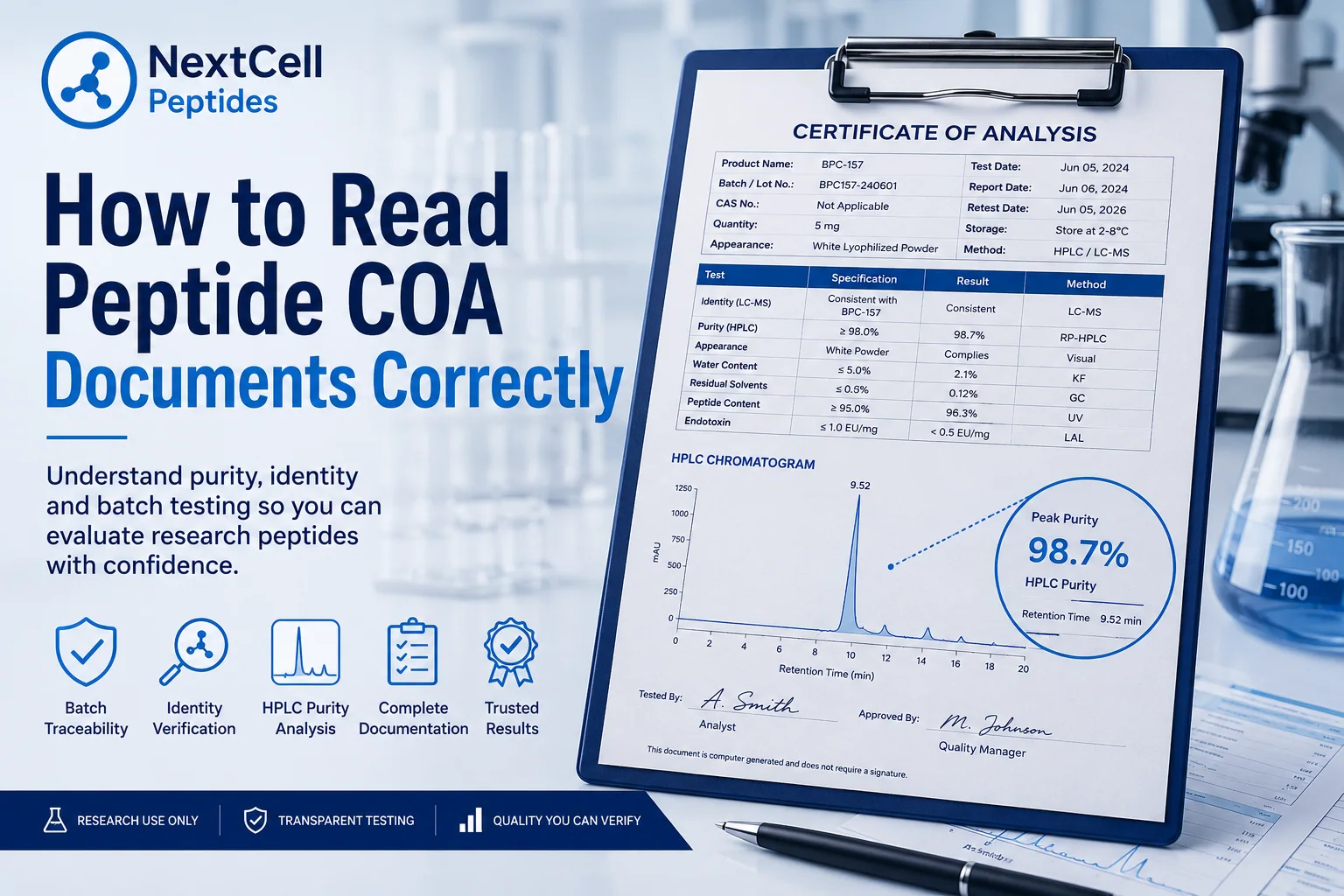
A Certificate of Analysis can look convincing at a glance: a purity percentage, a chromatogram, a laboratory logo, and a signature. But knowing how to read peptide COA documentation means checking whether those details actually belong to the material in front of you. For research buyers, the most useful COA is not simply a polished file. It is a batch-specific analytical record that supports identity, purity, and traceability.
A COA should be part of a wider supplier assessment, alongside clear labeling, appropriate storage information, and transparent product specifications. It does not establish that a compound is suitable for every research objective, but it can help you distinguish documented material from a product supported only by broad marketing claims.
How to Read Peptide COA: Start With Batch Traceability
The first detail to check is the batch or lot number. A meaningful COA should identify a specific production batch, and that number should match the number shown on the product vial, label, or accompanying packaging. If the COA says “Batch 240601” but the vial has no batch number, or displays a different one, the document cannot reliably verify that particular item.
Look for the product name, quantity, and form as well. For example, a COA for a lyophilized peptide should clearly identify the peptide being tested and should not be presented as a generic certificate applicable to every product in a catalog. Generic purity claims such as “99% tested” are useful only when they are tied to a named batch and an identifiable report.
The document date also deserves attention. A recent testing date is not automatically better than an older one, because testing should relate to the relevant production batch. What matters is that the timeline makes sense: manufacturing, analysis, release, and product availability should be logically connected.
Confirm the Peptide Identity
Purity alone does not confirm identity. A sample can show a clean chromatographic profile while still not being the intended peptide. Identity is typically supported by mass spectrometry, often listed as LC-MS, ESI-MS, MALDI-TOF, or a similar method.
Compare the expected molecular weight with the observed molecular weight on the COA. Small differences can be normal depending on how the result is reported, such as monoisotopic mass, average mass, charged ions, or a salt form. However, the certificate should make the result understandable enough to support the stated identity.
Where available, check whether the peptide sequence, molecular formula, or molecular weight corresponds to the requested compound. This is particularly valuable when comparing research materials with similar names, different chain lengths, or modified forms. A COA that provides an identity result without explaining the method is less informative than one that includes both the expected value and the measured analytical result.
Read the Purity Result in Context
High-performance liquid chromatography, usually shown as HPLC or RP-HPLC, is commonly used to estimate peptide purity. A COA may report a result such as “Purity: 98.5% by HPLC.” This generally means that the main peak represented 98.5% of the measured chromatographic area under the method used.
That is useful information, but it is not the same as a complete description of every property of the sample. HPLC purity is method-dependent. The column, mobile phases, wavelength, gradient, injection amount, and integration settings can affect how peaks are separated and calculated. Two reports may both state 99% purity while using different analytical conditions.
A good peptide COA should identify the method clearly enough to show what was measured. Look for details such as the HPLC method, detection wavelength, retention time, and a chromatogram with a visible primary peak. A chromatogram without labels, axes, or a stated purity calculation provides much less evidence than a complete report.
Purity also should not be confused with peptide content. A lyophilized vial can contain counterions, residual moisture, or other components associated with synthesis and processing. Depending on the research need, those specifications may matter. HPLC can be highly informative, but it does not answer every analytical question by itself.
What a Chromatogram Can Tell You
On an HPLC chromatogram, the main peak should typically be dominant and consistent with the reported purity. Smaller secondary peaks may indicate related impurities, deletion sequences, oxidation products, or other components detectable under that method. Their presence does not automatically make the material unsuitable for research, but unexplained large peaks deserve closer scrutiny.
The shape of the main peak matters as well. Severe tailing, unusual broadness, or poorly resolved neighboring peaks can make integration less clear. A clean-looking chromatogram is encouraging, yet it should be considered together with identity testing and batch traceability rather than treated as a standalone pass or fail signal.
Check Which Tests Were Actually Performed
The best way to evaluate a COA is to read it as a statement of scope. What did the laboratory test, and what did it not test? The answer depends on the compound, its form, and the intended research application.
For many research peptides, a useful documentation package includes identity confirmation by mass spectrometry and purity analysis by HPLC. Additional tests may be relevant in some cases, including water content, residual solvents, peptide content, microbial limits, endotoxin testing, or counterion analysis. Not every product requires every test, and a longer COA is not automatically a better one. The key is whether the reported tests match the supplier’s stated specifications and the level of documentation you need.
Be cautious with vague language such as “lab tested” when no method, result, batch number, or report date is provided. Likewise, “99% purity” should not be interpreted as proof that a product has been tested for every possible impurity. Transparent documentation states what was measured and avoids implying more than the analysis supports.
Evaluate the Laboratory and Report Details
A credible COA should identify the testing organization or clearly state whether testing was performed in-house or by an independent laboratory. Independent third-party testing can add useful separation between manufacturing and verification, particularly when the report includes the laboratory name, report number, analyst or reviewer approval, and testing date.
A laboratory logo alone is not enough. Check for practical traceability: a certificate number, a sample or batch reference, a method reference, and an authorized signature or approval field. Formatting can vary among laboratories, but the record should look like an analytical document rather than a marketing graphic.
When a supplier provides a QR code, downloadable certificate, or batch lookup process, treat it as a convenience feature rather than proof on its own. The underlying document still needs to match the product and contain meaningful analytical data. At FutureCell Peptides, batch documentation should be read with this same standard: verify the lot, review the methods, and make sure the reported results support the specification being presented.
Common COA Red Flags
A single missing field may be an administrative oversight, but several gaps together should change how much confidence you place in a report. Pay particular attention to these warning signs:
No batch or lot number that can be matched to the product label.
A purity percentage with no stated method, chromatogram, or test conditions.
No identity result, especially for a product presented as a defined peptide.
A generic certificate reused across multiple products or quantities.
Missing laboratory details, report date, approval information, or test reference.
Results that are difficult to read, internally inconsistent, or unrelated to the stated compound.
These points do not require buyers to become analytical chemists. They simply provide a practical standard for comparing documentation. A supplier that makes batch-specific information easy to review gives you a clearer basis for selecting research materials.
Use the COA Alongside Product Specifications
The COA is most useful when it agrees with the product page and physical labeling. The peptide name, quantity, purity threshold, batch number, and form should tell one consistent story. If a listing describes a lyophilized material with a stated purity standard, the related COA should support those claims with relevant methods and results.
It also helps to separate questions of quality documentation from questions of research design. A COA can help establish what was analyzed in a batch. It cannot replace literature review, method development, appropriate controls, or careful interpretation of experimental results. Those are separate parts of responsible research planning.
A carefully read COA turns a quality claim into something you can inspect. Start with the batch number, then check identity, purity method, chromatogram, testing scope, and report traceability. When those details align, you have a stronger foundation for comparing research peptides and selecting material with documentation that stands up to a closer look.