

Guides
How to Store Reconstituted Peptides: Best Practices for Stability
Learn how to store reconstituted research peptides correctly, understand the factors that influence stability, avoid common storage mistakes, and make more informed decisions when handling research materials.
FutureCell Research Team · 15 min read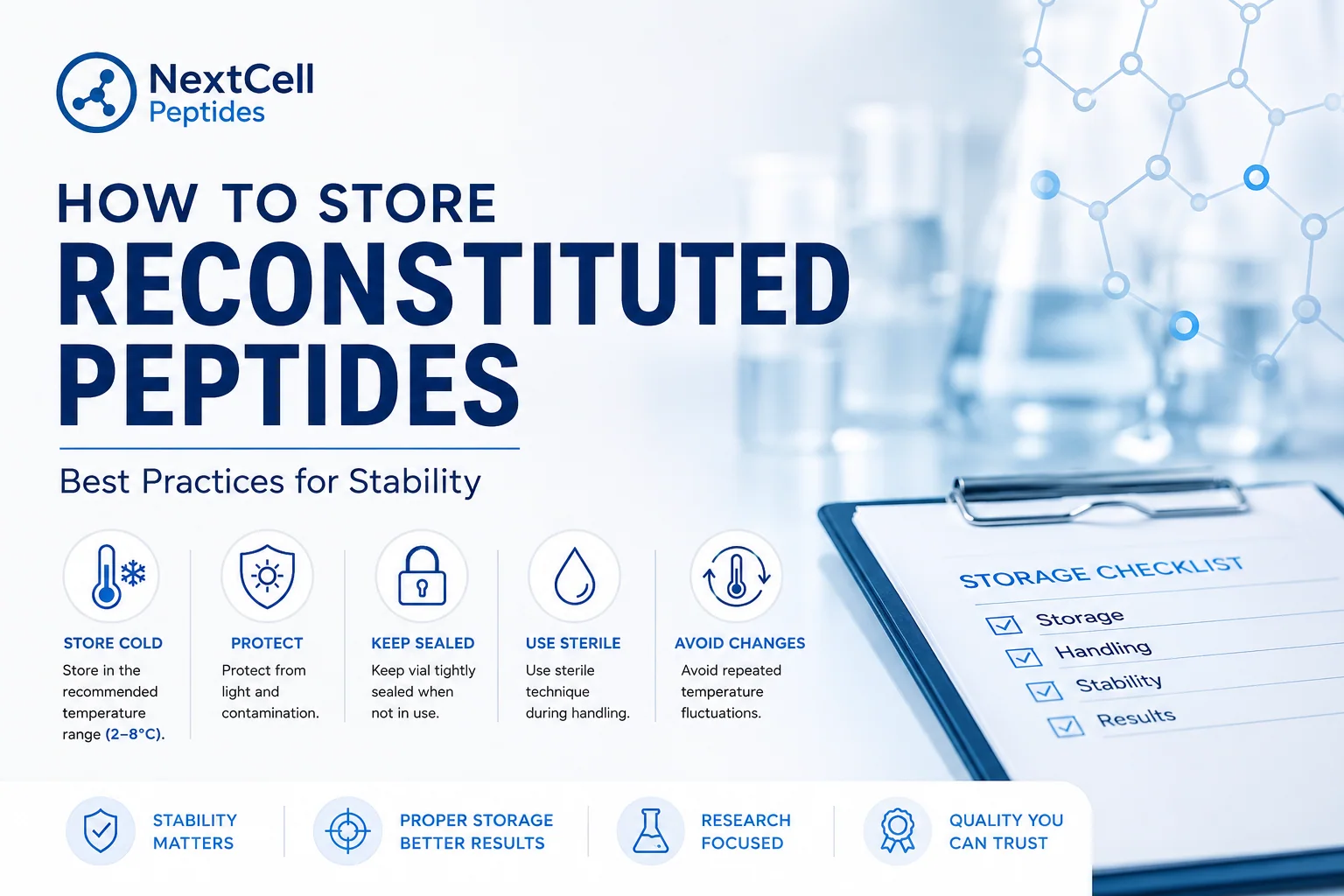
Once a research peptide has been reconstituted, proper storage becomes significantly more important.
While lyophilized peptides are generally valued for their stability during storage, adding a suitable solvent changes how the product should be handled. Temperature, light exposure, contamination and storage conditions can all influence long-term stability.
For researchers, understanding proper storage practices helps maintain product integrity throughout the intended research period and reduces unnecessary handling risks.
This guide explains the principles behind storing reconstituted research peptides, common mistakes to avoid and the factors buyers should consider when evaluating storage recommendations provided by research peptide suppliers.
Why Storage Matters After Reconstitution
Lyophilization removes water from the peptide, helping preserve stability during transport and long-term storage.
Once a peptide is reconstituted, moisture is reintroduced into the solution. From that point forward, the peptide becomes more sensitive to environmental conditions than it was in its lyophilized form.
Although stability varies between different peptides, proper storage practices generally help maintain product quality throughout laboratory use.
Understanding these principles allows researchers to handle products more consistently while reducing unnecessary exposure to conditions that may affect stability.
What Does "Reconstituted" Mean?
Reconstitution refers to dissolving a lyophilized peptide using an appropriate laboratory-grade solvent.
The resulting solution is often easier to measure and use in research applications, but it also requires greater attention to storage and handling.
Because the peptide is no longer in its dry, stabilized form, researchers should carefully follow appropriate laboratory storage practices from the moment reconstitution occurs.
Temperature Is One of the Most Important Factors
Temperature plays a central role in maintaining peptide stability after reconstitution.
Professional suppliers typically provide storage recommendations that reflect how the product should be handled once it has been prepared for research.
Although recommendations vary depending on the specific peptide and intended research application, refrigerated storage is commonly recommended for many reconstituted research peptides to help maintain stability over shorter research periods.
Researchers should avoid exposing reconstituted peptides to unnecessary temperature fluctuations whenever possible.
Consistent storage conditions are generally preferable to repeatedly moving products between different environments.
Protecting Peptides From Light
Some research peptides may be sensitive to prolonged exposure to light.
For this reason, suppliers often recommend storing products in their original vial or another suitable laboratory container that minimizes unnecessary light exposure.
Keeping products protected from direct sunlight and strong laboratory lighting represents a simple precaution that supports good laboratory handling practices.
Why Contamination Is a Common Concern
Once a peptide has been reconstituted, contamination becomes a greater consideration than during dry storage.
Each time a vial is opened, there is an opportunity for microorganisms or foreign particles to enter the solution if proper laboratory technique is not followed.
Researchers typically reduce this risk by:
Using sterile laboratory equipment
Minimizing unnecessary handling
Keeping vials closed when not in use
Avoiding repeated exposure to the surrounding environment
Good laboratory practices support both consistency and product integrity throughout the research process.
Storage Recommendations Should Be Easy to Find
Professional research peptide suppliers generally make storage recommendations easy to access before a purchase is made.
Clear storage guidance helps researchers understand how products should be handled after delivery and reduces unnecessary uncertainty.
When comparing suppliers, buyers should consider whether storage information is:
Clearly displayed on the product page
Consistent across the website
Easy to understand
Appropriate for the product being supplied
Transparent storage guidance reflects a supplier's commitment to educating customers rather than expecting them to search elsewhere for essential information.
Avoid Repeated Temperature Changes
One of the simplest ways to support peptide stability after reconstitution is to avoid unnecessary temperature fluctuations.
Repeatedly moving a vial between refrigerated storage and room temperature may expose the solution to changing environmental conditions. While the impact depends on the specific peptide, maintaining a stable storage environment is generally considered good laboratory practice.
Whenever possible, remove the vial only when needed and return it to the recommended storage conditions promptly after use.
Consistency is often more beneficial than frequent changes in storage temperature.
Keep the Vial Properly Sealed
Proper sealing is an important part of protecting reconstituted peptides.
Each time a vial is opened, the contents may be exposed to moisture, airborne particles and microorganisms. Limiting unnecessary exposure helps maintain a cleaner storage environment throughout the research period.
Researchers typically minimize contamination by:
Keeping the vial tightly sealed when not in use.
Using sterile laboratory equipment.
Handling the vial only when necessary.
Returning the product to storage immediately after use.
Good handling practices complement proper storage and help maintain consistent laboratory procedures.
Why Clean Laboratory Technique Matters
Storage and handling should always be considered together.
Even ideal storage conditions cannot compensate for poor laboratory technique during reconstitution or repeated handling.
Professional laboratory practice generally includes:
Using sterile syringes and needles.
Cleaning vial stoppers before each puncture.
Avoiding unnecessary contact with sterile equipment.
Working in a clean preparation area whenever possible.
These simple precautions reduce the likelihood of contamination and contribute to more consistent research practices.
Should Reconstituted Peptides Be Frozen?
Freezing is a topic that often creates confusion among buyers.
Whether freezing is appropriate depends on the individual peptide, the intended research protocol and the supplier's recommendations.
For this reason, researchers should avoid making assumptions based on general advice found online.
Instead, storage decisions should always take into account the guidance provided for the specific product being used.
When comparing suppliers, buyers should consider whether clear storage recommendations are provided before purchasing.
Professional suppliers typically explain appropriate storage conditions rather than leaving customers to search for information elsewhere.
Why Supplier Storage Guidance Is Important
One way to evaluate a research peptide supplier is by examining the quality of the storage information they provide.
Professional suppliers generally explain:
Recommended storage temperature.
Handling recommendations after reconstitution.
Basic storage precautions.
Practical guidance that is easy to understand.
Providing this information before purchase helps researchers prepare appropriate storage conditions in advance and demonstrates a commitment to customer education.
Clear storage guidance also reduces uncertainty, particularly for researchers who are new to working with lyophilized peptides.
Common Storage Mistakes
Many storage issues can be avoided by following simple laboratory practices.
Some of the most common mistakes include:
Leaving reconstituted peptides at room temperature for extended periods.
Frequently exposing the vial to changing temperatures.
Using non-sterile equipment during handling.
Forgetting to reseal the vial properly.
Ignoring the supplier's storage recommendations.
Exposing the product to unnecessary light.
Handling the vial more often than required.
Avoiding these mistakes helps create more consistent storage conditions throughout the research period.
Best Practices for Storing Reconstituted Peptides
Researchers looking for a simple storage framework can use the following checklist.
✓ Follow the storage recommendations provided by the supplier.
✓ Keep the vial refrigerated when recommended.
✓ Protect the product from unnecessary light exposure.
✓ Keep the vial tightly sealed between uses.
✓ Use sterile laboratory equipment during handling.
✓ Avoid unnecessary temperature fluctuations.
✓ Minimize repeated handling whenever possible.
✓ Store the product in a clean laboratory environment.
✓ Review storage guidance before beginning research.
Following these practical recommendations supports good laboratory practice and helps researchers maintain consistent handling procedures throughout the life of the product.
Frequently Asked Questions
How long can reconstituted peptides be stored?
Storage duration depends on the specific peptide, the solvent used and the storage conditions. Because stability varies between products, researchers should always follow the storage recommendations provided by the supplier for the specific peptide being used.
Should reconstituted peptides always be refrigerated?
Many research peptides are commonly stored under refrigerated conditions after reconstitution. However, storage recommendations vary depending on the peptide and intended laboratory use. Always refer to the guidance supplied with the product.
Does light affect peptide stability?
Some peptides may be sensitive to prolonged exposure to light. Keeping products in their original vial and away from direct sunlight is generally considered good laboratory practice unless otherwise specified.
Can repeated temperature changes affect reconstituted peptides?
Repeated temperature fluctuations are generally avoided in laboratory settings because consistent storage conditions support stable handling practices. Researchers should minimize unnecessary movement between different storage environments whenever possible.
Why is sterile handling important?
Once a peptide has been reconstituted, contamination becomes a greater consideration than during dry storage. Using sterile laboratory equipment and minimizing unnecessary handling helps support clean research procedures.
Should I follow general storage advice or the supplier's recommendations?
General educational resources can help explain best practices, but the storage recommendations provided for the specific product should always take priority. Different peptides may require different handling procedures.
What Experienced Buyers Look For
Storage guidance is often one of the easiest ways to compare research peptide suppliers.
Experienced buyers typically look beyond product prices and instead evaluate how much useful information a supplier provides before a purchase is made.
Questions they often ask include:
Are storage recommendations easy to find?
Does the supplier explain handling after reconstitution?
Is product information written clearly?
Are educational resources available?
Is information consistent across the website?
Does the supplier help buyers understand proper laboratory handling?
Clear answers to these questions help reduce uncertainty and demonstrate a commitment to transparency.
Related Research Guides
Proper storage is only one aspect of evaluating research peptides.
To build a more complete understanding of product quality and supplier standards, consider exploring these additional guides:
How Research Peptides Are Manufactured: From Peptide Synthesis to Lyophilization
Lyophilized vs Reconstituted Peptides: What's the Difference?
How to Spot Fake Research Peptides: 10 Red Flags Every Buyer Should Know
Reading these guides together provides a broader understanding of storage, handling, supplier transparency and informed purchasing.
Summary
Proper storage begins the moment a research peptide is reconstituted.
Maintaining consistent storage conditions, minimizing unnecessary handling and following the supplier's recommendations all contribute to good laboratory practice. While storage requirements differ between peptides, understanding the principles behind temperature control, sterile technique and proper handling helps researchers manage products more confidently.
When comparing research peptide suppliers, buyers should also evaluate the quality of the storage guidance provided. Clear recommendations, practical educational resources and transparent product information reflect a supplier's commitment to helping customers make informed decisions.
Rather than relying on assumptions or incomplete advice, experienced buyers look for suppliers who combine professional product presentation with comprehensive educational support. This approach makes it easier to compare products objectively and choose suppliers that prioritize clarity, consistency and long-term trust.
Key Takeaways
✓ Reconstituted peptides require more careful handling than lyophilized peptides.
✓ Consistent storage conditions are generally preferable to repeated temperature changes.
✓ Sterile handling practices help reduce the risk of contamination.
✓ Storage recommendations should always be easy to find and simple to understand.
✓ Professional suppliers provide practical storage guidance before a purchase is made.
✓ Evaluating supplier transparency alongside storage information helps buyers make more informed purchasing decisions.