

Guides
How to Identify High-Quality TB-500: A Buyer's Checklist (2026)
Learn how to identify high-quality TB-500 using a practical buyer's checklist covering HPLC purity testing, Certificates of Analysis (COAs), manufacturing quality, storage and supplier transparency.
FutureCell Research Team · 15 min read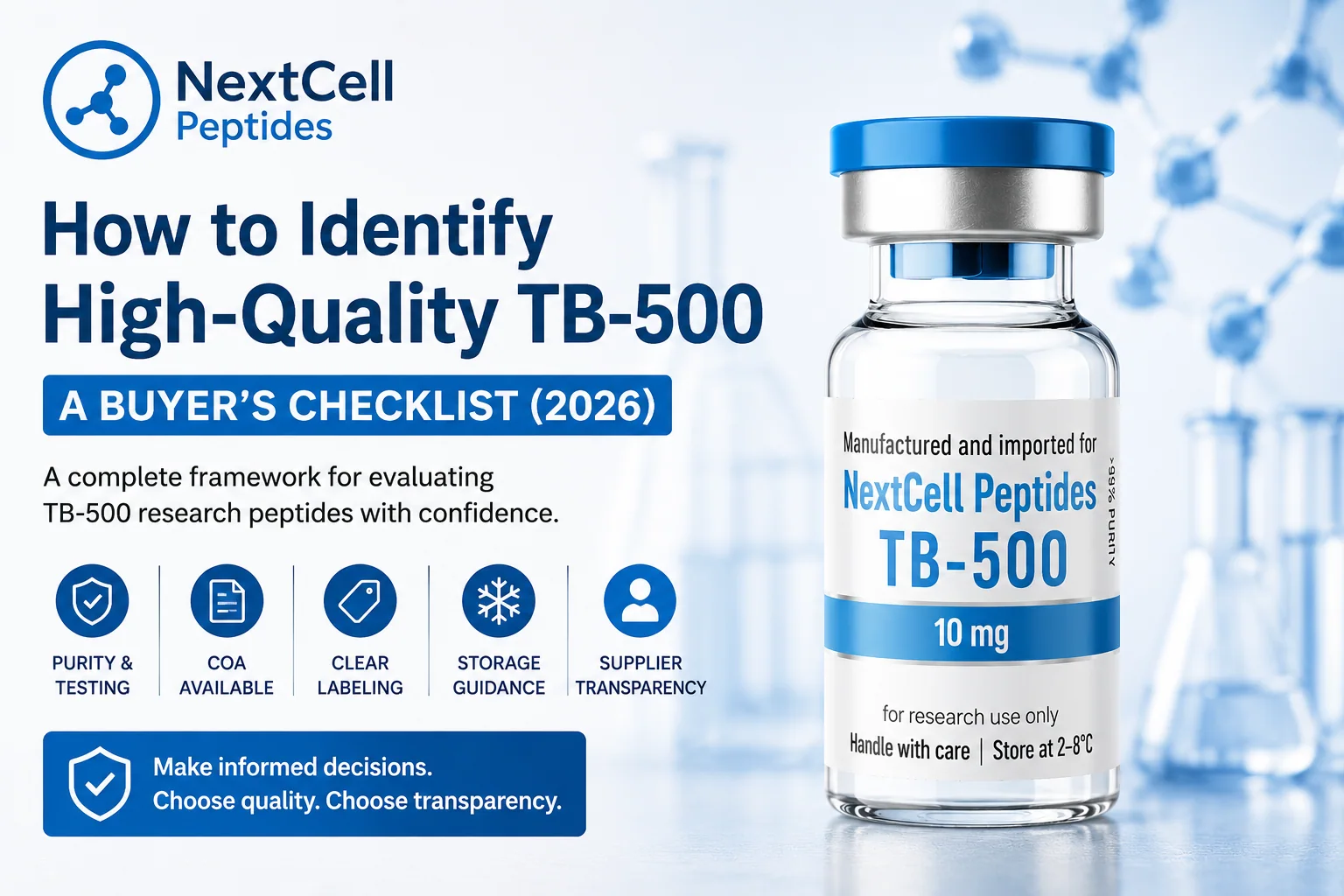
Introduction
Finding a high-quality TB-500 supplier has become increasingly difficult as the research peptide market continues to expand. While many products appear similar at first glance, significant differences often exist in manufacturing standards, analytical testing, documentation, packaging and overall transparency.
One supplier may advertise 99% purity, while another provides a comprehensive Certificate of Analysis, batch-specific HPLC data and detailed manufacturing information. Understanding which of these factors truly matters is essential for researchers seeking reliable laboratory materials.
This guide provides a practical framework for evaluating TB-500 beyond marketing claims. Rather than focusing on a single specification, it explains how experienced researchers assess manufacturing quality, analytical documentation, storage practices and supplier transparency before selecting a product.
Researchers looking for complete product specifications, storage guidance and batch documentation can also review the TB-500 product page before comparing suppliers.
Table of Contents
What Does "High-Quality TB-500" Actually Mean?
The Four Pillars of Research-Grade Quality
The FutureCell TB-500 Evaluation Framework™
Common Mistakes Buyers Make
Questions Every Researcher Should Ask
Frequently Asked Questions
Summary
Related Guides
What Does "High-Quality TB-500" Actually Mean?
Many buyers assume that research peptide quality can be judged by a single number, most commonly the advertised purity percentage. In reality, professional researchers rarely evaluate peptides this way.
A research-grade peptide is better understood as the result of an entire quality system rather than one laboratory measurement.
That system includes:
Manufacturing consistency
Analytical verification
Batch-specific documentation
Appropriate storage recommendations
Transparent quality control
Supplier accountability
Each of these contributes to the overall confidence researchers can place in a product.
Two products may both advertise 99% purity, yet differ substantially in the amount of supporting documentation, manufacturing transparency and batch traceability provided by the supplier.
For this reason, experienced researchers evaluate the complete quality profile instead of relying on a single specification.
The Four Pillars of Research-Grade Quality
Rather than treating every specification equally, it is useful to group quality indicators into four core areas.
1. Manufacturing Quality
Every research peptide begins with manufacturing.
Consistent peptide synthesis, purification and lyophilization reduce variation between production batches and establish the foundation for reliable analytical testing.
Researchers should consider whether a supplier explains how products are manufactured rather than simply advertising purity percentages.
2. Analytical Verification
Analytical testing provides objective laboratory evidence describing the characteristics of a production batch.
Important indicators include:
HPLC purity analysis
Batch-specific analytical reports
Identity verification
Batch identification
Certificate of Analysis (COA)
These documents allow researchers to evaluate measurable laboratory data rather than relying solely on product descriptions.
3. Documentation & Traceability
Professional suppliers typically provide documentation that connects each product to its manufacturing and analytical history.
Useful documentation may include:
Batch number
Certificate of Analysis
Product specifications
Storage recommendations
Manufacturing information
Documentation improves transparency and supports reproducibility across laboratory work.
4. Supplier Transparency
The final pillar is often overlooked.
High-quality suppliers generally invest time in explaining:
How products are manufactured.
How quality is verified.
Which analytical methods are used.
How products should be stored.
Which documentation accompanies each batch.
Educational transparency often provides a clearer indication of long-term quality standards than marketing language alone.
Why Many Buyers Make the Wrong Comparison
One of the most common mistakes is comparing suppliers using only three criteria:
Price
Purity percentage
Product description
While these factors are easy to compare, they rarely provide enough information to evaluate research-grade quality.
A more reliable comparison considers:
Manufacturing quality
Analytical verification
Documentation
Storage guidance
Supplier transparency
Evaluating these areas together provides a far more complete picture of product quality and helps reduce uncertainty before purchase.
Expert Insight
Professional laboratories rarely rely on a single quality indicator when evaluating research materials.
Instead, they review multiple independent sources of information—including manufacturing procedures, analytical testing, documentation and storage guidance—to build confidence in the consistency of each production batch.
The strongest purchasing decisions are generally based on objective laboratory documentation rather than promotional claims.
Why This Matters
Choosing high-quality TB-500 is not about finding the supplier with the highest advertised purity or the lowest price.
It is about understanding how quality is established, documented and communicated throughout the manufacturing process.
Researchers who evaluate multiple quality indicators rather than isolated specifications are better equipped to compare suppliers objectively and interpret laboratory documentation with greater confidence.
The FutureCell TB-500 Evaluation Score™
Comparing research peptide suppliers can be challenging because many products appear similar on the surface. Most advertise high purity, professional packaging and research-grade standards, making it difficult to distinguish meaningful quality differences.
To simplify the evaluation process, the FutureCell TB-500 Evaluation Score™ provides a structured framework based on the factors experienced researchers commonly review before selecting a supplier.
Rather than relying on a single specification, the framework evaluates the complete quality profile of a product.
Category 1 — Manufacturing Standards (20 Points)
Manufacturing quality forms the foundation of every research peptide. Even the most comprehensive analytical testing cannot compensate for inconsistent production standards.
When evaluating a supplier, consider whether they provide information about:
Peptide synthesis procedures
Purification methods
Controlled lyophilization
Batch-to-batch consistency
Manufacturing transparency
Score
16–20 points
The supplier demonstrates consistent manufacturing practices and provides meaningful information about production standards.
10–15 points
Some manufacturing information is available, but important details remain unclear.
0–9 points
Little or no manufacturing information is provided beyond basic marketing claims.
Category 2 — Analytical Verification (20 Points)
Objective laboratory testing allows researchers to evaluate measurable product characteristics rather than relying solely on product descriptions.
High-quality suppliers generally provide analytical documentation for each production batch.
Look for:
Batch identification
Analytical methodology
Product specifications
Analytical transparency helps researchers compare products using documented laboratory data instead of promotional language.
Category 3 — Documentation & Traceability (20 Points)
Professional documentation supports transparency throughout the product lifecycle.
Researchers should verify whether each product includes:
Batch number
Product specifications
Storage recommendations
Batch-specific documentation
Traceable analytical records
Products supported by complete documentation are generally easier to evaluate objectively and reproduce in future laboratory work.
Category 4 — Packaging & Storage (20 Points)
Packaging serves a practical purpose beyond presentation.
Proper packaging helps protect lyophilized peptides during transport and storage while preserving the integrity of the product before laboratory preparation.
Researchers should consider whether the supplier provides:
Secure vial sealing
Professional labeling
Appropriate storage recommendations
Protective shipping materials
Clear handling guidance
While packaging alone does not determine quality, it reflects the supplier's attention to consistency and product handling.
Category 5 — Supplier Transparency (20 Points)
Transparency is often the factor that separates professional suppliers from companies relying primarily on marketing claims.
Researchers should ask:
Does the supplier explain its quality control process?
Is educational content available?
Are analytical documents accessible?
Are product specifications clearly presented?
Does the supplier answer technical questions openly?
Companies that prioritize transparency generally make it easier for researchers to evaluate products objectively.
Interpreting Your Score
After reviewing all five categories, calculate your total score out of 100 points.
90–100 Points
Excellent documentation, transparency and quality assurance.
The supplier demonstrates strong research-grade standards across multiple quality indicators.
75–89 Points
Good overall quality with only minor gaps in documentation or transparency.
Researchers may still wish to review available analytical records before purchasing.
60–74 Points
Several important quality indicators are missing or insufficiently documented.
Additional verification is recommended before selecting the supplier.
Below 60 Points
Limited transparency and incomplete documentation make it difficult to evaluate overall product quality objectively.
Researchers should request additional information before making a purchasing decision.
Expert Insight
One of the biggest mistakes buyers make is comparing suppliers using a single specification such as purity percentage or price.
Experienced researchers instead compare the entire quality system surrounding a product. Manufacturing standards, analytical verification, documentation, packaging and transparency each contribute to a more reliable assessment than any individual metric.
The strongest purchasing decisions are typically based on documented evidence rather than isolated product claims.
How to Compare TB-500 Suppliers
Choosing a TB-500 supplier involves more than comparing prices or advertised purity percentages. While these factors may appear important, they rarely provide enough information to determine whether a product has been manufactured and documented according to consistent research-grade standards.
A structured comparison begins by asking a series of objective questions.
Does the Supplier Explain Its Manufacturing Process?
Professional suppliers generally provide information about how their products are manufactured, purified and prepared before release.
Although manufacturers are not expected to disclose proprietary production methods, they should explain the overall quality process in sufficient detail to help researchers understand how consistency is maintained.
Questions worth considering include:
Is the manufacturing process described?
Does the supplier explain how peptides are purified?
Are storage recommendations provided?
Is there evidence of batch-to-batch consistency?
Suppliers who explain their quality processes openly are generally easier to evaluate than those relying primarily on marketing language.
Is Analytical Documentation Available?
Analytical documentation provides objective laboratory information that cannot be replaced by advertising claims.
Before selecting a supplier, researchers should verify whether documentation is available for the specific production batch.
Useful documentation commonly includes:
Batch identification
Product specifications
Manufacturing date
The presence of documentation does not automatically indicate product quality, but it significantly improves transparency and allows researchers to make more informed comparisons.
Are Product Specifications Clearly Presented?
Clear product specifications reduce uncertainty and demonstrate attention to detail.
Researchers should expect to find information such as:
Peptide name
Net content
Product format
Storage recommendations
Batch number
Research-use designation
Products lacking basic technical information may be more difficult to evaluate objectively.
Red Flags to Watch For
While no single issue necessarily indicates poor quality, multiple warning signs should encourage researchers to investigate further before purchasing.
Potential red flags include:
No Certificate of Analysis available.
Generic documentation that is not batch specific.
No batch number displayed on the product.
Missing storage recommendations.
No explanation of analytical testing.
Marketing claims without supporting documentation.
Limited information about manufacturing standards.
Inconsistent product specifications across the website.
The more transparency a supplier provides, the easier it becomes to independently evaluate product quality.
Questions Every Researcher Should Ask
Before selecting TB-500, consider asking the following questions:
Is documentation available for the exact batch being supplied?
Batch-specific documentation provides significantly more value than generic laboratory reports.
Does the supplier explain how product quality is verified?
Reliable suppliers typically describe their quality control procedures rather than relying exclusively on promotional claims.
Are storage recommendations clearly stated?
Storage guidance demonstrates attention to product handling and helps researchers maintain peptide stability before laboratory preparation.
Is the product supported by professional documentation?
Clear specifications, analytical reports and batch identification improve transparency and simplify product comparisons.
Does the supplier invest in education?
Companies that publish educational resources often demonstrate a stronger commitment to transparency than suppliers whose websites focus exclusively on product promotion.
Expert Insight
Researchers frequently compare suppliers by asking which company advertises the highest purity percentage or the lowest price.
A more reliable approach is to compare the overall quality system supporting each product.
Manufacturing standards, analytical verification, documentation, storage guidance and supplier transparency provide a broader and more meaningful understanding of research-grade quality than any single specification.
Professional purchasing decisions are typically based on objective evidence rather than isolated marketing claims.
Frequently Asked Questions
What is the most important indicator of high-quality TB-500?
There is no single indicator that determines overall quality.
Experienced researchers evaluate manufacturing standards, analytical verification, documentation, storage guidance and supplier transparency together rather than relying on one specification.
Is a Certificate of Analysis enough to verify quality?
A Certificate of Analysis is an important quality document, but it represents only one part of the evaluation process.
Researchers should also consider manufacturing consistency, batch traceability, analytical testing and product specifications.
Should I choose the supplier with the highest purity percentage?
Not necessarily.
Purity is an important analytical measurement, but it should be interpreted alongside documentation, manufacturing quality and supplier transparency.
Why is batch-specific documentation important?
Batch-specific documentation allows researchers to review analytical information relating to the exact production batch rather than relying on generic reports.
This improves transparency and supports more informed purchasing decisions.
Does packaging indicate product quality?
Packaging alone cannot determine quality.
However, professional packaging, clear labeling and appropriate storage recommendations often reflect a supplier's attention to consistency and product handling.
Can two TB-500 products with the same purity differ in quality?
Yes.
Two products may report similar analytical purity while differing in manufacturing consistency, documentation quality, storage guidance and overall transparency.
For this reason, experienced researchers evaluate multiple quality indicators before selecting a supplier.
Summary
Identifying high-quality TB-500 requires more than comparing purity percentages or product prices. While these metrics are often the first details buyers notice, they represent only a small part of the overall quality profile of a research peptide.
Experienced researchers evaluate products using a broader framework that considers manufacturing standards, analytical verification, documentation quality, storage recommendations and supplier transparency. Together, these factors provide a more reliable basis for comparing products than any single specification alone.
The FutureCell TB-500 Evaluation Score™ is designed to encourage a structured approach to supplier evaluation. By reviewing multiple quality indicators instead of relying on isolated marketing claims, researchers can make more informed purchasing decisions and better understand the documentation supporting each production batch.
Ultimately, confidence in a research peptide is built through transparency, consistency and objective laboratory information—not through advertising claims or individual product specifications.
Related Guides
How Research Peptides Are Manufactured: From Peptide Synthesis to Lyophilization
How to Choose a High-Quality Research Peptide Supplier: The Complete Buyer's Guide
What Is a Certificate of Analysis (COA)? Everything Research Peptide Buyers Should Know
How to Read an HPLC Chromatogram: The Complete Guide for Research Peptide Buyers
How to Store Lyophilized Peptides Correctly: A Complete Guide
About FutureCell Peptides
FutureCell Peptides is committed to providing professionally manufactured research peptides supported by transparent documentation and educational resources.
Our objective is to help researchers understand how research peptides are manufactured, tested and evaluated by focusing on scientific clarity, analytical transparency and consistent quality standards.
Each product is intended exclusively for laboratory and scientific research and is supported by product specifications, storage guidance and batch-specific analytical documentation where available.
Researchers interested in reviewing specifications, storage recommendations and available documentation can also visit the TB-500 product page.