Research
CJC-1295 DAC Versus No DAC Clearly Explained
CJC-1295 DAC versus no DAC: compare albumin binding, research duration, naming, and quality checks for selecting documented research materials clearly.
FutureCell Research Team · 7 min read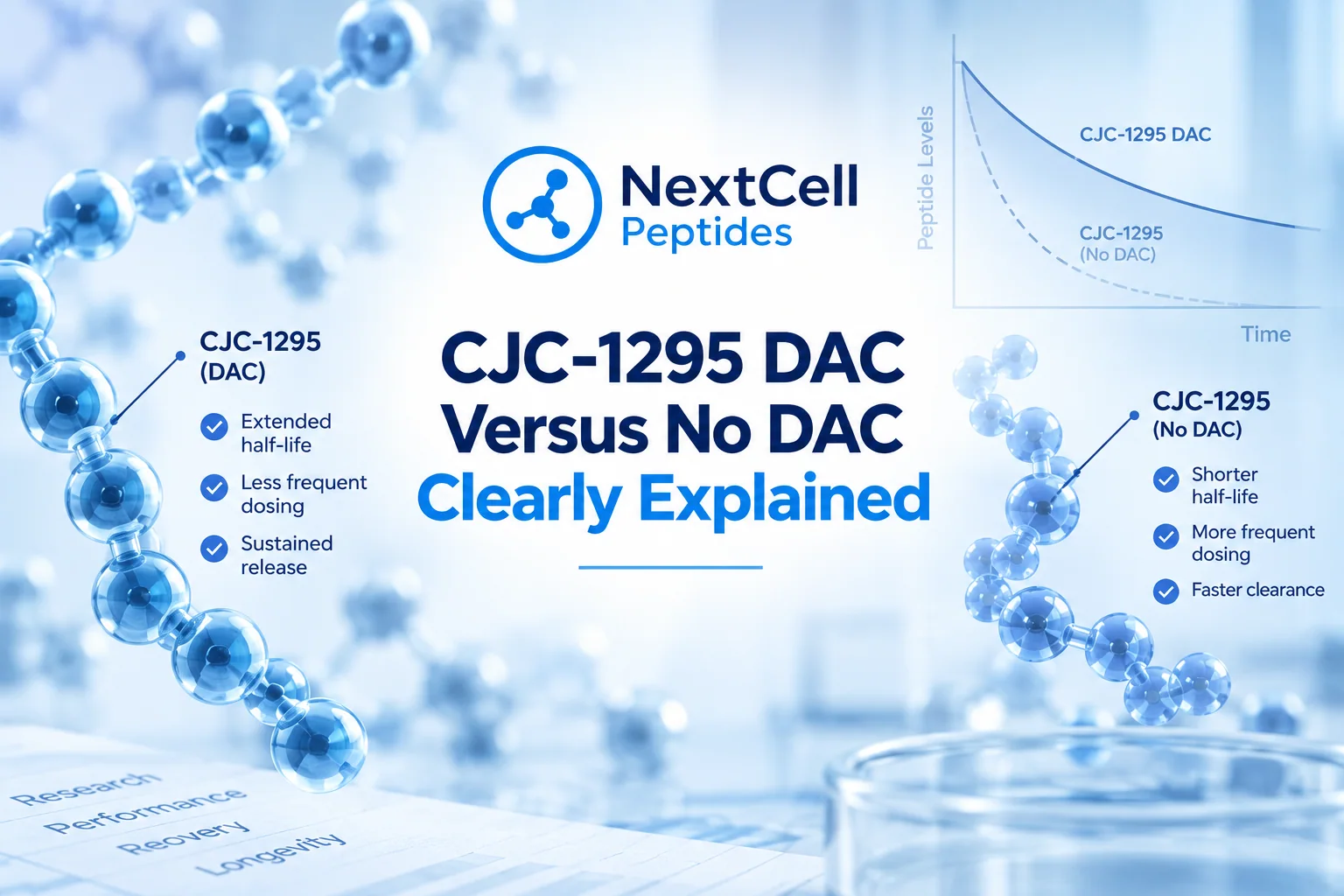
The distinction in CJC-1295 DAC versus no DAC is not a minor labeling detail. It changes the molecule’s design, its expected persistence in experimental systems, and the way a research protocol may be structured. For buyers comparing lyophilized peptide specifications, understanding that difference is more useful than relying on shorthand product names alone.
CJC-1295 is commonly discussed in growth hormone-releasing hormone, or GHRH, research. However, the name is frequently used inconsistently in commercial and informal settings. A careful comparison starts with the chemistry: DAC is a specific albumin-binding modification, while products described as “no DAC” generally refer to a shorter-acting GHRH analog, often associated with the name Modified GRF(1-29).
CJC-1295 DAC versus no DAC: the core difference
DAC stands for Drug Affinity Complex. In CJC-1295 DAC, a reactive group is incorporated into the peptide structure to support covalent binding to serum albumin. Albumin is an abundant transport protein, and this binding is intended to extend the peptide’s presence in circulation in research models.
The practical research implication is duration. The DAC-modified compound is designed for extended exposure, whereas a no-DAC analog is designed to clear more quickly. This difference can affect sampling schedules, assay design, experimental controls, and interpretation of time-dependent results.
No-DAC products do not contain the albumin-binding complex. They are therefore not simply a lower-strength version of CJC-1295 DAC. They are distinct peptide constructs with different pharmacokinetic design principles. Treating the two as interchangeable can introduce avoidable uncertainty into experimental planning.
Why albumin binding changes the comparison
A peptide that binds albumin is less available for immediate clearance than an unmodified short peptide. In research literature, DAC-containing CJC-1295 is consequently associated with a more prolonged signaling profile than no-DAC GHRH analogs. That does not establish a universal outcome for every model, assay, or research objective. It does explain why the two formats are selected for different experimental timeframes.
For studies that need to observe a sustained exposure pattern, the DAC construct may be the more relevant material. For work centered on shorter observation windows or more transient signaling dynamics, a no-DAC analog may fit the research question more closely. The correct choice depends on the study design, not on which format appears more convenient.
Naming is less standardized than buyers expect
One of the most significant issues in this category is nomenclature. “CJC-1295” may be used to describe the DAC-containing peptide, the no-DAC version, or a broader family of GHRH-related research compounds. Product names alone do not reliably confirm molecular identity.
The term CJC-1295 no DAC is often used for Modified GRF(1-29), a shortened GHRH analog with substitutions intended to improve stability relative to native GRF(1-29). Although the terms are widely associated in peptide research markets, buyers should not assume that every item carrying similar language has an identical sequence or modification profile.
A transparent supplier should make it possible to verify what is actually being sold. The relevant details include the stated peptide identity, whether DAC is present, net quantity, purity specification, batch or lot reference, and supporting analytical documentation. If a listing does not clearly distinguish DAC from no DAC, the product cannot be evaluated confidently on name recognition alone.
What to verify on the product specification
Before comparing price or vial quantity, check whether the product page and Certificate of Analysis identify the material in a way that matches the intended research requirement. For a DAC product, the documentation should support the presence of the relevant modified structure. For a no-DAC product, the listed identity should not imply albumin binding where none exists.
Purity is equally important, but it is only one part of the quality picture. A high-percentage purity claim has more value when connected to a traceable batch and an analytical method such as HPLC. Mass spectrometry may also be used to support identity confirmation. Together, these records help distinguish a documented research material from a generic label claim.
Choosing between the two for research procurement
The right procurement decision begins with the experimental objective. Researchers and informed private buyers should first ask whether their work requires a long-duration albumin-binding construct or a shorter-acting GHRH analog. Once that is clear, compare like for like: DAC against DAC, or no DAC against no DAC.
It is also useful to avoid comparing vial labels in isolation. Two products with the same stated mass may differ in molecular format, purity threshold, testing documentation, and batch transparency. Those differences can matter more to reproducibility than a small difference in listed quantity.
For combined peptide research, the distinction becomes even more relevant. CJC-1295 is sometimes paired with Ipamorelin in research-oriented product categories because the compounds are investigated through related but distinct signaling pathways. A combination listing should still identify whether the CJC component includes DAC. Without that detail, the buyer cannot accurately assess the duration profile of the CJC portion of the material.
Quality controls that matter beyond the DAC label
The DAC designation answers a structural question. It does not, by itself, verify quality. A premium research peptide supplier should provide evidence that the material corresponds to its specification and that the documentation relates to the batch being offered.
Look for a clearly labeled, lyophilized product with a stated net content and accessible Certificate of Analysis. HPLC data can support a purity result by separating constituents within a sample, while identity testing helps confirm that the expected peptide is present. Independent third-party testing adds another layer of confidence when it is available and clearly described.
Storage and handling information should also be presented responsibly, as peptide integrity can be influenced by environmental conditions. Product documentation should be concise but specific enough for buyers to understand what was tested, how the sample is identified, and what the reported result represents.
For EU customers, supplier logistics are part of the quality decision as well. EU-based fulfillment can simplify purchasing and delivery, but it should not replace analytical transparency. FutureCell Peptides emphasizes professionally labeled research materials, batch-linked documentation, and independent verification where applicable, allowing customers to compare specifications before placing an order.
A practical way to read a CJC product listing
When assessing a CJC-related listing, read the product title as a starting point, not a conclusion. Confirm the exact DAC status in the specification. Then review the peptide identity, purity claim, analytical method, lot reference, and Certificate of Analysis. If the material is part of a blend, identify each component rather than assuming the blend name explains the full composition.
This process is especially valuable when product names use familiar abbreviations. “No DAC,” “Modified GRF,” and “CJC-1295” may appear close together in search results, but they should not be treated as equivalent labels. Clear molecular disclosure protects the quality of the comparison and supports better research purchasing decisions.
The most useful question is not which format is universally better. It is whether the labeled structure, duration profile, and quality documentation align with the research material you intend to evaluate. That is where a meaningful CJC-1295 DAC versus no DAC comparison begins.