
Guides
How to Choose High-Quality Retatrutide: A Complete Buyer's Guide (2026)
Learn how to evaluate Retatrutide beyond marketing claims. This comprehensive buyer's guide explains peptide purity, HPLC testing, Certificates of Analysis (COAs), batch traceability, manufacturing standards and the quality indicators experienced research buyers look for before choosing a supplier.
FutureCell Research Team · 25 min read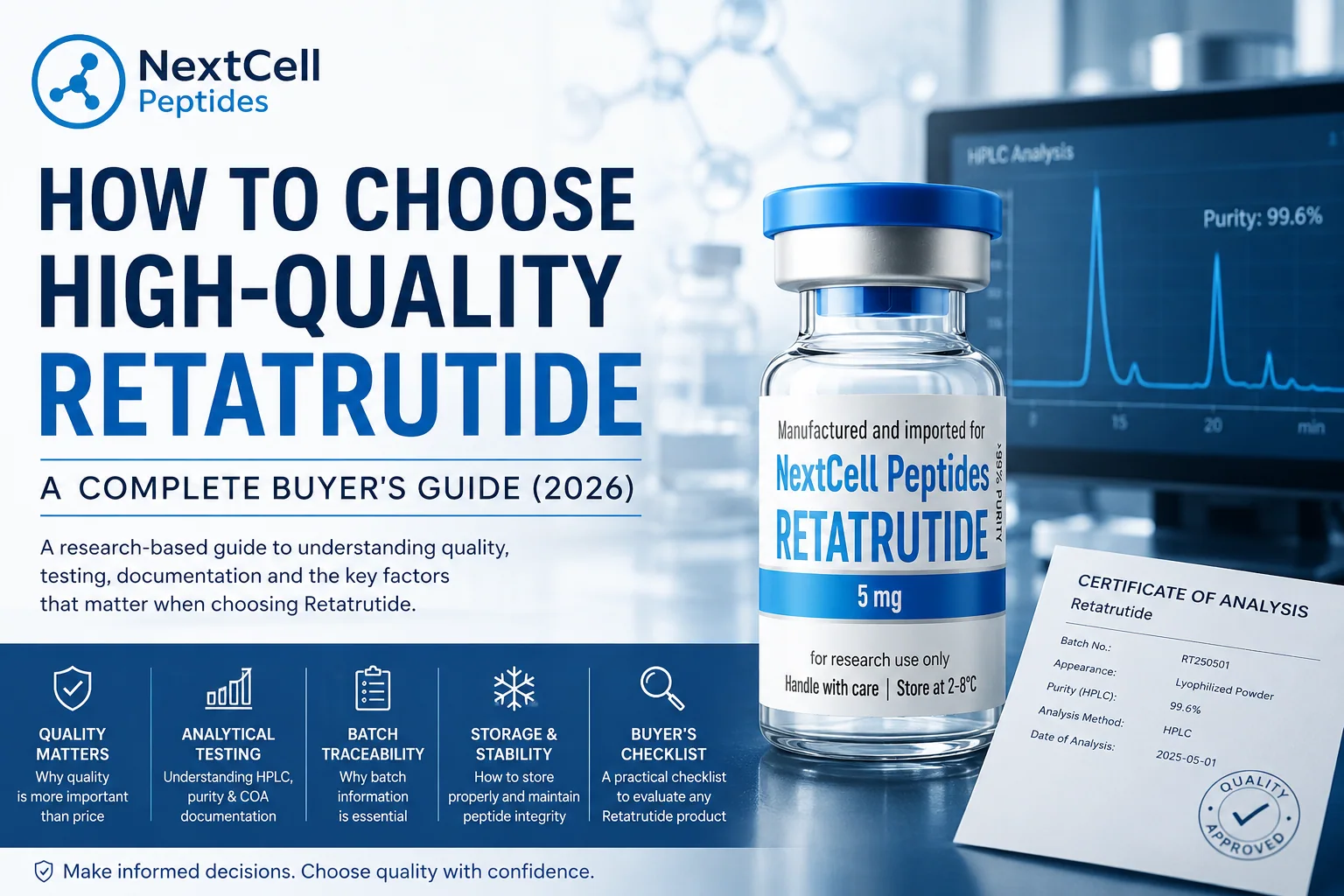
Introduction
Looking for a High-Quality Retatrutide Research Product?
If you're already comparing Retatrutide suppliers, you can also review our Retatrutide 5 mg research peptide. The product page includes detailed specifications, storage guidance and supporting quality documentation to help you evaluate it using the same principles discussed throughout this guide.
Retatrutide has quickly become one of the most discussed research peptides, attracting growing interest from researchers and buyers looking to evaluate one of the newest investigational compounds available. As demand has increased, so has the number of suppliers offering Retatrutide products, making it more important than ever to understand how quality should be assessed before making a purchase.
At first glance, many Retatrutide products appear nearly identical. Product labels often display the same peptide name, similar stated purity levels and comparable packaging. However, the quality of a research peptide extends far beyond what is printed on the vial.
Differences in peptide synthesis, purification methods, analytical verification, manufacturing consistency and supplier transparency can all influence how confidently a product can be evaluated. Understanding these factors allows buyers to compare research products using objective information rather than relying solely on marketing claims.
One of the most common mistakes buyers make is assuming that a reported purity percentage tells the entire story. In reality, peptide purity is only one part of a much larger quality assessment that also includes manufacturing standards, analytical documentation, batch traceability and proper storage.
Likewise, a supplier claiming that every product is "high purity" provides very little meaningful information unless those claims are supported by verifiable documentation such as Certificates of Analysis (COAs) and HPLC chromatograms.
This guide explains how experienced research buyers evaluate Retatrutide before selecting a supplier. Rather than focusing on promotional language or unsupported claims, it examines the objective quality indicators that can be independently reviewed and understood.
By the end of this guide, you'll understand how manufacturing quality, analytical testing and supplier transparency work together to help distinguish well-documented Retatrutide products from those supported by limited evidence.
Table of Contents
What Is Retatrutide?
Why Quality Matters More Than Price
How Retatrutide Is Manufactured
Understanding Peptide Purity
Why HPLC Testing Matters
How to Read a Certificate of Analysis (COA)
Batch Traceability and Manufacturing Standards
Packaging, Storage and Stability
The FutureCell Retatrutide Quality Evaluation Framework™
A Practical Buyer's Checklist
Frequently Asked Questions
Summary
What Is Retatrutide?
Retatrutide is a synthetic investigational peptide developed for laboratory research. It has attracted considerable attention because it belongs to a newer generation of research peptides designed with a more complex molecular structure than many compounds commonly used in peptide research.
From a manufacturing perspective, this complexity places greater importance on production quality and analytical verification. Producing a research peptide involves far more than simply synthesising the molecule itself. Every stage of manufacturing contributes to the quality and consistency of the finished product.
A modern peptide manufacturing process typically includes:
Peptide synthesis
Purification
Identity verification
Analytical testing
Lyophilization
Batch documentation
Final quality review
Each of these stages serves a specific purpose in helping manufacturers verify that a production batch meets its intended specifications before release.
If you'd like to understand this process in greater detail, our guide on how research peptides are manufactured explains each manufacturing stage from peptide synthesis through purification and freeze-drying.
Because Retatrutide is produced as a lyophilized research peptide, correct processing during lyophilization plays an important role in maintaining long-term stability during storage and transportation.
However, manufacturing quality alone does not tell the entire story.
The real confidence comes from analytical verification.
A well-documented Retatrutide product should be accompanied by evidence supporting its stated specifications rather than relying exclusively on information printed on the label. This typically includes analytical documentation, batch identification and laboratory testing that allows buyers to independently review the available quality data.
Understanding how to interpret this documentation is often far more valuable than comparing product descriptions alone.
Why Quality Matters More Than Price
When comparing Retatrutide suppliers, it can be tempting to focus primarily on price. While cost is naturally an important consideration, experienced buyers rarely evaluate a research peptide based on price alone.
Two products may both be labelled as Retatrutide, contain the same stated peptide content and advertise identical purity percentages, yet differ substantially in manufacturing consistency, analytical testing and documentation.
For this reason, professional buyers generally evaluate several quality indicators together, including:
Manufacturing transparency
Batch traceability
Independent analytical testing
Availability of Certificates of Analysis (COAs)
Availability of HPLC chromatograms
Product labelling
Storage recommendations
Supplier documentation
Looking at these factors collectively provides a much more complete understanding of product quality than relying on a single specification or marketing claim.
Perhaps most importantly, trustworthy suppliers make it possible for buyers to review the evidence supporting their products rather than asking customers to rely solely on trust.
That principle forms the foundation of every high-quality research peptide purchase.
How Retatrutide Is Manufactured
The quality of a research peptide begins long before it reaches a laboratory. Every stage of the manufacturing process plays a role in determining the consistency, purity and overall quality of the finished product.
Retatrutide is a synthetic peptide produced using advanced peptide manufacturing techniques developed specifically for complex peptide molecules. Because of its molecular structure, manufacturing requires strict process control, highly purified raw materials and multiple quality control steps before a production batch can be released.
Understanding how Retatrutide is manufactured provides valuable context when comparing suppliers. While buyers are not expected to become peptide chemists, knowing the major stages of production makes it much easier to evaluate the documentation and quality claims that accompany a finished product.
For readers interested in the complete manufacturing process, our guide on How Research Peptides Are Manufactured explains every stage in greater detail.
Step 1: Peptide Synthesis
Manufacturing begins with peptide synthesis, where individual amino acids are assembled into the correct sequence using automated laboratory equipment.
Modern manufacturers typically use Solid-Phase Peptide Synthesis (SPPS), a method that allows amino acids to be added one at a time while reducing unwanted reactions during production.
Because Retatrutide is significantly more complex than many traditional research peptides, precision during synthesis is particularly important. Even small deviations during this stage can affect the final product and increase the need for additional purification later in the manufacturing process.
At this stage, the peptide has been created—but it is not yet ready for research use.
Step 2: Purification
Following synthesis, the crude peptide contains the desired molecule alongside small amounts of by-products, incomplete peptide chains and other manufacturing impurities.
Purification removes as many of these unwanted materials as possible, producing a cleaner and more consistent final product.
The effectiveness of purification has a direct influence on the overall quality of the finished peptide, which is why it represents one of the most important stages of manufacturing.
Many buyers assume that all purification processes are identical. In reality, purification methods and manufacturing standards can differ between facilities, making supplier quality control an important consideration.
This stage also lays the foundation for the analytical testing discussed later in this guide.
What Is Peptide Purity? Everything Buyers Should Know
Step 3: Identity Verification
Once purification has been completed, manufacturers verify that the finished material corresponds to the intended peptide.
Identity testing helps confirm that the manufactured peptide matches the expected molecular structure before additional quality testing is performed.
This step is particularly important for complex research peptides, where accurate identification supports confidence in the manufacturing process before products are released for laboratory use.
Identity verification is typically performed alongside other analytical procedures rather than as a standalone quality measure.
Step 4: Lyophilization
After purification and initial quality verification, Retatrutide is commonly converted into a lyophilized powder through a process known as freeze-drying.
During lyophilization, water is removed from the peptide under carefully controlled conditions, resulting in a dry powder that offers improved stability during storage and transportation.
This manufacturing step helps protect the peptide until it is reconstituted for laboratory research.
The quality of the lyophilization process itself can also influence the appearance and consistency of the finished product.
Readers interested in this topic can learn more in our guide to How to Store Lyophilized Peptides Correctly.
Step 5: Final Quality Control
Before a production batch is released, manufacturers perform a final review of the available analytical data and production records.
This quality control stage helps verify that the product meets the manufacturer's specifications and that supporting documentation has been completed.
Depending on the manufacturer, this documentation may include:
Batch identification
Analytical purity results
Identity verification
Manufacturing records
Storage recommendations
Certificates of Analysis
The availability of this documentation is often one of the clearest indicators of supplier transparency.
Rather than asking buyers to rely solely on marketing claims, reputable manufacturers provide information that allows product quality to be evaluated independently.
What Is a Certificate of Analysis (COA)? Everything Research Peptide Buyers Should Know
Why Manufacturing Matters
Although manufacturing takes place long before a product reaches the customer, its effects can be seen throughout the entire quality evaluation process.
Every stage—from peptide synthesis and purification to lyophilization and final quality control—contributes to the consistency of the finished research material.
For buyers, understanding these manufacturing principles provides valuable context when comparing suppliers, reviewing documentation and assessing overall product quality.
In the next section, we'll examine one of the most frequently misunderstood aspects of research peptides: Peptide Purity—what it actually means, how it is measured and why purity percentages should never be interpreted without considering the supporting analytical data.
Understanding Peptide Purity
One of the first specifications buyers notice when comparing Retatrutide products is the reported purity percentage. While purity is undoubtedly an important quality indicator, it is also one of the most misunderstood.
Many buyers assume that a higher percentage automatically means a better product. In reality, peptide purity should never be evaluated in isolation. Instead, it should be considered alongside the manufacturing process, analytical testing and supporting documentation.
If you're unfamiliar with the fundamentals of peptide purity, our in-depth guide on What Is Peptide Purity? Everything Buyers Should Know explains the topic in greater detail.
What Does Peptide Purity Mean?
Peptide purity refers to the proportion of the finished material that consists of the intended peptide molecule compared with other detectable components that may remain after manufacturing.
These additional components can include small amounts of synthesis-related by-products, incomplete peptide fragments or other impurities that are removed during purification.
Because no manufacturing process is perfectly efficient, purification plays a critical role in reducing these unwanted materials before the product undergoes analytical testing.
The reported purity percentage reflects the result of that purification process—but it does not describe every aspect of product quality.
Why Purity Is Only One Quality Indicator
Purity provides useful information, but it cannot answer every question a buyer should ask.
For example, a reported purity value does not explain:
How the peptide was manufactured.
Whether the analytical result is batch-specific.
Which analytical methods were used.
Whether the documentation can be independently reviewed.
How consistently different production batches are manufactured.
This is why experienced buyers rarely compare products using purity alone.
Instead, purity becomes one part of a broader quality assessment that also considers manufacturing standards, documentation and supplier transparency.
Understanding Reported Purity Values
Different suppliers may report similar purity values while providing very different levels of supporting documentation.
For example, two Retatrutide products might both state a purity of 99%.
However, one supplier may also provide:
Batch-specific analytical documentation.
Detailed testing methods.
Chromatographic data.
Batch identification.
Storage recommendations.
Another supplier may simply display a purity percentage without explaining how that value was obtained.
Although the reported percentage appears identical, the amount of information available to verify the result is significantly different.
For this reason, transparency surrounding purity testing is often just as valuable as the reported number itself.
How Is Peptide Purity Measured?
Purity is typically evaluated using analytical laboratory techniques designed to separate and analyse the different components present within a sample.
Among these techniques, High-Performance Liquid Chromatography (HPLC) is one of the most widely used methods for assessing peptide purity.
Rather than relying solely on a numerical purity value, HPLC generates analytical data that helps demonstrate how the reported result was obtained.
Common Misconceptions About Purity
As Retatrutide has become more widely available, several misconceptions about peptide purity have also become increasingly common.
"The highest purity is always the best choice."
Not necessarily.
A reported purity percentage is meaningful only when supported by reliable analytical documentation.
Without supporting evidence, buyers have limited information for evaluating how the result was obtained.
"All suppliers measure purity the same way."
Analytical methods, reporting standards and documentation practices may vary between manufacturers.
For this reason, comparing supporting documentation often provides more insight than comparing purity percentages alone.
"Purity tells you everything about product quality."
Purity is one important quality indicator—but it represents only one part of the overall picture.
Manufacturing consistency, analytical verification, batch traceability and supplier transparency all contribute to understanding product quality.
What Experienced Buyers Look For
Rather than focusing exclusively on the reported purity value, experienced buyers often evaluate several related factors together.
These typically include:
Is the purity supported by analytical documentation?
Can the supplier provide a batch-specific Certificate of Analysis (COA)?
Is there an HPLC chromatogram available for review?
Is the manufacturing process clearly explained? How Research Peptides Are Manufactured
Is batch identification included?
Does the supplier explain how products should be stored? How to Store Lyophilized Peptides Correctly
Looking at these factors together provides a far more complete understanding of product quality than relying on purity alone.
Key Takeaway
Peptide purity remains one of the most important specifications when evaluating Retatrutide, but it should never be interpreted without considering the analytical evidence that supports it.
Rather than asking only "What purity is reported?", experienced buyers ask a more useful question:
"What evidence supports the reported purity?"
That distinction often separates transparent suppliers from those that rely primarily on marketing claims.
In the next section, we'll examine why HPLC testing has become one of the most widely used analytical techniques for evaluating research peptide purity and how buyers can use it to better understand product documentation.
Why HPLC Testing Matters
When comparing Retatrutide products, few quality indicators are as widely referenced as High-Performance Liquid Chromatography (HPLC). Yet despite its importance, many buyers are unsure what HPLC actually measures or why reputable suppliers include chromatograms with their analytical documentation.
HPLC is one of the most commonly used laboratory techniques for evaluating peptide purity. Rather than relying solely on a stated purity percentage, it provides analytical data that helps demonstrate how that value was determined.
If you're new to chromatograms, our guide on How to Read an HPLC Chromatogram: The Complete Guide for Research Peptide Buyers explains every part of an HPLC report in detail.
What Is HPLC?
High-Performance Liquid Chromatography is an analytical laboratory technique used to separate the individual components present within a sample.
For research peptides such as Retatrutide, HPLC allows laboratories to evaluate whether the sample primarily consists of the intended peptide or whether additional components are also present.
Instead of producing a simple "pass" or "fail" result, HPLC generates a chromatogram—a graphical representation showing the different compounds detected during analysis.
This analytical profile provides considerably more information than a purity percentage alone.
Why HPLC Is Important When Buying Retatrutide
A purity percentage printed on a product page tells you what the supplier reports.
An HPLC chromatogram helps explain how that result was obtained.
This distinction is important because experienced buyers generally prefer analytical evidence over unsupported claims.
When a supplier provides batch-specific chromatograms alongside analytical documentation, buyers have greater confidence that the reported specifications are supported by laboratory testing.
That doesn't mean every buyer needs to interpret chromatograms in detail.
However, understanding that analytical evidence exists—and knowing how to review it—can make supplier comparisons much more objective.
What Can HPLC Tell You?
An HPLC analysis may provide information about:
The primary peptide peak.
The presence of additional detectable components.
The reported analytical purity.
Batch-specific analytical results.
Overall analytical consistency.
It is important to remember that HPLC evaluates analytical purity.
It is not designed to evaluate every aspect of product quality, manufacturing standards or biological performance.
For this reason, HPLC should always be considered alongside other quality indicators rather than interpreted on its own.
Why Batch-Specific HPLC Reports Matter
One of the strongest indicators of supplier transparency is whether HPLC documentation is linked to a specific production batch.
A batch-specific chromatogram demonstrates that analytical testing was performed on the batch associated with the product rather than relying on generic example documentation.
When reviewing supplier documentation, buyers may wish to consider:
Is the chromatogram batch-specific?
Does the batch number match the accompanying documentation?
Is the analytical report complete?
Is the testing date provided?
Does the documentation appear consistent across products?
These details contribute to a clearer understanding of how thoroughly a supplier documents its quality control process.
HPLC Should Never Be Viewed in Isolation
Although HPLC is one of the most valuable analytical tools available, it should not be interpreted as the only measure of quality.
Experienced buyers generally evaluate HPLC together with several additional factors, including:
Manufacturing documentation How Research Peptides Are Manufactured
Batch traceability
Storage recommendations How to Store Lyophilized Peptides Correctly
Supplier transparency
Looking at these elements collectively provides a far more complete picture than relying on any single analytical result.
Common Misconceptions About HPLC
"If a supplier says 99% purity, an HPLC report isn't necessary."
Analytical documentation helps buyers understand how reported purity was determined. While the reported percentage is useful, supporting evidence provides additional transparency.
"Every HPLC report is equally informative."
The value of an HPLC report depends not only on the chromatogram itself but also on whether it is complete, batch-specific and accompanied by relevant analytical information.
"HPLC alone proves product quality."
HPLC is an important analytical technique, but product quality should always be assessed alongside manufacturing standards, documentation, traceability and supplier transparency.
Key Takeaway
HPLC has become one of the most widely used analytical techniques for evaluating research peptide purity because it provides laboratory-generated data rather than relying solely on reported specifications.
For buyers, the greatest value of HPLC lies not in the graph itself but in the transparency it provides.
Suppliers willing to share batch-specific chromatograms allow customers to review analytical evidence instead of relying exclusively on marketing claims.
In the next section, we'll examine how to interpret another essential piece of quality documentation: the Certificate of Analysis (COA) and the information buyers should expect to find within it.
How to Read a Certificate of Analysis (COA)
A Certificate of Analysis (COA) is one of the most valuable documents a research peptide supplier can provide. Rather than relying solely on product descriptions or marketing claims, a COA offers documented analytical information for a specific production batch.
For buyers comparing Retatrutide suppliers, learning how to review a COA can provide far greater confidence than comparing product pages alone.
If you're unfamiliar with these documents, our detailed guide on What Is a Certificate of Analysis (COA)? Everything Research Peptide Buyers Should Know explains each section in greater depth.
What Is a Certificate of Analysis?
A Certificate of Analysis is a laboratory document that records analytical information for a specific manufacturing batch.
Depending on the manufacturer and testing laboratory, a COA may include:
Product name
Batch or lot number
Date of manufacture
Date of analysis
Analytical methods
Reported purity
Identity confirmation
Storage recommendations
Laboratory approval
The purpose of a COA is to provide documented evidence supporting the specifications reported for that particular batch.
Unlike marketing material, a properly prepared COA is intended to document analytical results rather than promote the product.
Why Is a COA Important?
Retatrutide is a complex research peptide, making documentation particularly valuable when evaluating product quality.
A COA allows buyers to verify that analytical testing has been performed and that the reported specifications are linked to a specific production batch.
Without supporting documentation, buyers have little objective information beyond the supplier's own product description.
For this reason, many experienced buyers view the availability of a batch-specific COA as an important indicator of supplier transparency.
What Should You Look For?
Not every Certificate of Analysis contains the same level of detail.
When reviewing a COA, buyers may wish to check whether the document includes:
A clearly identified product name.
A batch or lot number.
The analytical methods used.
Reported purity results.
Testing dates.
Storage recommendations.
Laboratory approval or authorisation.
Complete documentation makes it easier to understand how the reported specifications were established.
Does Every Supplier Provide a COA?
No.
Some suppliers publish batch-specific Certificates of Analysis for every production run.
Others provide only generic example reports, while some provide no analytical documentation at all.
The absence of a COA does not automatically indicate poor product quality.
However, it does reduce the amount of information available for buyers to independently evaluate the product.
For this reason, transparency often becomes an important part of the purchasing decision.
How Does a COA Work Together With HPLC?
A Certificate of Analysis and an HPLC chromatogram are closely related but serve different purposes.
A COA summarises the analytical findings for a production batch.
An HPLC chromatogram provides the graphical analytical data supporting one part of those findings.
Reviewing both documents together gives buyers a more complete understanding of the available quality documentation.
Neither document should be viewed in isolation.
Instead, they form part of a broader quality assessment that also includes manufacturing information, batch traceability and storage guidance.
Questions Worth Asking
When comparing Retatrutide suppliers, consider asking:
Is the COA specific to the batch being sold?
Does the batch number match the product label?
Are the analytical methods identified?
Is the reported purity supported by analytical documentation?
Does the supplier explain how the product was manufactured? How Research Peptides Are Manufactured
Are storage recommendations included? How to Store Lyophilized Peptides Correctly
These questions help buyers compare suppliers using documented information rather than assumptions.
Transparency Matters More Than Marketing
One of the strongest indicators of a quality-focused supplier is a willingness to provide documentation that allows buyers to independently review the available evidence.
Marketing claims may attract attention, but analytical documentation builds confidence.
A supplier that openly shares Certificates of Analysis, manufacturing information and analytical testing demonstrates a commitment to transparency that many experienced buyers value when evaluating research peptides.
Key Takeaway
A Certificate of Analysis is far more than a technical document.
It provides buyers with an opportunity to review the analytical information supporting a specific production batch, making it one of the most valuable resources available when comparing Retatrutide suppliers.
Rather than asking whether a supplier simply claims high purity, experienced buyers often ask a more useful question:
"Can the supplier provide documentation supporting those claims?"
The answer frequently says more about supplier transparency than any marketing statement ever could.
Batch Traceability and Manufacturing Standards
When evaluating a Retatrutide product, analytical testing and purity are only part of the picture. Equally important is the ability to trace a product back to the manufacturing batch from which it originated.
This process, known as batch traceability, helps connect the finished product with its production records, analytical documentation and quality control data. For suppliers that prioritise transparency, traceability provides an additional layer of confidence by allowing documentation to be linked to a specific manufacturing batch rather than to a product line in general.
While batch traceability may seem like a technical detail, it plays an important role in quality assurance throughout the research peptide industry.
What Is Batch Traceability?
A manufacturing batch is a defined quantity of product produced during a single production run under controlled manufacturing conditions.
Each batch is typically assigned its own identification number, allowing manufacturers to associate that specific batch with production records and analytical documentation.
This information makes it possible to distinguish one production run from another and helps ensure that supporting documentation corresponds to the product being evaluated.
Rather than asking buyers to rely solely on general product specifications, batch traceability provides evidence that analytical testing relates to a specific batch of material.
Why Does Batch Traceability Matter?
Research peptides are manufactured in batches rather than as one continuous process.
Although manufacturers aim for consistency between production runs, each batch is normally evaluated individually before release.
This approach allows manufacturers to document important quality information, including analytical testing and manufacturing records, for each production batch.
For buyers, this means that the available documentation can be linked to the exact batch associated with the product they receive.
Without batch identification, it becomes much more difficult to determine whether a Certificate of Analysis or analytical report actually applies to the product being purchased.
What Should Buyers Look For?
When reviewing a Retatrutide product, it is worth checking whether the available documentation consistently refers to the same batch.
Some useful questions include:
Does the product label display a batch or lot number?
Does the Certificate of Analysis (COA) reference the same batch?
Are analytical reports linked to that batch?
Does the supplier explain how batch documentation is maintained?
Is manufacturing information available? How Research Peptides Are Manufactured
When these details align, buyers have a clearer basis for understanding the documentation provided with the product.
Manufacturing Standards Go Beyond Documentation
Documentation is important, but it reflects only one part of a manufacturer's quality system.
Reliable manufacturing also depends on consistent production procedures, appropriate quality control measures and clearly defined manufacturing standards.
Although individual manufacturers may follow different internal procedures, quality-focused facilities generally aim to maintain consistency throughout:
Raw material handling
Peptide synthesis
Purification
Lyophilization
Packaging
Documentation
Final quality review
Consistency throughout these stages helps reduce variation between production batches and supports reliable analytical testing.
Why Transparency Matters
One of the easiest ways to compare suppliers is to evaluate how openly they discuss their manufacturing and documentation practices.
Transparent suppliers are more likely to explain:
How products are manufactured.
Which analytical tests are performed.
How batches are identified.
Which documents are available for review.
How products should be stored after production. How to Store Lyophilized Peptides Correctly
Providing this information allows buyers to make decisions based on documented evidence rather than assumptions.
By contrast, suppliers that provide very little technical information leave buyers with fewer objective criteria for evaluating product quality.
Batch Traceability Is Part of a Larger Quality System
Batch traceability should not be viewed as a standalone quality indicator.
Instead, it forms part of a broader quality framework that includes:
Manufacturing consistency.
Appropriate packaging.
Proper storage recommendations.
Supplier transparency.
Each element contributes additional information that helps buyers evaluate a Retatrutide product with greater confidence.
Looking at all of these factors together provides a far more balanced assessment than relying on a single specification or marketing claim.
Key Takeaway
Batch traceability helps connect a finished Retatrutide product with the manufacturing and analytical records that support it.
For buyers, this means greater transparency, clearer documentation and more confidence that the available analytical data relates to the specific product being evaluated.
Rather than viewing batch numbers as administrative details, experienced buyers often see them as an important part of the overall quality assurance process.
Packaging, Storage and Stability
The quality of a research peptide is influenced not only by how it is manufactured and tested, but also by how it is packaged, stored and handled before it reaches the laboratory.
Even a well-manufactured Retatrutide product benefits from appropriate packaging and storage practices designed to protect the lyophilized peptide from unnecessary environmental exposure during transportation and storage.
While packaging alone cannot determine product quality, it forms an important part of the overall quality assurance process and reflects the level of care taken throughout the supply chain.
Why Packaging Matters
Packaging serves two primary purposes.
First, it helps protect the product from physical damage during transportation.
Second, it helps reduce unnecessary exposure to environmental factors such as moisture, light and contamination before the product is used for laboratory research.
For lyophilized peptides like Retatrutide, maintaining the integrity of the vial and closure system is particularly important because the freeze-dried powder is intended to remain stable until reconstitution.
Well-designed packaging also makes it easier to identify the product and review important information before use.
What Information Should Be Displayed?
Although label designs vary between manufacturers, quality-focused suppliers generally provide clear product identification together with essential manufacturing information.
A product label may include:
Product name
Peptide content
Batch or lot number
Storage recommendations
Expiration or retest information where applicable
Clear labelling supports batch traceability and allows buyers to compare the product with the accompanying analytical documentation.
Learning How to Read a Research Peptide Label can help buyers better understand the information presented on product packaging.
Why Storage Conditions Matter
Proper storage helps preserve the quality of a lyophilized research peptide throughout its shelf life.
Although manufacturers provide storage recommendations for their own products, following these recommendations helps minimise unnecessary environmental stress before the peptide is reconstituted for laboratory research.
Typical considerations include:
Storage temperature
Protection from moisture
Protection from direct sunlight
Stable storage conditions
Keeping the vial properly sealed until use
More detailed guidance is available in our article on How to Store Lyophilized Peptides Correctly.
Lyophilized vs Reconstituted Retatrutide
One important distinction for buyers is the difference between a lyophilized peptide and a reconstituted peptide.
Lyophilized Retatrutide has undergone freeze-drying during manufacturing, allowing it to be stored as a dry powder before laboratory preparation.
Once reconstituted, storage considerations change because the peptide is no longer in its original freeze-dried form.
Understanding this difference helps researchers follow the appropriate handling recommendations throughout the product's lifecycle.
Readers interested in this topic can learn more in Lyophilized vs Reconstituted Peptides: What's the Difference?.
Guidance for prepared peptide solutions is also covered in How to Store Reconstituted Peptides.
Packaging Is Part of Supplier Transparency
Packaging should not be viewed simply as a marketing feature.
Instead, it provides another opportunity for suppliers to communicate important product information clearly and consistently.
Professional packaging often reflects attention to detail by including:
Consistent product identification.
Clearly printed batch numbers.
Readable storage recommendations.
Professional labelling.
Documentation that matches the product being supplied.
Although packaging alone cannot verify product quality, inconsistencies between packaging, labelling and analytical documentation may prompt buyers to review the available information more carefully.
What Experienced Buyers Look For
When reviewing a Retatrutide product, experienced buyers often consider whether:
The label is complete and easy to understand.
The batch number matches the accompanying Certificate of Analysis (COA).
Storage recommendations are clearly stated.
The product appears professionally packaged.
Documentation is consistent across the product, analytical reports and supplier information.
These observations are typically considered alongside manufacturing quality, analytical testing and supplier transparency rather than as standalone indicators.
Key Takeaway
Packaging and storage are often overlooked when comparing Retatrutide suppliers, yet both contribute to the overall quality assurance process.
Professional packaging, clear product labelling and appropriate storage recommendations help support product integrity while making it easier for buyers to review analytical documentation and verify batch information.
When considered together with manufacturing standards, purity, analytical testing and supplier transparency, these factors provide a more complete picture of overall product quality.
The FutureCell Retatrutide Quality Evaluation Framework™
Choosing a high-quality Retatrutide product should never depend on a single specification.
Reported purity, pricing or product descriptions each provide useful information, but none of them offer a complete picture on their own.
For this reason, experienced buyers often evaluate multiple quality indicators together before selecting a supplier.
The FutureCell Retatrutide Quality Evaluation Framework™ was developed to provide a simple, structured approach for comparing research peptides using objective criteria rather than marketing claims.
Rather than asking "Which supplier says they have the best Retatrutide?", this framework encourages buyers to ask:
"Which supplier provides the strongest evidence supporting their product?"
Step 1: Review the Manufacturing Information
Every quality assessment should begin with understanding how the product was manufactured.
Although buyers do not need to understand every technical detail, reputable suppliers should explain the manufacturing process clearly enough for customers to understand how quality is maintained.
Look for information about:
Peptide synthesis.
Purification.
Lyophilization.
Quality control procedures.
Suppliers that openly explain their manufacturing process generally provide buyers with greater transparency.
For a more detailed explanation of peptide production, see How Research Peptides Are Manufactured.
Step 2: Evaluate the Available Documentation
Once manufacturing information has been reviewed, the next step is evaluating the documentation available for the product.
Well-documented research peptides are typically supported by analytical information rather than promotional language.
Useful documentation may include:
Batch identification.
Storage recommendations.
Manufacturing information.
The goal is not simply to collect documents, but to determine whether they consistently support the information presented about the product.
Step 3: Consider Purity Within Context
Purity should always be interpreted alongside the evidence supporting it.
Rather than comparing percentages alone, ask:
Is the reported purity supported by analytical documentation?
Is the documentation specific to the production batch?
Can the testing methodology be identified?
Understanding peptide purity within its broader context provides a much more meaningful basis for comparison than relying on a single reported value.
Step 4: Verify Batch Traceability
Reliable documentation should be connected to a clearly identified production batch.
This allows analytical reports, manufacturing records and product labels to reference the same batch throughout the quality documentation.
Questions worth considering include:
Does the batch number appear on the product label?
Does the same batch appear on the COA?
Is the analytical documentation batch-specific?
Consistent batch traceability improves confidence that the documentation corresponds to the product being evaluated.
Step 5: Review Packaging and Storage Information
Packaging should support product identification while protecting the lyophilized peptide during storage and transportation.
Look for:
Clear product labelling.
Batch identification.
Storage recommendations.
Professional packaging.
Appropriate storage guidance also demonstrates attention to product handling throughout the supply chain.
Readers interested in storage recommendations can learn more in How to Store Lyophilized Peptides Correctly.
Step 6: Evaluate Supplier Transparency
Finally, consider how transparent the supplier is overall.
Reliable suppliers generally explain:
How products are manufactured.
What analytical testing is performed.
Which documents are available.
How products should be stored.
How buyers can review supporting information.
Transparency does not guarantee product quality.
However, it gives buyers more information with which to evaluate the available evidence.
The Framework at a Glance
Before choosing a Retatrutide product, ask yourself:
✔ Does the supplier explain how the peptide is manufactured?
✔ Is analytical documentation available?
✔ Is purity supported by evidence rather than claims?
✔ Can the production batch be identified?
✔ Are storage recommendations clearly provided?
✔ Is the supplier transparent about quality control procedures?
If the answer to most of these questions is yes, buyers have substantially more information available for evaluating the product than they would from price or marketing claims alone.
Why This Framework Matters
Research peptides should be compared using objective information wherever possible.
The purpose of this framework is not to identify a single "best" supplier.
Instead, it provides buyers with a practical method for evaluating documentation, transparency and quality indicators consistently across different suppliers.
When applied carefully, this approach helps reduce uncertainty and encourages purchasing decisions based on evidence rather than assumptions.
Key Takeaway
No single document, analytical result or specification can fully determine the quality of a Retatrutide product.
However, when manufacturing information, analytical testing, batch traceability, packaging and supplier transparency are evaluated together, buyers gain a much clearer understanding of the evidence supporting a product.
Using a structured framework like this makes supplier comparisons more objective, more consistent and ultimately more informed.
A Practical Buyer's Checklist
After learning about manufacturing standards, analytical testing and supplier transparency, the next step is applying that knowledge when comparing Retatrutide products.
Rather than relying on marketing language or a single specification, experienced buyers typically evaluate several quality indicators together. A structured checklist makes this process more consistent and helps ensure that important details are not overlooked.
The checklist below is designed to help buyers review the information available before purchasing a Retatrutide research product.
Product Information
Before considering analytical documentation, review the basic product information provided by the supplier.
Ask yourself:
✔ Is the product clearly identified as Retatrutide?
✔ Is the peptide content clearly stated?
✔ Is the product intended for research use?
✔ Are storage recommendations provided? How to Store Lyophilized Peptides Correctly
✔ Is the product label clear and easy to understand? How to Read a Research Peptide Label
Clear product information helps establish the foundation for evaluating the remaining documentation.
Manufacturing Transparency
Understanding how a product is manufactured can provide valuable insight into the supplier's overall quality standards.
Consider whether the supplier explains:
✔ The peptide manufacturing process.
✔ Purification procedures.
✔ Lyophilization.
✔ Quality control practices.
✔ Manufacturing consistency.
For readers interested in the complete production process, see How Research Peptides Are Manufactured.
Analytical Documentation
Documentation allows buyers to evaluate the evidence supporting a product's stated specifications.
Look for:
✔ A batch-specific Certificate of Analysis (COA).
✔ Batch-specific HPLC chromatograms.
✔ Clearly reported analytical methods.
✔ Batch identification.
✔ Consistent documentation across all reports.
Analytical documentation provides considerably more confidence than unsupported quality claims.
Product Quality Indicators
Rather than focusing on a single specification, review the overall quality profile.
Questions worth asking include:
✔ Is the reported peptide purity supported by analytical evidence?
✔ Is batch traceability maintained?
✔ Are manufacturing procedures explained?
✔ Are storage recommendations clearly stated?
✔ Does the supplier appear transparent about quality control?
Evaluating these factors together provides a much more balanced assessment than relying on any individual specification.
Supplier Transparency
Transparency is often one of the easiest ways to distinguish suppliers.
Reliable suppliers typically explain:
✔ Manufacturing methods.
✔ Available documentation.
✔ Analytical testing procedures.
✔ Product storage guidance.
✔ Quality assurance processes.
The more information buyers can independently review, the easier it becomes to compare suppliers objectively.
Questions Worth Asking Before Purchasing
Before choosing a Retatrutide product, consider asking the supplier:
Is a batch-specific Certificate of Analysis available?
Can the HPLC chromatogram for this batch be reviewed?
Does the batch number on the product match the analytical documentation?
How is product quality verified before release?
Are storage recommendations provided?
Is manufacturing information available?
Suppliers willing to answer these questions openly often provide buyers with greater confidence throughout the purchasing process.
Common Mistakes Buyers Make
Even experienced buyers occasionally focus too heavily on a single specification.
Some of the most common mistakes include:
Comparing products based only on price.
Assuming a higher reported purity automatically indicates higher overall quality.
Ignoring manufacturing information.
Overlooking batch-specific documentation.
Failing to review analytical reports before purchasing.
Avoiding these common mistakes allows buyers to evaluate research peptides using a broader and more objective approach.
Final Checklist
Before making a purchasing decision, ask yourself:
☐ Have I reviewed the available analytical documentation?
☐ Is the reported purity supported by evidence?
☐ Can the production batch be identified?
☐ Does the supplier explain its manufacturing process?
☐ Are storage recommendations clearly provided?
☐ Does the documentation appear complete and consistent?
☐ Does the supplier demonstrate transparency throughout the purchasing process?
If most of these questions can be answered with confidence, buyers have a much stronger foundation for evaluating the available evidence before choosing a Retatrutide research product.
Key Takeaway
There is no single specification that determines the quality of a Retatrutide product.
Instead, informed purchasing decisions are based on a combination of manufacturing quality, analytical documentation, transparency and consistent quality control.
Using a structured checklist helps buyers compare products more objectively while reducing uncertainty throughout the evaluation process.
Frequently Asked Questions
What is Retatrutide?
Retatrutide is an investigational synthetic peptide developed for laboratory research. It has attracted attention because of its unique molecular design and is currently being studied in scientific research settings. Understanding how it is manufactured and tested is just as important as understanding what the peptide is.
What should I look for when buying Retatrutide?
Rather than focusing only on price, experienced buyers typically evaluate:
Manufacturing transparency.
Analytical documentation.
Batch traceability.
Storage recommendations.
Looking at these factors together provides a more complete picture of product quality.
Is a higher purity percentage always better?
Not necessarily.
Reported purity is an important analytical specification, but it should always be interpreted alongside the documentation supporting that result.
A supplier that provides complete analytical documentation often allows buyers to evaluate product quality more confidently than one that simply advertises a purity percentage.
Why is HPLC testing important?
HPLC is widely used to evaluate peptide purity by separating the components within a sample.
Rather than relying only on a reported purity value, HPLC provides analytical data that helps explain how that result was obtained.
Learn more in How to Read an HPLC Chromatogram.
What is a Certificate of Analysis (COA)?
A Certificate of Analysis is a laboratory document that records analytical information for a specific production batch.
Depending on the laboratory, it may include product identity, purity, analytical methods, batch number and storage recommendations.
Our guide on What Is a Certificate of Analysis (COA)? explains each section in detail.
Why does batch traceability matter?
Batch traceability links analytical documentation to a specific manufacturing batch.
This allows buyers to verify that the documentation corresponds to the product being evaluated rather than representing generic example data.
How is Retatrutide manufactured?
Retatrutide is produced using peptide synthesis followed by purification, analytical verification, lyophilization and quality control before release.
You can learn more in How Research Peptides Are Manufactured.
Why is lyophilization used?
Lyophilization removes water from the peptide under controlled conditions, producing a stable dry powder suitable for storage before laboratory preparation.
More information is available in Lyophilized vs Reconstituted Peptides: What's the Difference?.
How should lyophilized Retatrutide be stored?
Manufacturers provide storage recommendations for each product.
Following those recommendations helps maintain product integrity during storage.
Additional guidance is available in How to Store Lyophilized Peptides Correctly.
Does packaging matter?
Yes.
Professional packaging helps protect the product during transportation while providing clear identification, batch information and storage guidance.
Packaging should always be evaluated alongside manufacturing quality and analytical documentation.
How can I compare Retatrutide suppliers?
Rather than comparing suppliers by price alone, consider:
Manufacturing transparency.
Batch-specific documentation.
Analytical testing.
Product labelling.
Storage guidance.
Overall supplier transparency.
Reviewing these factors together provides a more balanced comparison.
Can two Retatrutide products with the same purity be different?
Yes.
Two products may report the same purity while differing significantly in manufacturing consistency, analytical documentation and supplier transparency.
For this reason, experienced buyers rarely compare products using purity alone.
What documents should a supplier provide?
Depending on the supplier, documentation may include:
Batch identification.
Manufacturing information.
Storage recommendations.
The availability of these documents helps buyers independently review product specifications.
Why is supplier transparency important?
Transparency allows buyers to evaluate documented information rather than relying solely on marketing claims.
Suppliers that openly explain manufacturing, testing and quality control procedures often make it easier for customers to compare products objectively.
What is the most important factor when evaluating Retatrutide?
There is no single factor.
Experienced buyers typically evaluate:
Manufacturing quality.
Analytical testing.
Documentation.
Batch traceability.
Storage.
Supplier transparency.
Considering all of these together provides a much stronger basis for comparison than relying on any single specification.
Summary
Choosing a Retatrutide product involves much more than comparing prices or reading product descriptions.
Manufacturing quality, analytical testing, documentation and supplier transparency all contribute to understanding how thoroughly a research peptide has been produced and verified.
Throughout this guide, we've explored the key factors that experienced buyers often consider when evaluating Retatrutide products, from peptide synthesis and purification to HPLC testing, Certificates of Analysis (COAs), batch traceability and storage recommendations.
Rather than relying on marketing claims alone, reviewing objective documentation provides a more informed basis for comparing suppliers and understanding the evidence supporting a product.
If you'd like to explore these topics further, you may also find these guides helpful:
By combining these resources, buyers can build a more complete understanding of research peptide quality and evaluate Retatrutide products using clear, evidence-based criteria rather than assumptions.