
Guides
How to Identify High-Quality GHK-Cu: A Buyer's Checklist (2026)
Learn how to identify high-quality GHK-Cu research peptides by evaluating product specifications, HPLC testing, Certificates of Analysis (COAs), batch traceability, storage recommendations and supplier transparency using an objective buyer's checklist.
FutureCell Research Team · 16 min read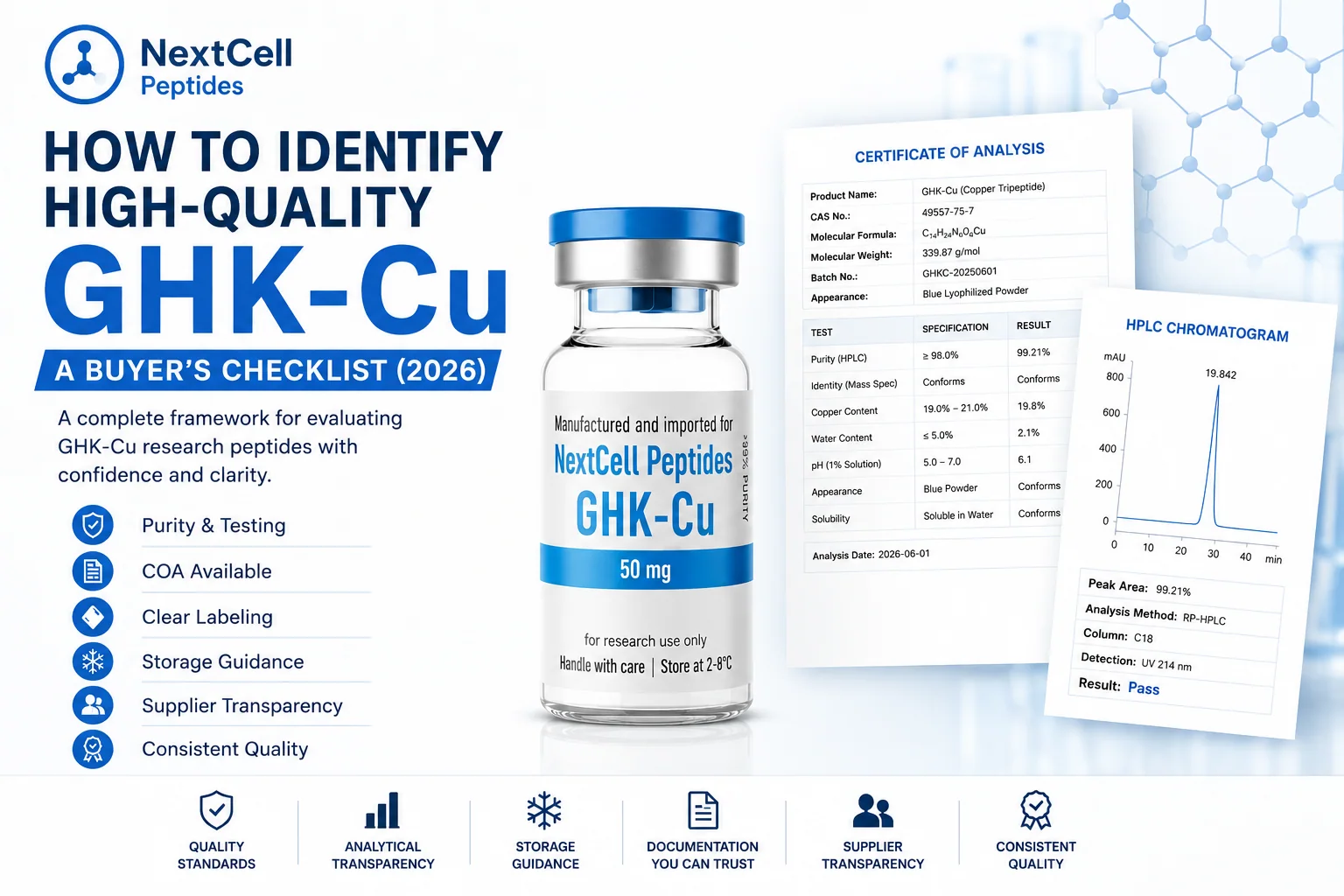
Introduction
As interest in GHK-Cu research peptides continues to grow, researchers are presented with an increasing number of suppliers offering products that often appear similar at first glance. Labels may display comparable purity percentages, identical peptide names, and professional packaging, making it difficult to determine which products truly meet high laboratory standards.
Experienced buyers rarely rely on a single specification when evaluating a research peptide. Instead, they assess a combination of factors, including analytical documentation, manufacturing transparency, storage recommendations, product labeling, supplier communication, and the overall quality of technical information provided.
This guide explains how to identify high-quality GHK-Cu using objective evaluation criteria rather than marketing claims. It is intended for researchers who want to compare suppliers systematically and better understand the documentation and quality indicators associated with laboratory research peptides.
Rather than recommending one supplier over another, this article provides a practical framework that can be applied consistently when evaluating any GHK-Cu research product.
Table of Contents
Why Product Quality Matters
Understanding GHK-Cu Quality
Essential Quality Indicators
How to Evaluate Analytical Documentation
Understanding Product Specifications
Storage and Packaging Quality
Supplier Transparency
Professional Buyer's Checklist
Common Mistakes When Comparing GHK-Cu
Frequently Asked Questions
Related Guides
Summary
Why Product Quality Matters
Research outcomes depend on consistent materials, accurate documentation, and transparent manufacturing practices. While GHK-Cu products from different suppliers may appear similar, meaningful differences often exist in the amount of technical information available before purchase.
Evaluating quality involves much more than comparing purity percentages. Comprehensive product specifications, analytical reports, clear storage guidance, and batch identification all contribute to a more complete understanding of a research peptide.
High-quality suppliers generally prioritize transparency by providing researchers with the information needed to evaluate products objectively rather than relying on promotional language.
What Does "High-Quality GHK-Cu" Actually Mean?
The phrase "high-quality GHK-Cu" is frequently used within the research peptide industry, yet it is rarely defined consistently.
From a laboratory perspective, quality should be evaluated using measurable criteria rather than subjective claims.
These criteria commonly include:
Clearly identified peptide sequence
Verified analytical purity
Reliable batch traceability
Comprehensive product specifications
Appropriate storage recommendations
Transparent laboratory documentation
Consistent product labeling
Professional manufacturing standards
No single characteristic determines overall quality. Instead, experienced researchers evaluate multiple indicators together to build confidence in a product before it enters the laboratory.
The First Things Experienced Buyers Check
Professional buyers often begin their evaluation long before reviewing laboratory reports.
Some of the earliest indicators of quality include:
Is the product information complete and technically accurate?
Are storage recommendations clearly explained?
Is the product label consistent with the published specifications?
Does the supplier explain technical terminology in understandable language?
Are analytical documents referenced where appropriate?
Is batch identification included?
Does the website prioritize education over marketing?
While none of these factors alone proves product quality, together they provide valuable insight into a supplier's attention to detail and commitment to transparency.
Expert Insight
One common misconception is that purity percentage alone determines product quality.
In reality, experienced researchers typically evaluate the entire purchasing experience—including documentation, analytical transparency, manufacturing consistency, packaging, storage information, and supplier communication—before forming an overall assessment.
A supplier that openly explains these areas often makes it easier for buyers to compare products objectively and understand the technical information supporting each research peptide.
Essential Quality Indicators
Identifying a high-quality GHK-Cu research peptide requires evaluating several objective quality indicators rather than relying on a single specification. While purity is often the first figure buyers notice, experienced researchers consider the complete package of documentation, analytical testing and supplier transparency.
The following indicators provide a structured framework for evaluating GHK-Cu products before purchase.
Product Specifications
Complete product specifications form the foundation of an objective product evaluation.
A professionally documented GHK-Cu product should clearly present:
Product name
Peptide sequence
Molecular weight
Quantity per vial
Appearance
Storage recommendations
Batch number
Research use statement
These specifications allow researchers to compare products consistently while reducing uncertainty regarding the material being supplied.
Incomplete or inconsistent specifications can make meaningful product comparisons considerably more difficult.
Product Labeling
The product label is often the first physical quality indicator a researcher encounters.
A professionally designed label should present clear technical information that matches the published product specifications.
Experienced buyers commonly verify:
Product name
Quantity
Batch number
Storage recommendations
Research Use Only statement
Manufacturer or supplier identification where appropriate
Consistency between the product label, technical documentation and online specifications demonstrates attention to detail throughout the quality process.
Analytical Documentation
Analytical documentation provides important technical evidence supporting product transparency.
Rather than simply stating a purity percentage, reputable suppliers often provide supporting information explaining how analytical testing has been performed.
Documentation may include:
Certificate of Analysis (COA)
HPLC chromatogram
Analytical purity
Batch identification
Laboratory testing information
The availability of supporting documentation helps researchers interpret reported specifications using objective laboratory data.
Understanding HPLC Testing
High-Performance Liquid Chromatography (HPLC) is one of the most widely used analytical techniques for evaluating research peptides.
During analysis, compounds within a sample are separated according to their chemical properties, producing a chromatogram that illustrates the distribution of individual components.
Researchers reviewing HPLC documentation commonly evaluate:
Peak separation
Peak symmetry
Overall chromatogram quality
Reported analytical purity
Batch consistency
While HPLC represents only one component of quality assessment, it provides valuable analytical information when interpreted alongside other supporting documentation.
Certificates of Analysis (COAs)
A Certificate of Analysis provides laboratory-generated information associated with a specific production batch.
Although formats vary between laboratories, comprehensive COAs commonly include:
Product identification
Batch number
Date of analysis
Analytical methods
Test results
Laboratory identification
One of the most important aspects of any COA is that the batch number corresponds to the batch identified on the product label.
This connection improves traceability and allows researchers to verify that analytical documentation relates to the correct product.
Expert Insight
Experienced researchers rarely evaluate individual quality indicators in isolation.
Instead, they compare product specifications, analytical documentation, HPLC reports, Certificates of Analysis, storage recommendations and supplier transparency together.
This broader evaluation framework provides a more balanced understanding of product quality than relying on purity percentages or promotional claims alone.
Key Takeaways
Complete product specifications support objective comparison.
Professional product labeling improves traceability and consistency.
HPLC testing provides valuable analytical information regarding purity.
Certificates of Analysis strengthen product transparency.
Batch identification connects products with laboratory documentation.
Multiple quality indicators should always be evaluated together rather than individually.
This section also creates several natural internal linking opportunities to your existing guides on HPLC, Certificates of Analysis (COAs), Peptide Purity, How Research Peptides Are Manufactured, and your GHK-Cu 50 mg product page without overlapping with the pillar guide.
How to Compare GHK-Cu Suppliers
Choosing a GHK-Cu research peptide involves more than comparing product names or reported purity values. Different suppliers may present similar technical specifications while varying considerably in the amount of information, documentation and educational resources they provide.
A structured comparison framework helps researchers evaluate products more consistently and reduces the likelihood of relying on incomplete information.
Rather than asking which supplier is "best," experienced buyers often ask which supplier provides the clearest, most transparent and most complete product information.
Product Information Quality
The quality of a product page often reflects the quality of the information available to researchers before purchase.
Well-prepared product pages typically provide:
Complete product specifications
Peptide sequence
Molecular weight
Storage recommendations
Batch information where appropriate
Research use statement
Professional product images
Comprehensive product information makes it easier to compare research peptides objectively and reduces uncertainty during the evaluation process.
Documentation Transparency
Documentation is one of the strongest indicators of supplier transparency.
Researchers should consider whether the supplier provides clear explanations of analytical documentation rather than simply mentioning laboratory testing.
Useful documentation commonly includes:
Product specifications
Certificate of Analysis (COA) where appropriate
HPLC information
Storage recommendations
Batch identification
Educational explanations of technical terminology
Transparent documentation helps buyers understand what information is available and why it matters.
Storage and Handling Information
Storage recommendations are sometimes overlooked during product comparisons, yet they form an important part of technical documentation.
Reliable suppliers clearly explain:
Recommended storage temperature
Storage before reconstitution
General handling recommendations
Packaging designed to protect product integrity during transport
Providing this information before purchase demonstrates attention to product handling throughout the supply process.
Educational Resources
One of the clearest differences between suppliers is the quality of their educational content.
Rather than relying solely on product descriptions, suppliers committed to transparency often provide detailed guides explaining:
Research peptide purity
HPLC analysis
Certificates of Analysis
Manufacturing processes
Storage recommendations
Product labeling
Educational resources help researchers interpret technical information independently and compare products using objective criteria.
A Practical Supplier Comparison Framework
When comparing GHK-Cu suppliers, consider the following questions:
Are the product specifications complete and consistent?
Is technical terminology clearly explained?
Are storage recommendations easy to find?
Is analytical documentation available where appropriate?
Are educational resources provided alongside the product?
Is batch traceability supported?
Does the supplier prioritize transparency over promotional language?
Looking at these questions together provides a more balanced assessment than focusing on a single specification such as purity or price.
See a Practical Example
The principles discussed throughout this guide can be seen in practice on our GHK-Cu 50 mg Research Peptide product page.
There you'll find complete product specifications, peptide sequence, molecular weight, storage recommendations and professionally presented technical information that reflects the objective evaluation criteria covered in this guide.
Rather than relying on marketing language, the page is designed to help researchers review product information, documentation and quality indicators before making a purchasing decision.
Expert Insight
Experienced buyers rarely identify high-quality research peptides by looking for a single "perfect" specification. Instead, they build confidence by evaluating how consistently a supplier presents technical information across product pages, documentation, labeling and educational resources.
This documentation-first approach supports more informed comparisons and is often a stronger indicator of professionalism than any individual analytical value presented in isolation.
Professional Buyer's Checklist
Before purchasing a GHK-Cu research peptide, experienced buyers often review several quality indicators rather than relying on a single specification.
The following checklist provides a structured framework for evaluating products objectively.
Product Information
Is the product name clearly identified?
Are the peptide sequence and molecular weight provided?
Is the quantity per vial clearly stated?
Are product specifications complete and consistent?
Analytical Documentation
Is a Certificate of Analysis (COA) available where appropriate?
Does the supplier explain HPLC testing?
Can analytical documentation be linked to the correct batch?
Is technical information presented clearly?
Storage & Handling
Are storage recommendations easy to find?
Are handling instructions provided before purchase?
Is the product supplied as a lyophilized powder?
Does the packaging appear suitable for laboratory storage?
Supplier Transparency
Does the supplier explain technical terminology?
Are educational resources available?
Is the website focused on information rather than promotional claims?
Is documentation presented consistently across products?
Using this checklist allows researchers to compare GHK-Cu products using objective quality indicators rather than assumptions or marketing language.
Common Mistakes When Evaluating GHK-Cu
Even experienced buyers sometimes focus on a single specification while overlooking the broader quality picture.
Some of the most common mistakes include:
Assuming identical purity percentages indicate identical products.
Comparing products based only on price.
Ignoring Certificates of Analysis and supporting documentation.
Overlooking storage recommendations.
Failing to verify batch traceability.
Relying on promotional language instead of technical information.
Comparing suppliers without reviewing educational resources.
A structured evaluation process helps reduce these mistakes and supports more informed purchasing decisions.
Frequently Asked Questions
What should I look for when comparing GHK-Cu products?
Focus on complete product specifications, analytical documentation, storage recommendations, batch traceability and supplier transparency rather than a single specification.
Does a higher purity percentage always indicate a better product?
No. Purity is an important analytical measurement, but it represents only one aspect of product evaluation. Documentation, manufacturing consistency and traceability should also be considered.
Why are Certificates of Analysis important?
Certificates of Analysis help researchers review laboratory-generated information associated with a specific production batch, improving transparency and supporting objective product evaluation.
Is product labeling important?
Yes. Clear and consistent labeling improves product identification, supports traceability and helps researchers verify that product information matches the associated documentation.
How can I compare suppliers objectively?
Rather than relying on marketing claims, compare suppliers using standardized criteria such as documentation quality, analytical transparency, storage guidance, educational resources and consistency across product information.
Continue Your Research
If you would like to explore the topics discussed throughout this guide in greater detail, the following resources may also be helpful:
These guides expand on the technical concepts covered in this article and provide additional context for evaluating research peptides using objective quality indicators.
Explore Our GHK-Cu Research Peptide
To see these quality indicators presented in practice, explore our GHK-Cu 50 mg Research Peptide product page.
It includes comprehensive product specifications, peptide sequence, molecular weight, storage recommendations and professionally presented technical information designed to help researchers evaluate products with confidence.
Whether you're reviewing documentation or comparing suppliers, the product page provides a practical example of the evaluation principles discussed throughout this guide.
Summary
Identifying a high-quality GHK-Cu research peptide requires a structured evaluation process built on transparency, documentation and consistency. While purity remains an important analytical measurement, it should always be considered alongside product specifications, Certificates of Analysis, HPLC testing, batch traceability and storage recommendations.
By reviewing multiple quality indicators together, researchers can compare products more objectively and make informed purchasing decisions based on technical information rather than marketing claims.
This documentation-first approach supports greater confidence throughout the evaluation process and provides a stronger foundation for selecting research peptides suitable for laboratory applications.