
Research
HPLC Peptide Purity Testing for Research Buyers
Understand HPLC peptide purity testing, how chromatograms and COAs are read, and what batch documentation tells research peptide buyers about quality per batch.
FutureCell Research Team · 7 min read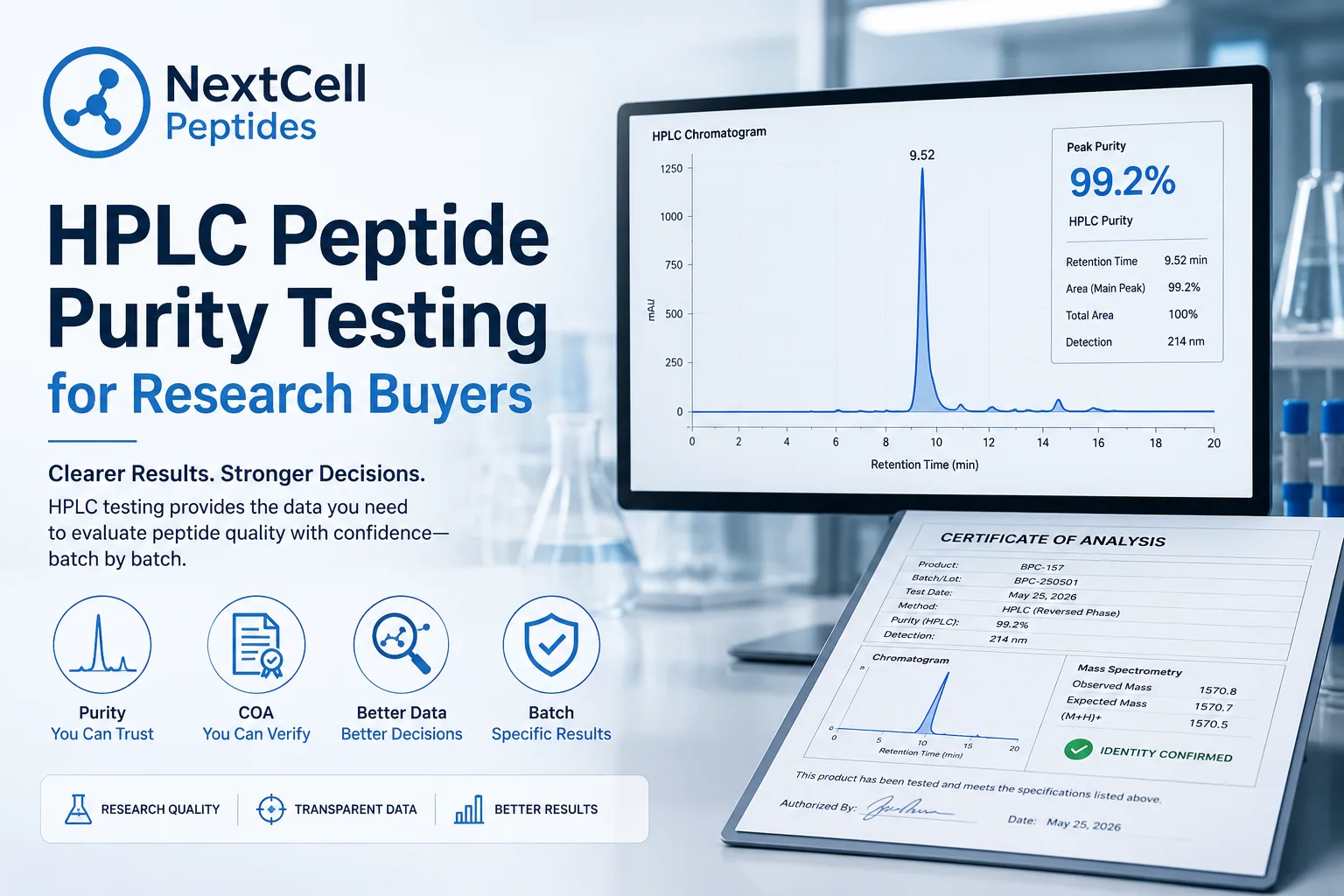
A peptide label stating “99% purity” is only useful when the number can be traced to a defined analytical method, a specific batch, and supporting documentation. For research buyers, HPLC peptide purity testing is one of the clearest ways to assess whether a product has been evaluated beyond its packaging. It is also frequently misunderstood: a high HPLC purity result is meaningful evidence of chemical cleanliness, but it is not a complete identity or quantity assessment on its own.
The practical question is not simply whether a supplier displays a purity percentage. It is whether the reported result is credible, batch-relevant, and presented alongside the details needed to interpret it.
What HPLC peptide purity testing measures
High-performance liquid chromatography, usually shortened to HPLC, separates components in a sample as they move through a column under controlled solvent conditions. A detector records the compounds as peaks over time, producing a chromatogram. For peptides, reversed-phase HPLC is commonly used because it separates peptide-related components according to their interactions with the column and mobile phase.
The largest peak is generally assigned to the target peptide. Smaller peaks can indicate related impurities, such as incomplete synthesis sequences, deletion sequences, oxidation products, residual protecting-group derivatives, or other byproducts. Purity is often reported as the main peak area divided by the total integrated peak area, expressed as a percentage.
If the main peak represents 99% of the integrated chromatographic area, the material is commonly described as 99% HPLC pure under that method. This gives a useful, accessible indicator of the sample’s chromatographic profile. It does not mean that every possible impurity has been identified, nor does it independently prove the target peptide’s sequence, molecular weight, or vial content.
That distinction matters when comparing research peptides such as BPC-157, GHK-Cu, TB-500, Semax, Epitalon, or multi-component products. Different peptide sequences, modifications, and formulations can behave differently during separation and detection. A meaningful result should therefore be tied to the specific material tested, rather than treated as a generic claim applied across an entire catalog.
How to read an HPLC chromatogram
A chromatogram plots detector response on the vertical axis against retention time on the horizontal axis. Retention time is the point at which a compound reaches the detector under the stated method. It can help characterize a sample, but it is not a universal identifier. A change in column type, solvent gradient, flow rate, temperature, or instrument setup may shift retention time.
When reviewing a chromatogram, start with the main peak. It should be clearly integrated and visually distinguishable from nearby peaks. A clean profile often shows one dominant peak with limited minor signals. However, appearances can mislead. A broad or asymmetric peak may result from the sample, the method, the column condition, or injection settings. A narrow, attractive peak does not by itself establish purity either.
The most helpful chromatogram includes readable axes, a stated detection wavelength, retention time, and peak-area data. If only a cropped image and a purity percentage are shown, the reader has less context for judging the result. Full method validation data are not always available for research-grade catalog products, but the analytical report should still be sufficiently clear to connect the displayed trace with the reported batch.
Peak area is not the same as mass percentage
HPLC purity is often calculated by UV peak area. This is convenient and widely used, but compounds do not always absorb UV light equally at the selected wavelength. As a result, area percentage is best understood as chromatographic purity under the reported detection conditions, not automatically as exact weight-for-weight composition.
This is not a reason to dismiss HPLC. It is a reason to interpret it correctly. For standard research peptide purchasing, HPLC offers a valuable view of major peptide-related impurities and batch consistency. Where a project requires higher analytical certainty, buyers may look for complementary methods and more detailed release documentation.
Why HPLC should be paired with identity testing
HPLC separates components. It does not, by itself, confirm that the dominant peak has the expected molecular mass. Mass spectrometry is commonly used as a complementary identity tool because it measures mass-to-charge signals consistent with the expected peptide molecular weight.
The strongest routine documentation usually combines an HPLC purity result with mass spectrometry confirmation. HPLC addresses the question, “How clean is this chromatographic profile?” Mass spectrometry addresses, “Is the observed material consistent with the expected molecular mass?” Neither result should be stretched beyond what it shows, but together they provide a more useful quality picture.
For complex or modified materials, additional testing may be relevant depending on the product and intended research setting. Examples include peptide content assays, residual solvent analysis, moisture measurement, counterion determination, endotoxin testing, or microbiological testing. These are separate quality attributes. A product can have high HPLC purity while still requiring other specifications to be evaluated for a particular research workflow.
What a useful Certificate of Analysis should show
A Certificate of Analysis, or COA, turns an analytical claim into a document that can be reviewed. The most useful COA is specific enough to establish a traceable link between the vial or product listing and the tested lot.
At minimum, look for a product name, batch or lot number, test date or report date, stated purity result, and the testing method. The document should identify the sample in a way that matches the product being considered. A generic certificate with no batch reference offers much less assurance than a batch-specific document.
For HPLC data, useful details may include the chromatogram, detection wavelength, retention time, and integration results. For identity testing, the COA may show an expected mass, observed mass, and method designation. The lab name, analyst approval, or report authorization can add further traceability, although document layouts vary between laboratories.
A COA is not valuable merely because the acronym appears on a product page. It should answer practical questions: What was tested? Which batch was tested? What method was used? What result was obtained? Can the documentation be reasonably matched to the product being supplied?
HPLC peptide purity testing and batch consistency
Batch testing matters because peptide synthesis is a multi-step process. Even when the same sequence and manufacturing approach are used, impurity profiles can vary from batch to batch. A result from a previous production run is informative at best; it is not a substitute for evidence tied to the current material.
This is especially relevant for buyers comparing research peptide suppliers online. Product photos, a stated purity threshold, and professionally designed labels can help organize information, but they do not replace batch documentation. A supplier that presents clear product specifications and COAs makes it easier to evaluate quality before purchase and to maintain records after delivery.
For private research buyers, the right level of scrutiny depends on the project. A preliminary comparison may begin with a published HPLC purity percentage and available COA. More sensitive analytical work may require confirmation of the exact batch, a fuller chromatogram, independent third-party test documentation, or additional specifications. There is no single document that answers every quality question.
Questions to ask before relying on a purity claim
When evaluating a research peptide, use the claimed purity as the start of the review, not the finish. Check whether the value is expressed as HPLC purity and whether a chromatogram or batch COA supports it. Confirm that the lot number on the document aligns with the supplied product. Then determine whether identity has been assessed through mass spectrometry or another appropriate technique.
It is also sensible to distinguish purity from net peptide content. A lyophilized vial may contain a specified amount of material, while HPLC purity describes the relative chromatographic composition of that material. These figures answer different questions and should not be treated as interchangeable.
FutureCell Peptides emphasizes transparent product specifications, Certificates of Analysis, and independent testing where applicable so customers can compare research materials with greater confidence. For EU buyers, clear documentation also supports a more straightforward purchasing process: the product can be assessed on its stated analytical evidence rather than on broad quality language alone.
A well-presented HPLC result will not eliminate every research decision, but it gives that decision a firmer foundation. Prioritize batch-linked evidence, read the chromatogram in context, and treat purity as one essential part of a complete quality assessment.