Guides
Semax: The Complete Research Peptide Buyer's Guide (2026)
Discover everything research buyers should know about Semax, including peptide structure, manufacturing, HPLC purity testing, Certificates of Analysis (COAs), storage, supplier transparency, and laboratory documentation.
FutureCell Research Team · 25 min read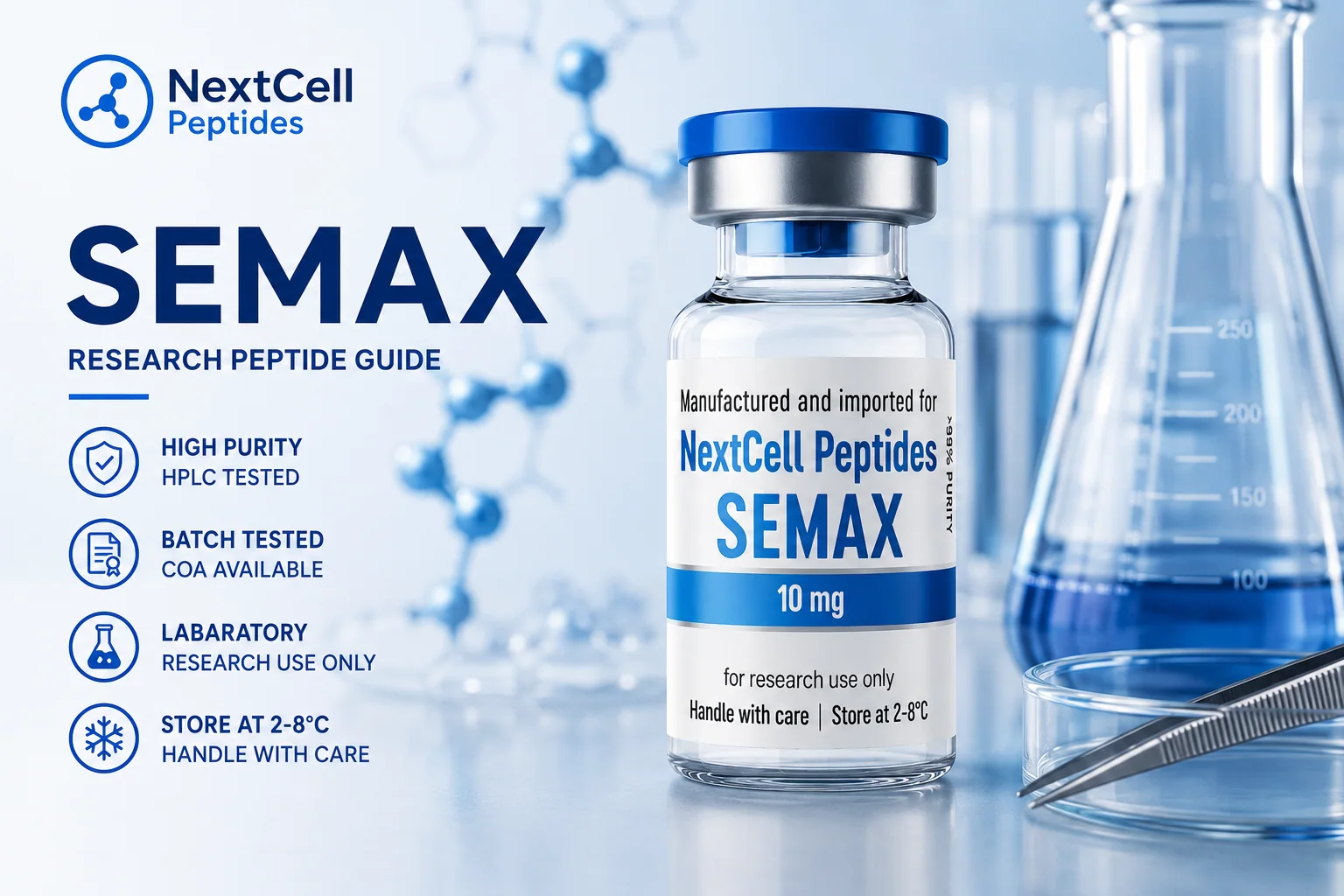
Introduction
Semax has become one of the most widely recognized research peptides in laboratory neuroscience and peptide research. Originally developed as a synthetic peptide derived from a fragment of adrenocorticotropic hormone (ACTH), Semax is primarily investigated in preclinical and experimental settings because of its unique peptide structure and stability as a lyophilized compound.
As interest in research peptides continues to grow, buyers are presented with an increasing number of suppliers offering products that appear similar on the surface. Labels often advertise high purity percentages, laboratory testing, and Certificates of Analysis (COAs), yet the underlying manufacturing standards, analytical documentation, and batch traceability can differ considerably.
Understanding these differences is essential when evaluating any research peptide. A product label alone cannot confirm identity, purity, manufacturing quality, or analytical verification. Instead, experienced buyers assess the complete quality framework surrounding a product, including manufacturing practices, independent laboratory testing, documentation, storage recommendations, and supplier transparency.
This guide provides a comprehensive educational overview of Semax for research purposes. Rather than focusing on marketing claims, it explains the scientific concepts, quality indicators, and documentation that researchers and informed buyers use when evaluating research-grade peptides. Throughout the guide, you'll also learn how to interpret analytical documentation, compare suppliers objectively, and identify the characteristics commonly associated with high-quality research products.
Readers interested in reviewing product specifications alongside this educational guide can also explore the Semax product page.
Table of Contents
What Is Semax?
Peptide Structure and Characteristics
How Semax Is Manufactured
Why Lyophilization Matters
How Semax Quality Is Verified
Understanding HPLC Purity Testing
Certificates of Analysis (COAs)
Batch Identification and Traceability
Storage and Stability
Choosing a High-Quality Semax Supplier
Frequently Asked Questions
Related Research Guides
Summary
What Is Semax?
Semax is a synthetic peptide originally developed from a modified fragment of adrenocorticotropic hormone (ACTH). Unlike the full ACTH molecule, Semax consists of a shorter amino acid sequence that has been specifically designed for laboratory investigation and biochemical research.
Today, Semax is commonly supplied as a lyophilized peptide, a freeze-dried format that helps preserve molecular stability during storage and transport before laboratory reconstitution. Lyophilization is widely used throughout peptide manufacturing because it reduces degradation caused by moisture while extending product shelf life under appropriate storage conditions.
Like all research peptides, the quality of Semax is determined by considerably more than the name printed on the vial. Factors such as manufacturing consistency, analytical testing, purity verification, batch traceability, and supplier transparency all contribute to the overall quality profile of a research product.
For this reason, experienced buyers evaluate the supporting documentation surrounding a peptide—not simply the advertised purity percentage. Reliable suppliers typically provide clear analytical records, batch identification, and transparent quality documentation that allow each batch to be independently assessed.
Peptide Structure and Characteristics
Semax belongs to the family of synthetic research peptides and consists of a defined sequence of amino acids produced using solid-phase peptide synthesis (SPPS). This manufacturing technique enables precise assembly of peptide chains while maintaining a high level of consistency between production batches.
After synthesis, the crude peptide undergoes purification to remove incomplete peptide fragments, synthesis by-products, and other impurities. Purification is commonly performed using high-performance liquid chromatography (HPLC), one of the most widely accepted analytical techniques in peptide manufacturing.
Because peptide quality depends on both manufacturing precision and analytical verification, reputable suppliers typically combine purification with additional identity testing and documented quality control before a product is released for research use.
How Semax Is Manufactured
The manufacturing of research-grade Semax follows a structured quality process designed to maximize consistency and reproducibility.
The process generally includes:
Solid-phase peptide synthesis (SPPS)
Cleavage and deprotection
Purification using HPLC
Identity verification
Sterile filling into laboratory vials
Batch documentation and quality review
Each stage contributes to the final quality of the finished peptide. Even when two products claim identical purity percentages, differences in manufacturing standards, quality control procedures, and documentation can influence overall product consistency.
Buyers should therefore consider the entire manufacturing process rather than relying solely on purity claims printed on product labels.
Why Lyophilization Matters
Most research peptides are supplied as lyophilized powder rather than as pre-mixed solutions. During lyophilization, water is removed under carefully controlled freezing and vacuum conditions, helping preserve peptide stability throughout storage and transportation.
The lyophilized format offers several advantages for laboratory research:
Improved long-term stability
Reduced moisture exposure
Easier transportation
Greater flexibility before laboratory preparation
Proper storage remains important even after freeze-drying. Temperature fluctuations, excessive humidity, and repeated exposure to unsuitable environmental conditions may reduce long-term stability.
How Semax Quality Is Verified
The quality of a research peptide extends far beyond the name printed on the vial. While Semax products from different suppliers may appear similar, the methods used to manufacture, test, document, and verify each batch can vary considerably. For this reason, experienced researchers typically evaluate the complete quality assurance process rather than relying solely on marketing claims.
Quality verification begins during manufacturing and continues through analytical testing, documentation, packaging, and final batch release. Each stage is designed to confirm that the finished peptide meets predefined quality standards before it becomes available for laboratory research.
Reliable suppliers generally support their products with transparent documentation rather than broad claims of purity or quality. This documentation allows researchers to review how a specific production batch has been evaluated and provides greater confidence in the consistency of the final product.
When comparing Semax products, buyers should consider analytical evidence as one component of a broader quality assessment that also includes manufacturing consistency, batch traceability, storage recommendations, and supplier transparency.
Understanding HPLC Purity Testing
One of the most widely used analytical techniques in peptide manufacturing is High-Performance Liquid Chromatography (HPLC). HPLC is used to evaluate the purity of a peptide sample by separating its individual components and measuring the proportion that corresponds to the target peptide.
For research peptides such as Semax, HPLC testing provides valuable information about the manufacturing process and the effectiveness of purification. A chromatogram generated during HPLC analysis allows researchers to assess whether the sample primarily contains the intended peptide or whether additional impurities are present.
Although purity is an important quality indicator, it should not be interpreted in isolation. A reported purity percentage does not independently confirm peptide identity, manufacturing quality, sterility, or long-term stability. Instead, HPLC results should be reviewed alongside other analytical documentation to obtain a more complete understanding of product quality.
Reputable suppliers commonly provide batch-specific HPLC reports that correspond to the product being supplied. These reports contribute to transparency and allow researchers to evaluate quality using documented analytical data rather than relying solely on product descriptions.
Certificates of Analysis (COAs)
A Certificate of Analysis (COA) is one of the most valuable documents accompanying a research peptide. Rather than serving as a marketing document, a COA summarizes analytical information relating to a specific production batch and provides researchers with documented quality information before a product is used in laboratory studies.
Although formats differ between manufacturers and analytical laboratories, a comprehensive COA commonly includes information such as batch identification, analytical methods, purity results, testing dates, and product identification. Some suppliers may also include additional analytical information depending on their quality control procedures.
When reviewing a COA, researchers should ensure that the documentation corresponds to the batch number printed on the product label. Batch-specific documentation provides significantly greater confidence than generic certificates that are reused across multiple production batches.
A transparent supplier should make Certificates of Analysis readily available and clearly explain what the reported analytical data represents. Providing documentation without context is often less helpful than explaining how the results relate to overall product quality.
Batch Identification and Traceability
Batch identification is an important component of quality assurance for research peptides. Every production batch should be assigned a unique batch or lot number that allows analytical documentation to be linked directly to the corresponding product.
Traceability helps researchers confirm that Certificates of Analysis (COAs), HPLC reports, and other quality documentation relate to the specific batch they have received rather than to a different manufacturing run. This process improves transparency and supports consistent record-keeping within laboratory environments.
Batch identification also allows manufacturers to maintain internal quality control records throughout production, packaging, and distribution. While researchers may never need to reference these records directly, knowing that a product can be traced back to a specific manufacturing batch demonstrates a structured approach to quality management.
When evaluating Semax suppliers, buyers should consider batch traceability alongside analytical testing, manufacturing standards, and supporting documentation. Together, these factors provide a more complete picture of research-grade quality than any single quality indicator viewed in isolation.
Storage and Stability
Proper storage plays an important role in preserving the quality and stability of research peptides. Although Semax is commonly supplied as a lyophilized peptide to improve long-term stability, storage conditions before laboratory use can still influence the integrity of the product over time.
Reputable manufacturers provide clear storage recommendations based on the peptide's physical form and intended laboratory handling. Following these recommendations helps reduce unnecessary exposure to heat, moisture, and environmental conditions that may affect peptide stability.
It is also important to distinguish between storage recommendations for lyophilized and reconstituted peptides. Once a peptide has been prepared for laboratory use, storage requirements may differ from those of the original freeze-dried product.
Researchers should always follow the guidance provided by the manufacturer and review any accompanying laboratory documentation before storing or handling a research peptide.
Choosing a High-Quality Semax Supplier
Selecting a Semax supplier involves considerably more than comparing prices or advertised purity percentages. Experienced researchers typically evaluate the supplier's commitment to transparency, documentation, and quality assurance before making a purchasing decision.
A reputable supplier should provide batch-specific analytical documentation rather than relying solely on marketing claims. Information such as Certificates of Analysis (COAs), HPLC reports, batch numbers, and storage recommendations allows researchers to independently review the quality information associated with each product.
It is also worth considering how openly a supplier communicates its manufacturing processes, quality control procedures, and analytical testing methods. Companies that invest in educational resources and transparent documentation often provide researchers with greater confidence than suppliers offering only limited product descriptions.
When comparing Semax suppliers, buyers may wish to ask the following questions:
Is a batch-specific Certificate of Analysis available?
Has HPLC purity testing been performed?
Is the batch number clearly displayed on both the product and documentation?
Are storage recommendations clearly explained?
Does the supplier provide educational information about manufacturing and quality control?
Is documentation readily available before purchase?
Taking a structured approach to supplier evaluation helps reduce uncertainty and allows researchers to compare products using objective quality indicators rather than marketing language.
Frequently Asked Questions
What is Semax?
Semax is a synthetic research peptide derived from a modified fragment of adrenocorticotropic hormone (ACTH). It is supplied for laboratory research and should be evaluated using appropriate analytical documentation and quality standards.
Is Semax supplied as a lyophilized peptide?
Most research-grade Semax products are supplied as lyophilized powder to improve stability during storage and transportation before laboratory preparation.
Why is HPLC testing important?
HPLC testing helps evaluate peptide purity and provides researchers with analytical information relating to the composition of a specific production batch.
What is a Certificate of Analysis (COA)?
A Certificate of Analysis is a laboratory document summarizing analytical information associated with a specific production batch, including purity testing and batch identification.
How should Semax be stored?
Researchers should always follow the manufacturer's storage recommendations and any guidance provided within the accompanying documentation.
How can researchers compare Semax suppliers?
Supplier evaluation should include analytical documentation, manufacturing transparency, batch traceability, storage guidance, and overall quality assurance rather than relying solely on price or advertised purity.
Does a higher purity percentage always indicate a better product?
Not necessarily. Purity is only one aspect of product quality and should always be considered alongside manufacturing standards, documentation, analytical testing, and supplier transparency.
Why is batch traceability important?
Batch traceability allows researchers to verify that analytical documentation corresponds to the specific product they have received, improving transparency and quality assurance.
Related Research Guides
Continue exploring our educational resources:
Research Peptides Explained
How Research Peptides Are Manufactured
What Is Peptide Purity?
Understanding Certificates of Analysis (COAs)
How to Read an HPLC Chromatogram
How to Choose a High-Quality Research Peptide Supplier
How to Store Lyophilized Peptides
Semax Product Page
Summary
Semax is a well-established research peptide that should be evaluated using objective quality indicators rather than marketing claims alone. Manufacturing consistency, analytical testing, Certificates of Analysis (COAs), batch traceability, storage recommendations, and supplier transparency all contribute to understanding the overall quality of a research product.
By reviewing batch-specific documentation and comparing suppliers using consistent quality criteria, researchers can make more informed decisions based on evidence rather than assumptions. Whether purchasing Semax for the first time or comparing multiple suppliers, taking a structured approach to product evaluation helps support confidence in laboratory research.
Researchers interested in learning more can explore the Semax product page together with the educational guides referenced throughout this article.