
Guides
TB-500 5 mg vs 10 mg: A Complete Buyer's Guide (2026)
Learn the key differences between TB-500 5 mg and 10 mg, how to evaluate product quality, understand HPLC testing, COAs, supplier transparency, and choose the right vial for your research needs.
FutureCell Research Team · 10 min read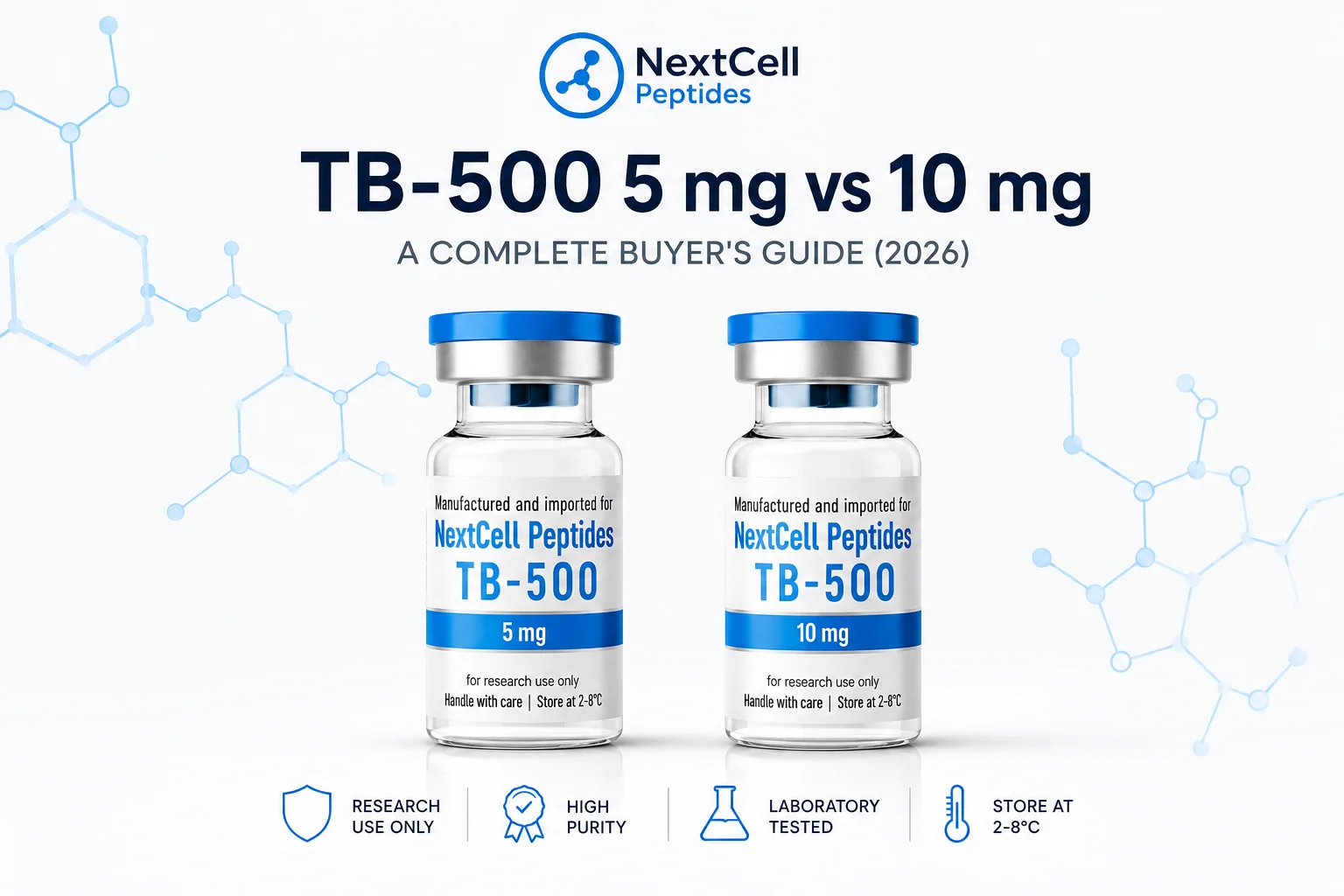
Introduction
Choosing between TB-500 5 mg and TB-500 10 mg is one of the most common questions among researchers comparing research peptide products. While both contain the same synthetic peptide, the difference in peptide quantity can influence laboratory planning, purchasing decisions, documentation management, and overall value.
Many first-time buyers assume that a higher milligram amount means a stronger or higher-quality product. In reality, the milligram value refers only to the amount of lyophilized peptide contained within the vial. It does not indicate a different peptide sequence, greater purity, or superior manufacturing standards. A properly manufactured 5 mg vial and a 10 mg vial should meet the same quality expectations, differing only in the quantity of peptide provided.
Understanding this distinction is important when comparing suppliers. The amount of peptide is only one aspect of product evaluation. Factors such as analytical testing, batch consistency, manufacturing transparency, storage recommendations, and supporting documentation often provide a much clearer picture of overall product quality than vial size alone.
This guide explains the key differences between TB-500 5 mg and 10 mg, explores when each option may be appropriate for different research requirements, and highlights the quality indicators experienced buyers commonly evaluate before purchasing a research peptide. Rather than focusing on marketing claims, the goal is to provide practical, evidence-based information that helps readers make well-informed decisions.
Research Use Only: TB-500 products discussed throughout this guide are intended exclusively for laboratory and scientific research. They are not approved for human consumption, therapeutic use, or the diagnosis, treatment, cure, or prevention of disease.
Table of Contents
What Is TB-500?
What's the Difference Between TB-500 5 mg and 10 mg?
When Does a 5 mg Vial Make Sense?
When Is a 10 mg Vial the Better Choice?
Cost per Milligram: Which Offers Better Value?
Beyond Milligrams: What Matters More Than Vial Size?
How to Compare TB-500 Suppliers
Common Buying Mistakes
Frequently Asked Questions
Related Research Guides
Summary
What Is TB-500?
TB-500 is a synthetic research peptide derived from an active region of Thymosin Beta-4 (TB4), a naturally occurring protein found in many mammalian tissues. Rather than being the complete protein, TB-500 is a shorter synthetic peptide developed for laboratory research, where its stability and handling characteristics have made it widely used in experimental settings.
Although the names TB-500 and Thymosin Beta-4 are often used interchangeably online, they are not identical. Thymosin Beta-4 is a naturally occurring protein composed of 43 amino acids, whereas TB-500 is a synthetic peptide designed to represent one of its biologically active regions. Understanding this distinction helps researchers interpret scientific literature more accurately and compare products from different suppliers with greater confidence.
Most reputable manufacturers supply TB-500 as a lyophilized peptide. Lyophilization, commonly referred to as freeze-drying, is a preservation process that removes water under controlled conditions, helping maintain peptide stability during transport and storage. The resulting powder remains stable when stored according to the manufacturer's recommendations until it is prepared for laboratory use.
When comparing TB-500 products, the amount of peptide contained within the vial should not be the only consideration. Experienced researchers often place greater emphasis on factors such as independent analytical testing, Certificates of Analysis (COAs), High-Performance Liquid Chromatography (HPLC) purity testing, batch traceability, manufacturing consistency, and supplier transparency. These quality indicators provide a more comprehensive understanding of a product than the milligram amount printed on the label alone.
Once these fundamentals are understood, comparing TB-500 5 mg and 10 mg becomes much more straightforward, as the primary distinction between the two products is simply the quantity of peptide supplied rather than differences in composition or manufacturing quality.
What's the Difference Between TB-500 5 mg and 10 mg?
At first glance, the difference between TB-500 5 mg and TB-500 10mg appears straightforward: one vial contains 5 milligrams of lyophilized peptide, while the other contains 10 milligrams. However, many buyers mistakenly assume that a higher milligram amount indicates a stronger, purer, or more effective product. In reality, this is not the case.
Both products should contain the same synthetic TB-500 peptide with an identical amino acid sequence. Assuming they are manufactured to the same quality standards, there should be no difference in molecular structure, purity, or intended laboratory application. The only distinction is the quantity of peptide contained within each vial.
This is similar to purchasing two bottles of the same laboratory reagent in different sizes. The larger bottle does not contain a different or superior product—it simply contains more of it. The same principle applies when comparing TB-500 5 mg and 10 mg.
For researchers, the choice between vial sizes often comes down to practical considerations rather than differences in quality. These may include the scale of the research project, expected peptide requirements, purchasing frequency, storage logistics, and overall cost efficiency.
It is also important to understand that peptide quality cannot be determined by the milligram amount displayed on the label. A high-quality 5 mg vial from a reputable supplier is generally preferable to a poorly manufactured 10 mg vial lacking proper analytical documentation. Independent quality verification should always take priority over quantity alone.
When comparing suppliers, experienced buyers often evaluate factors such as:
Whether a Certificate of Analysis (COA) is available for the specific batch.
Whether HPLC purity testing has been performed and documented.
Whether each vial includes a traceable batch or lot number.
Whether storage recommendations are clearly provided.
Whether the supplier demonstrates transparency regarding manufacturing and quality control.
These factors provide far more meaningful insight into product quality than the amount of peptide contained within the vial.
When Does a 5 mg Vial Make Sense?
Although larger vials often receive more attention, a TB-500 5 mg vial can be an entirely appropriate choice depending on the goals of a laboratory project. Selecting a smaller quantity is not an indication of lower quality—it is simply a matter of choosing the amount of peptide that best matches the intended research requirements.
A 5 mg vial may be suitable for researchers conducting preliminary investigations, proof-of-concept studies, or smaller laboratory projects where only a limited quantity of peptide is required. Purchasing smaller quantities may also help reduce unnecessary material waste when research protocols are still being developed or optimized.
Some researchers also prefer smaller vials when evaluating a new supplier for the first time. Before committing to larger purchases, they may wish to review product documentation, inspect packaging quality, verify analytical reports, and assess overall supplier transparency. In these situations, the decision is based on procurement strategy rather than the peptide itself.
From a storage perspective, smaller quantities can also simplify inventory management for laboratories that use multiple research peptides simultaneously. Instead of storing larger amounts of a single peptide, researchers may choose to maintain smaller inventories across several different compounds.
Ultimately, the decision should be guided by the specific needs of the research project rather than the assumption that a larger vial is automatically the better option.
When Is a 10 mg Vial the Better Choice?
A TB-500 10 mg vial contains twice the amount of peptide found in a 5 mg vial while maintaining the same peptide sequence and, when produced correctly, the same manufacturing standards. The larger quantity may therefore be a practical option for laboratories with ongoing research projects or higher peptide requirements.
One reason researchers choose larger vials is purchasing efficiency. Depending on supplier pricing, a 10 mg product may offer a lower cost per milligram than purchasing two separate 5 mg vials. While pricing varies between suppliers, evaluating value based on cost per milligram rather than the total purchase price often provides a more meaningful comparison.
Using fewer vials may also simplify inventory management, documentation, and batch tracking within laboratory environments. Managing one larger vial instead of multiple smaller ones can reduce packaging waste and make record-keeping more straightforward, particularly for laboratories operating standardized research workflows.
However, a larger vial should never be selected solely because it appears to offer better value. Before considering quantity, researchers should first confirm that the supplier provides appropriate analytical documentation, transparent manufacturing information, batch traceability, and clearly communicated storage recommendations.
For many experienced buyers, the question is not whether a vial contains 5 mg or 10 mg, but whether the supplier demonstrates consistent quality standards across every batch produced. Once those quality standards have been verified, choosing between the two sizes becomes primarily a matter of convenience, project requirements, and purchasing efficiency.
Cost per Milligram: Which Offers Better Value?
When comparing TB-500 5 mg and 10 mg products, many buyers focus on the total purchase price. While this is understandable, experienced researchers often evaluate value using a different metric: cost per milligram.
Calculating the price per milligram provides a more meaningful comparison because it reflects the amount of peptide received rather than the price of the vial itself. Two products may appear similarly priced at first glance, yet offer noticeably different value depending on the amount of peptide they contain.
However, cost should never be evaluated in isolation. A lower price per milligram does not automatically represent the better purchase if the supplier cannot demonstrate consistent manufacturing standards or provide appropriate analytical documentation. Saving money on a research peptide may ultimately offer little value if the product lacks transparency or quality verification.
Instead, buyers should view price as only one part of a broader evaluation process. Before comparing cost, it is worth confirming that the supplier provides clear evidence of product quality and batch consistency. Once these fundamentals have been established, comparing the overall value of different vial sizes becomes much more meaningful.
For many laboratories, the best value is not necessarily the lowest-priced option, but the product that combines transparent quality documentation with a competitive cost per milligram.
Beyond Milligrams: What Matters More Than Vial Size?
The amount of peptide contained within a vial is often the first specification buyers notice, but it is rarely the most important one. Whether choosing a 5 mg or 10 mg product, the overall quality of the research peptide depends on a range of factors that extend far beyond the number printed on the label.
One of the first indicators of quality is the availability of a Certificate of Analysis (COA). A COA is a laboratory document that summarizes analytical testing performed on a specific production batch. While the exact contents may vary between manufacturers, reputable suppliers typically provide information relating to peptide identity, purity, batch identification, and testing methods. Access to batch-specific documentation demonstrates a commitment to transparency and allows researchers to verify that analytical testing has been performed.
Another important consideration is High-Performance Liquid Chromatography (HPLC) testing. HPLC is one of the most widely used analytical techniques for evaluating peptide purity and confirming manufacturing consistency. Although HPLC does not provide a complete assessment of every quality parameter, it remains one of the most valuable tools for verifying that a peptide has been manufactured according to expected standards.
Researchers should also consider batch traceability. Reliable suppliers assign batch or lot numbers to individual production runs, allowing analytical reports to be linked directly to the product being purchased. This level of traceability improves documentation and supports quality assurance throughout the supply chain.
Storage recommendations are another frequently overlooked factor. Because peptides are sensitive biological molecules, manufacturers should provide clear guidance regarding storage conditions before use. Proper storage helps preserve product stability and reflects a supplier's attention to handling procedures throughout manufacturing, packaging, and distribution.
Finally, supplier transparency plays a significant role in overall confidence. Companies that openly explain their manufacturing practices, quality control procedures, testing methods, and documentation standards generally provide researchers with more information to evaluate than suppliers relying primarily on marketing language.
Taken together, these quality indicators offer a far more comprehensive picture of a TB-500 product than vial size alone. Whether a vial contains 5 mg or 10 mg, transparency, documentation, analytical testing, and manufacturing consistency remain the characteristics that experienced buyers typically prioritize.
How to Compare TB-500 Suppliers
With a growing number of research peptide suppliers available online, comparing products can quickly become challenging. While pricing and vial size are often the most visible differences, experienced buyers usually adopt a broader evaluation process that focuses on documentation, consistency, and transparency.
A useful starting point is determining whether the supplier provides batch-specific analytical documentation rather than generic product descriptions. Independent testing, clearly identified batch numbers, and accessible Certificates of Analysis allow researchers to verify that quality control procedures have been performed for the specific product being purchased.
It is also worth evaluating how openly a supplier explains its quality standards. Reputable companies typically describe their analytical testing procedures, storage recommendations, packaging methods, and manufacturing controls in a clear and consistent manner. Rather than relying on promotional language, they allow documentation to demonstrate product quality.
Website quality can also provide useful insight. Well-organized educational resources, detailed product information, clearly written storage guidance, and transparent answers to frequently asked questions often reflect a stronger commitment to supporting researchers beyond the initial purchase.
When comparing multiple suppliers, asking a few simple questions can help simplify the decision-making process:
Is batch-specific documentation available?
Does the supplier provide HPLC analytical reports or Certificates of Analysis?
Are storage recommendations clearly explained?
Is manufacturing and quality control information transparent?
Can the product be traced to an identifiable production batch?
Does the supplier prioritize education rather than relying solely on marketing claims?
No single factor determines product quality on its own. Instead, confidence is built through the combination of transparent documentation, analytical verification, consistent manufacturing practices, and clear communication. These qualities often provide a much stronger basis for comparison than vial size or price alone.
Common Buying Mistakes
Choosing between TB-500 5 mg and 10 mg may appear straightforward, but several common misconceptions can make the decision more confusing than it needs to be. Understanding these mistakes can help researchers evaluate products more objectively and place greater emphasis on the factors that genuinely influence product quality.
One of the most frequent misunderstandings is assuming that a 10 mg vial is inherently stronger than a 5 mg vial. The milligram value refers only to the quantity of peptide contained within the vial. Assuming both products are manufactured to the same standards, there should be no difference in peptide sequence, purity, or overall quality.
Another common mistake is focusing exclusively on price. While comparing costs is sensible, choosing the lowest-priced product without considering documentation, analytical testing, or supplier transparency may increase uncertainty regarding product quality. A slightly higher-priced product accompanied by comprehensive analytical reports and batch-specific documentation often provides greater confidence than a cheaper alternative with limited information.
Many buyers also overlook the importance of independent quality documentation. Certificates of Analysis, HPLC purity reports, batch numbers, and clear storage recommendations are valuable indicators that a supplier has implemented structured quality control procedures. These documents often provide more meaningful insight than marketing claims alone.
Finally, some researchers confuse TB-500 with Thymosin Beta-4. Although the two are closely related, they are not identical molecules. Understanding this distinction helps when reviewing scientific literature, comparing suppliers, and interpreting product specifications.
Avoiding these common mistakes allows buyers to evaluate research peptides using objective quality indicators rather than assumptions based on vial size or advertising language.
Frequently Asked Questions
Is TB-500 10 mg stronger than TB-500 5 mg?
No. A 10 mg vial contains a larger quantity of peptide, but it is not inherently stronger or higher quality than a 5 mg vial. Assuming both products are manufactured to the same standards, they contain the same synthetic peptide sequence.
Do TB-500 5 mg and 10 mg have the same peptide sequence?
Yes. The difference between the two products is the amount of peptide contained within the vial, not the molecular structure or amino acid sequence.
Which option offers better value?
The answer depends on supplier pricing and the amount of peptide required for a research project. Many researchers compare products based on cost per milligram while also considering analytical documentation and overall supplier transparency.
Does vial size affect peptide purity?
No. Purity is determined by manufacturing quality and analytical testing rather than the quantity of peptide contained within the vial. A well-manufactured 5 mg product may demonstrate the same purity as a 10 mg product.
Why is HPLC testing important?
High-Performance Liquid Chromatography (HPLC) is widely used to assess peptide purity and manufacturing consistency. Reviewing HPLC documentation helps researchers evaluate whether a product has undergone appropriate analytical testing.
What should a Certificate of Analysis include?
Although formats vary between laboratories, a Certificate of Analysis commonly includes batch identification, analytical methods, purity results, and other quality control information relevant to the tested product.
How should TB-500 be stored?
Storage recommendations should always follow the manufacturer's guidance. Reputable suppliers typically provide clear instructions regarding appropriate storage conditions for lyophilized peptides before laboratory use.
Is a larger vial always the better choice?
Not necessarily. The most appropriate vial size depends on the specific requirements of a research project, purchasing preferences, storage considerations, and overall value rather than quantity alone.
What should I look for when comparing TB-500 suppliers?
Experienced buyers often evaluate analytical documentation, HPLC testing, Certificates of Analysis, batch traceability, manufacturing transparency, storage guidance, and overall supplier credibility before making a purchasing decision.
Why is supplier transparency important?
Transparent suppliers make it easier for researchers to evaluate product quality by providing documentation, explaining quality control procedures, and clearly communicating manufacturing and storage information rather than relying solely on marketing claims.
Related Research Guides
If you're researching TB-500, you may also find these educational resources helpful:
Summary
Choosing between TB-500 5 mg and TB-500 10 mg is ultimately a question of peptide quantity rather than product quality. Both products contain the same synthetic peptide and, when manufactured according to appropriate quality standards, should offer the same peptide sequence, purity expectations, and analytical characteristics.
While vial size is an important purchasing consideration, experienced researchers generally place greater emphasis on factors such as analytical testing, batch traceability, Certificates of Analysis, manufacturing consistency, storage recommendations, and supplier transparency. These indicators provide a more comprehensive understanding of product quality than the milligram amount displayed on the label.
Whether selecting a 5 mg or 10 mg vial, taking the time to review available documentation and evaluate supplier quality standards can help support more informed purchasing decisions. By focusing on transparency rather than marketing claims, researchers are better positioned to compare products objectively and identify suppliers that demonstrate consistent quality and reliable documentation.