
Guides
Understanding CJC-1295 (No DAC) + Ipamorelin Combination Products: What Research Buyers Should Know
Learn what distinguishes CJC-1295 (No DAC) + Ipamorelin combination products from single-peptide formulations. Discover how manufacturing, analytical documentation, Certificates of Analysis (COAs), product labeling, and batch traceability help researchers evaluate combination research peptides with greater confidence.
FutureCell Research Team · 10 min read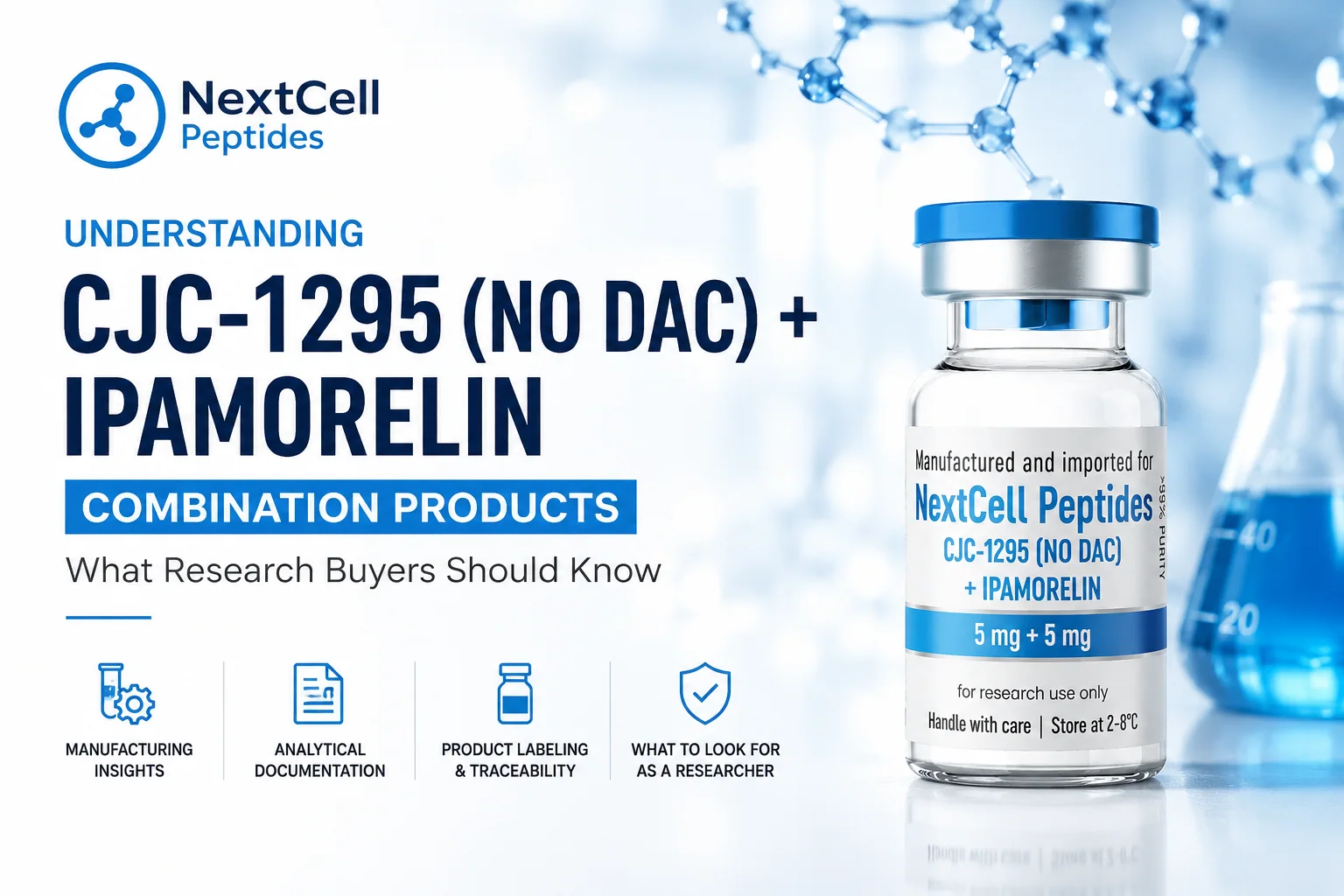
Introduction
CJC-1295 (No DAC) + Ipamorelin is one of the most widely recognized combination products in the research peptide market. Rather than supplying each peptide in separate vials, manufacturers formulate two independently synthesized peptides into a single lyophilized research product while preserving the molecular identity of each individual compound.
Because combination products differ from single-peptide formulations, evaluating them requires more than reviewing a reported purity percentage. Researchers should also consider how the product is manufactured, how analytical documentation is presented, whether both peptide components are clearly identified, and how batch-specific records support traceability throughout production.
Understanding these principles makes it easier to compare suppliers, interpret laboratory documentation, and evaluate product specifications with greater confidence. Researchers interested in this formulation can also explore our CJC-1295 (No DAC) + Ipamorelin product page for detailed specifications and product information.
If you're new to research peptides, we also recommend reading Research Peptides Explained: The Complete Beginner's Guide, which introduces the terminology and quality concepts referenced throughout this article.
Table of Contents
What Is a Combination Peptide Product?
Why Are CJC-1295 (No DAC) and Ipamorelin Frequently Combined?
How Combination Products Are Manufactured
Analytical Documentation for Combination Products
Product Labels and Batch Traceability
Common Misconceptions
Frequently Asked Questions
Summary
What Is a Combination Peptide Product?
A combination peptide product contains two individual peptides supplied within the same vial. Each peptide is synthesized independently before being formulated into the finished research product.
Unlike a chemically modified peptide, a combination product does not create a new molecule. Instead, the individual peptides retain their own molecular identities while being presented together for research purposes.
This distinction is important because analytical documentation should reflect the composition of the finished product rather than treating the combination as a single peptide.
Why Are CJC-1295 (No DAC) and Ipamorelin Frequently Combined?
CJC-1295 (No DAC) and Ipamorelin are often supplied together because they are commonly discussed within the same areas of peptide research. As a result, manufacturers may formulate combination products to provide both peptides within a single lyophilized vial intended for laboratory use.
Although they are supplied together, the peptides remain independent compounds. CJC-1295 (No DAC) is not a modified form of Ipamorelin, and Ipamorelin is not a variation of CJC-1295. Each peptide has its own molecular identity, manufacturing process, and analytical characteristics.
Researchers comparing combination products should therefore evaluate the documentation provided for the finished product rather than assuming that information relating to one peptide automatically applies to the other.
For readers interested in understanding the differences between CJC-1295 variants, see CJC-1295 (No DAC) vs CJC-1295 DAC: Understanding the Differences and Where Ipamorelin Fits in Research.
How Combination Products Are Manufactured
Combination peptide products begin as two independently synthesized peptides that are manufactured using established peptide synthesis and purification processes. Rather than being created as a single new molecule, each peptide retains its own molecular identity before the components are combined into one finished research product.
After purification, the peptides are formulated according to the intended specification and typically undergo lyophilization, producing a stable freeze-dried powder suitable for laboratory storage and transportation. Because two peptide components are present in the same vial, manufacturers must maintain consistent formulation procedures to help ensure uniform composition across production batches.
The manufacturing process therefore involves more than simply combining two ingredients. Quality-focused suppliers should use validated production procedures, batch controls, and documented manufacturing standards to support consistency between batches.
Researchers interested in the manufacturing process itself may also find How Research Peptides Are Manufactured: From Peptide Synthesis to Lyophilization helpful for understanding how research peptides are produced before final packaging.
Analytical Documentation for Combination Products
Analytical documentation plays an important role when evaluating any research peptide, but combination products require particular attention because two independent peptide components are supplied within the same vial.
A well-documented combination product should include batch-specific information that clearly identifies the formulation, the peptide components, manufacturing batch, and analytical testing performed on the finished material. Supporting documentation should remain consistent across the product label, Certificate of Analysis (COA), and any accompanying laboratory reports.
When reviewing documentation, researchers should confirm that the reported analytical data corresponds to the specific combination product rather than to one of the individual peptides alone. Clear documentation helps reduce confusion when comparing suppliers and improves confidence that the material being evaluated matches the product specification.
For readers unfamiliar with laboratory documentation, What Is a Certificate of Analysis (COA)? and How to Read an HPLC Chromatogram provide additional background on interpreting analytical reports.
Product Labels and Batch Traceability
Professional product labeling provides more than branding—it serves as an important source of product identification and traceability throughout the research process.
For combination products, labels should clearly identify both peptide components, the amount of each peptide contained within the vial, batch identification, storage recommendations, and any other relevant product specifications. This information should remain consistent with the accompanying Certificate of Analysis and other analytical documentation.
Batch traceability allows researchers to associate every vial with its corresponding production records and laboratory testing. Suppliers that maintain clear batch identification and consistent documentation make it easier to compare research materials and verify product information before purchase.
Understanding how to interpret research peptide labels can also help researchers identify incomplete or inconsistent product documentation when evaluating different suppliers.
Common Misconceptions
"A combination product is a new peptide."
This is one of the most common misunderstandings. A CJC-1295 (No DAC) + Ipamorelin product is not a newly synthesized peptide. Instead, it contains two independently manufactured research peptides that are formulated together in a single lyophilized vial.
"Ipamorelin is a modified version of CJC-1295."
Although the peptides are frequently discussed together, they are entirely separate molecules. Ipamorelin has its own amino acid sequence, manufacturing process, analytical profile, and laboratory documentation. It should not be viewed as a variation of CJC-1295.
"Documentation for one peptide automatically applies to both."
Each peptide has its own analytical identity, and combination products should be supported by documentation that corresponds to the finished formulation. Product specifications, batch records, and Certificates of Analysis should always match the exact material being evaluated.
"Combination products require less quality documentation."
The opposite is generally true. Because two peptide components are supplied in one product, clear labeling, batch traceability, and consistent analytical documentation become even more important when comparing research materials from different suppliers.
Frequently Asked Questions
What is a combination peptide product?
A combination peptide product contains two separately manufactured research peptides formulated into a single lyophilized vial. Each peptide retains its own molecular identity while being supplied together for laboratory research.
Is CJC-1295 (No DAC) chemically bonded to Ipamorelin?
No. In commercially available combination products, the peptides are formulated together rather than chemically fused into a new molecule. They remain separate peptide components within the finished product.
Do combination products require separate analytical testing?
Quality-focused suppliers should provide analytical documentation that corresponds to the finished combination product. Researchers should ensure that batch information and supporting documentation match the exact formulation being supplied.
Should combination products have their own Certificate of Analysis?
Yes. The Certificate of Analysis should identify the specific combination product, batch number, and analytical results associated with that finished material rather than referring only to an individual peptide.
Are CJC-1295 (No DAC) and Ipamorelin manufactured together?
No. The peptides are synthesized independently before being formulated into a combination product during manufacturing.
How can researchers compare different combination products?
Researchers should compare supplier transparency, manufacturing standards, analytical documentation, product labeling, batch traceability, and consistency between the Certificate of Analysis and the product specification rather than relying on product names alone.
Summary
Combination products containing CJC-1295 (No DAC) and Ipamorelin provide a different presentation format rather than a new peptide entity. Understanding how these products are manufactured, documented, and identified helps researchers evaluate laboratory materials more accurately.
Rather than focusing solely on the presence of two peptides within one vial, researchers should consider the quality of the supporting documentation, the clarity of product labeling, and the consistency of batch-specific records. These factors contribute to a more transparent evaluation process and support informed comparisons between research products.