
Research
How to Compare Peptide Specifications Before You Buy
Learn how to compare peptide specifications by reviewing purity, quantity, HPLC data, batch records, and Certificates of Analysis for research purchase.
FutureCell Research Team · 6 min read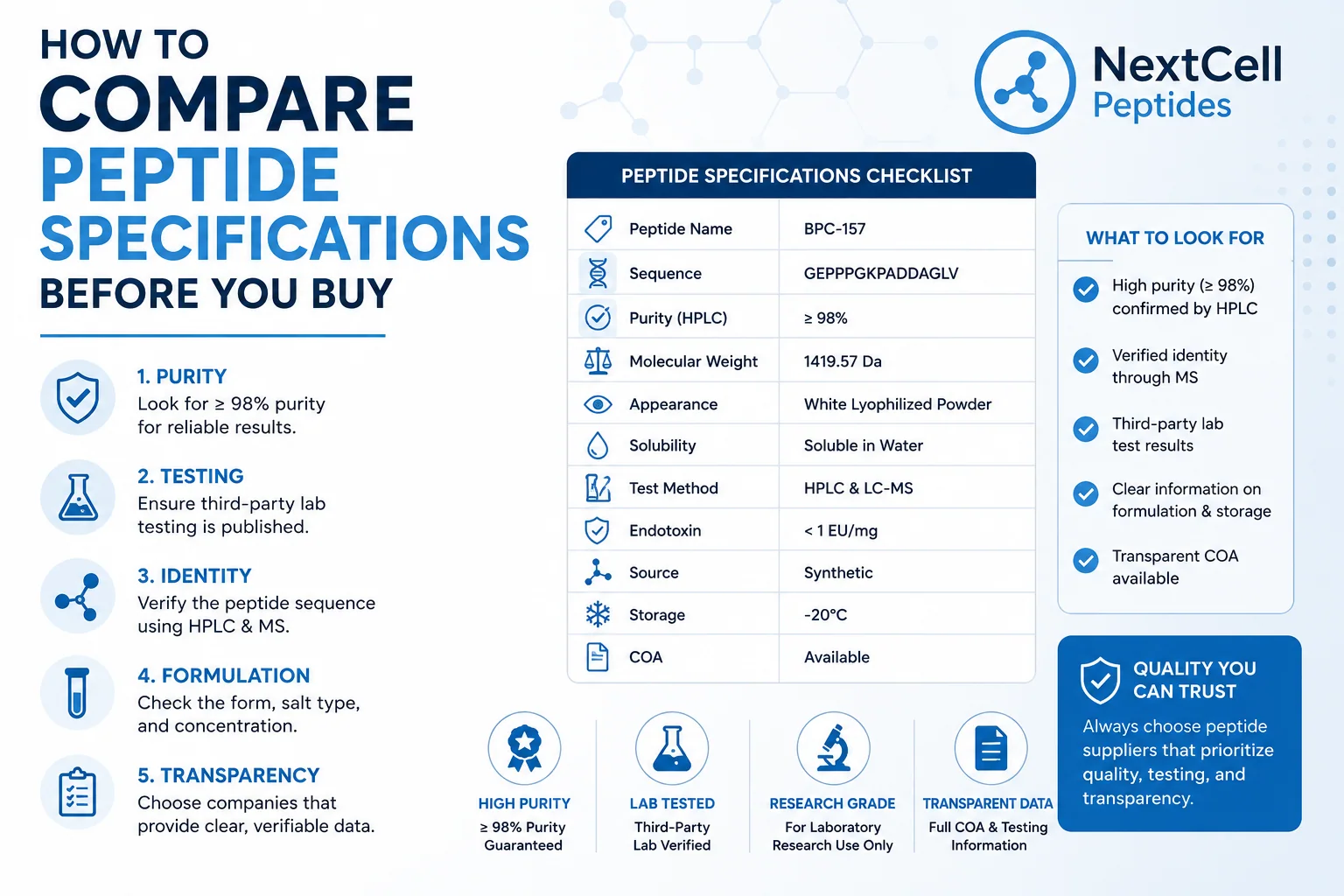
A product label that says “99% purity” may look decisive, but it is only one part of the evaluation. Knowing how to compare peptide specifications means reading the product page, batch documentation, and analytical data as one record. This helps distinguish a clearly documented research material from one supported by only broad marketing language.
For private research customers, the goal is not to find the longest specification sheet. It is to find a specification sheet that answers practical questions: What compound is this? How much material is supplied? What does the reported purity measure? Which batch does the data apply to? And can the supplier provide documentation that supports those claims?
Start with the exact compound identity
The first comparison point is the peptide itself. Product names can be abbreviated, written differently between suppliers, or used for closely related compounds. A proper listing should identify the peptide name and make its molecular identity clear through details such as amino acid sequence, molecular formula, molecular weight, or stated modifications where relevant.
This matters particularly for modified peptides and blends. For example, a product described as CJC-1295 may require closer review of the stated form or modification, while a combination product such as CJC-1295 with Ipamorelin should identify both components and their respective quantities. A name alone does not establish that two products are directly comparable.
Check whether the specification identifies the salt or counterion when applicable, such as acetate or trifluoroacetate. Counterions can affect the total mass shown on a vial, so two products with the same labeled vial weight may not necessarily contain the same peptide content. This is a technical detail, but it becomes relevant when comparing value, analytical results, and consistency across batches.
Compare peptide specifications beyond the purity percentage
Purity is a central quality indicator, yet the number should be interpreted in context. Many peptide listings report purity by HPLC, often as a percentage based on chromatographic peak area. This can provide useful evidence of the relative composition of a sample, but it does not by itself answer every identity or content question.
A meaningful purity comparison considers the stated method. Look for a defined threshold, such as purity of 98% or higher, along with a batch-specific HPLC chromatogram or Certificate of Analysis. A generic statement that all products are high purity is less informative than documentation tied to the actual lot being purchased.
HPLC results should also be read carefully. A clear main peak is generally expected for a well-characterized peptide sample, while additional peaks may represent impurities, related substances, or synthesis byproducts. The reported purity figure should correspond to the chromatogram and should not be presented without context.
Where available, identity data adds another layer of confidence. Mass spectrometry can support confirmation that the measured molecular mass aligns with the expected peptide. HPLC and mass spectrometry answer different questions: HPLC is commonly used to assess chromatographic purity, while mass analysis supports molecular identity. Strong product documentation recognizes that distinction rather than treating one test as a complete substitute for the other.
Purity is not the same as total peptide content
This distinction is easy to miss. A high HPLC purity result indicates that the main detected component represents a high proportion of the measured sample. It does not automatically verify the exact number of milligrams of peptide in a vial.
When comparing products, review the stated net quantity alongside the purity result. A 10 mg lyophilized vial and a 5 mg vial may both meet the same purity threshold, but they are not equivalent offerings. Likewise, a supplier should be clear about whether the labeled amount refers to the peptide material as supplied and whether a counterion is present.
Review quantity, format, and presentation
Research peptides are commonly supplied as lyophilized material. Lyophilization removes water under controlled conditions and supports stable handling during storage and transport. The vial should be professionally labeled with the compound name, stated quantity, batch or lot number, and appropriate research-use designation.
Quantity should be compared on a like-for-like basis. Start with the amount per vial, then review the number of vials in the package. Avoid comparing a multi-vial pack with a single vial based solely on the headline price. The useful comparison is the documented quantity, purity standard, and testing support attached to the actual product.
Presentation is not merely cosmetic. Clear labeling helps connect the physical product to its batch record and Certificate of Analysis. If a COA cannot be matched to a lot number on the vial or packaging, its practical value is limited.
Read the Certificate of Analysis as a batch record
A Certificate of Analysis, often shortened to COA, should be treated as a document for a specific batch rather than a decorative attachment. It should identify the product and batch or lot number, report the relevant test result, and indicate the test method used. Depending on the product and testing scope, it may also include molecular mass data, appearance, water content, residual solvent information, or microbial testing information.
The most useful COAs are specific, legible, and internally consistent. The product name, batch number, reported purity, and test date should align with the item listing. A document without a lot number, a date, or a clear analytical method provides less assurance because it cannot be confidently connected to the material being evaluated.
Independent third-party testing is particularly valuable because it adds separation between the supplier and the analytical result. It does not mean every possible quality attribute has been tested, and customers should avoid assuming that it does. However, independently verified batch data is a meaningful sign that a supplier is willing to support its specifications with external analytical evidence.
Questions to ask when comparing COAs
Before selecting a research peptide, confirm four points: whether the COA is batch-specific, whether the lot number matches the product, whether the stated test method is named, and whether the reported results support the claims on the listing. These checks take little time and prevent comparisons based on incomplete information.
The testing date also deserves attention. A recent test date is not automatically better, since manufacturing and release timelines vary, but the document should fit logically within the product's batch history. The key is traceability, not a single date viewed in isolation.
Evaluate consistency across the supplier catalog
A supplier's quality approach often becomes clearer when you compare several product pages rather than one. Look for consistent use of purity thresholds, standardized quantity descriptions, batch identification, and documentation practices. If BPC-157, GHK-Cu, TB-500, and NAD+ are each presented with clear but compound-appropriate specifications, that suggests an organized catalog standard.
Consistency does not mean every product must have identical test panels. Different compounds may require different analytical considerations. Instead, it means that the supplier explains what has been tested, uses terminology accurately, and provides comparable documentation where applicable.
It is also reasonable to assess practical factors around the specification itself. Can customers access the relevant quality information before purchase? Are product details easy to understand without exaggerated claims? Is the item fulfilled from within the EU when that matters for delivery expectations? For European customers, EU-based fulfillment can make the purchasing process more straightforward, but it should complement rather than replace product-level quality evidence.
Avoid common comparison mistakes
The most frequent error is choosing solely by a purity number. A stated 99% result has limited value if no method, batch number, or COA is available. Another mistake is assuming products with the same name are identical without checking form, sequence, modification, quantity, and associated testing.
Price comparisons can also be misleading when they ignore documentation. A lower unit price may reflect a smaller quantity, weaker traceability, or a less clearly defined product. Conversely, a premium specification should be supported by visible evidence, not simply a premium label.
Finally, do not read a COA as a promise about experimental outcomes. A COA speaks to defined analytical attributes of the supplied material. It does not establish research results, suitability for every experimental design, or any outcome beyond the scope of the reported testing.
Build a repeatable comparison process
A practical comparison can be completed in a few minutes. First, confirm the exact compound identity and stated format. Next, compare vial quantity and package count. Then review purity with its HPLC method and chromatogram, followed by any identity-supporting data. Finally, match the COA to the batch number and consider whether independent testing is disclosed.
FutureCell Peptides applies this specification-first approach across its research catalog, with professionally labeled products, batch-focused documentation, and independent laboratory verification where applicable. For customers comparing research materials online, these details create a clearer basis for selection than broad quality claims alone.
The best purchase decision is usually the one supported by the clearest trail of evidence. When a product's identity, quantity, analytical results, and batch documentation all tell the same story, you can spend less time interpreting marketing language and more time selecting materials with confidence for research purposes.