
Research
How to Evaluate Independent Peptide Testing
Learn how to evaluate independent peptide testing, read HPLC and MS results, verify batch details, and compare research suppliers before purchasing online.
FutureCell Research Team · 5 min read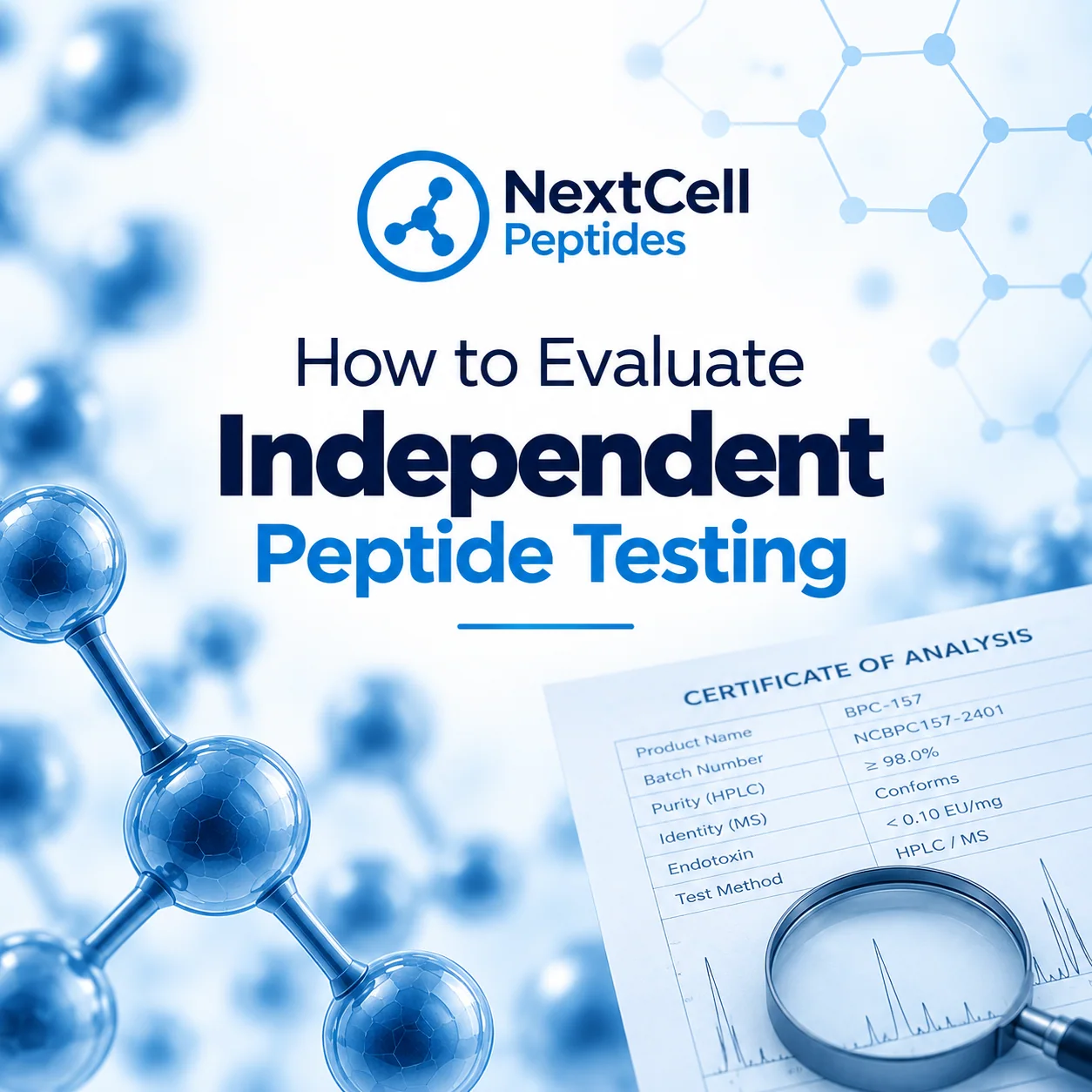
A Certificate of Analysis can look convincing at first glance: a laboratory name, a purity percentage, a chromatogram, and a signature. The real question is whether those details establish a credible connection between the tested material and the vial being considered. Knowing how to evaluate independent peptide testing helps researchers distinguish meaningful quality documentation from paperwork that offers little evidence about a specific batch.
For research peptides, independent testing is not a single pass-or-fail label. It is a chain of evidence covering identity, purity, batch traceability, analytical methods, and the laboratory behind the report. A strong evaluation considers each link.
Start With What Independent Testing Actually Means
Independent testing should mean that a sample was analyzed by a laboratory separate from the supplier or manufacturer. That separation matters because the laboratory's analytical work is not simply an internal quality-control statement reproduced on branded documentation.
Independence alone is not enough, however. A report should identify the laboratory clearly, show when testing occurred, state the tested sample or batch identifier, and describe the analytical method used. A laboratory name without a report number, method details, or batch reference provides limited value.
There is also a practical distinction between a laboratory that receives a submitted sample and one that performs controlled sampling from inventory. In most retail research-peptide settings, the laboratory tests a supplier-submitted sample. This can still provide useful evidence, but it makes batch matching especially important. The report supports the quality of the submitted material only when the product batch can be reliably tied to that sample.
How to Evaluate Independent Peptide Testing Reports
Begin with the Certificate of Analysis, but read it as an analytical record rather than a marketing asset. The document should identify the compound by name and, ideally, include a product code, batch number, lot number, or another unique sample identifier. The same identifier should be visible on the product label or available from the supplier on request.
A COA that says only “BPC-157,” “99% purity,” or “tested” is not sufficiently specific on its own. Peptide names can be used broadly, and a generic report may relate to a different production run, concentration, or even a different form of the material. Batch-level documentation is the meaningful standard for customers comparing research products.
Check the report date as well. A recent date is generally helpful, but recency does not replace traceability. A report from several months earlier may still be relevant if it is clearly attached to the same batch and the product has been stored appropriately. Conversely, a recent generic report with no batch match does not establish much.
Confirm Identity Before Focusing on Purity
Purity and identity answer different questions. Purity estimates how much of a sample is represented by the target chromatographic peak. Identity addresses whether the material is actually consistent with the claimed peptide.
For many peptides, mass spectrometry is used to confirm molecular mass. A mass result consistent with the expected molecular weight is a valuable identity indicator, particularly when presented alongside HPLC data. The report should show the expected mass, observed mass, and the method used, such as LC-MS or high-resolution mass spectrometry.
Still, molecular mass confirmation has limits. It does not necessarily distinguish every possible structural variant or sequence-related impurity with a similar mass. For higher-complexity identity questions, more advanced characterization may be relevant, depending on the peptide and the purpose of the research. The appropriate level of testing depends on the compound, the claimed specification, and the decisions being made from the material.
The key point is simple: a high purity percentage without credible identity evidence is incomplete documentation.
Read HPLC Results in Context
High-performance liquid chromatography, or HPLC, is commonly used to assess peptide purity. The chromatogram separates components in a sample over time, producing peaks that correspond to compounds or related species under the selected conditions. The reported purity is often calculated from the relative area of the main peak.
When reviewing an HPLC report, look for a readable chromatogram, a labeled main peak, the stated purity result, and basic method conditions. Useful details can include the column type, mobile phases, gradient, wavelength, flow rate, and retention time. These details show that the result comes from a defined analytical procedure rather than an unexplained percentage.
A result such as “99% by HPLC” is not automatically comparable across every supplier. Different HPLC methods, detection wavelengths, integration settings, and sample preparations can affect how peaks are measured and reported. HPLC area percentage also does not equal absolute peptide content by weight. A lyophilized material can contain water, counterions, or residual components that are not captured by a simple area-percent statement.
That does not make HPLC unsuitable. It means the result should be interpreted correctly. A clear chromatogram and transparent method information are stronger evidence than a purity number presented without supporting data.
Look Beyond the Main Peak
Small secondary peaks are not automatically a reason to reject a batch. Peptide synthesis can produce related substances, including deletion sequences, oxidation products, or other process-related impurities. What matters is whether the main peak is clearly dominant, the reported specification is met, and the documentation is consistent with the product claim.
The same principle applies to unusually perfect-looking reports. A chromatogram with no visible baseline variation, no method data, or a repeated image used across multiple batches may warrant further questions. Quality documentation should be specific, legible, and proportionate to the product being sold.
Verify the Batch-to-Product Connection
The most useful COA is one that can be matched directly to the item in hand. Check whether the lot number, batch number, peptide quantity, and product form align with the listing and label. If a product is supplied as a lyophilized peptide, the documentation should not create uncertainty about whether the tested sample was a raw material, a filled vial, or a finished batch.
Ask how the supplier manages this connection. A transparent supplier should be able to explain whether each production batch is tested, whether a representative sample is submitted, and how tested inventory is segregated or recorded. Exact procedures vary, but vague answers create avoidable uncertainty.
Packaging details add useful context. Professionally labeled research products should identify the compound, stated quantity, batch or lot where applicable, and research-use status. These label details do not replace analytical testing, but they support traceability from catalog specification to physical product.
Assess the Method Against the Claim
No single test answers every quality question. HPLC and mass spectrometry are central tools for evaluating peptide purity and identity, but additional tests may be relevant depending on the product and research context.
For example, moisture or water-content analysis can be relevant to a lyophilized material. Residual solvent testing may matter where synthesis and purification processes make it appropriate. Microbiological or endotoxin-related testing may be requested for particular research requirements, though its relevance and specification should be assessed carefully rather than assumed from a standard COA.
The right question is not “Does the supplier test for everything?” It is “Does the available testing support the stated product specification and the intended research use?” More data is useful only when the test, sample, method, and acceptance criteria are clear.
Compare Suppliers With a Documentation Standard
When several products appear similar, compare their evidence rather than relying only on a listed purity figure. A practical documentation standard includes these five elements:
A batch-specific Certificate of Analysis that matches the product.
Independent laboratory identification and report dating.
HPLC purity data with a readable chromatogram and stated method information.
Identity support, commonly through mass spectrometry.
Clear product labeling and a supplier able to answer traceability questions.
A supplier does not need to make exaggerated claims to demonstrate quality. In fact, clear specifications, accessible COAs, and direct explanations of testing methods are more credible than broad claims about being “pharmaceutical grade” or universally superior. Research peptides should be described according to their actual specifications and intended research status.
For EU customers, fulfillment location and handling transparency can also be relevant operational factors. EU-based fulfillment can simplify delivery and customer support, but it should not be treated as proof of analytical quality. Testing documentation remains the central evidence.
Questions Worth Asking Before You Purchase
If any part of a report is unclear, ask focused questions. Request the COA for the current batch, confirm whether the batch number matches the product label, and ask which laboratory performed the analysis. It is also reasonable to ask whether identity was confirmed by mass spectrometry and whether the HPLC percentage is reported by peak area.
The response itself is informative. A quality-focused supplier should be comfortable explaining what its documentation does and does not demonstrate. At FutureCell Peptides, product selection is supported by clear specifications and independent testing documentation where applicable, helping customers compare research compounds on evidence rather than presentation alone.
The best purchasing decision is rarely based on one impressive number. Choose research peptides supported by a traceable batch, an identifiable laboratory report, appropriate analytical methods, and documentation you can read with confidence.