
Guides
How to Read a Research Peptide Label: Everything Buyers Should Know
Learn how to read a research peptide label, understand what every element means, identify signs of professional packaging, and compare suppliers with greater confidence before purchasing.
FutureCell Research Team · 15 min read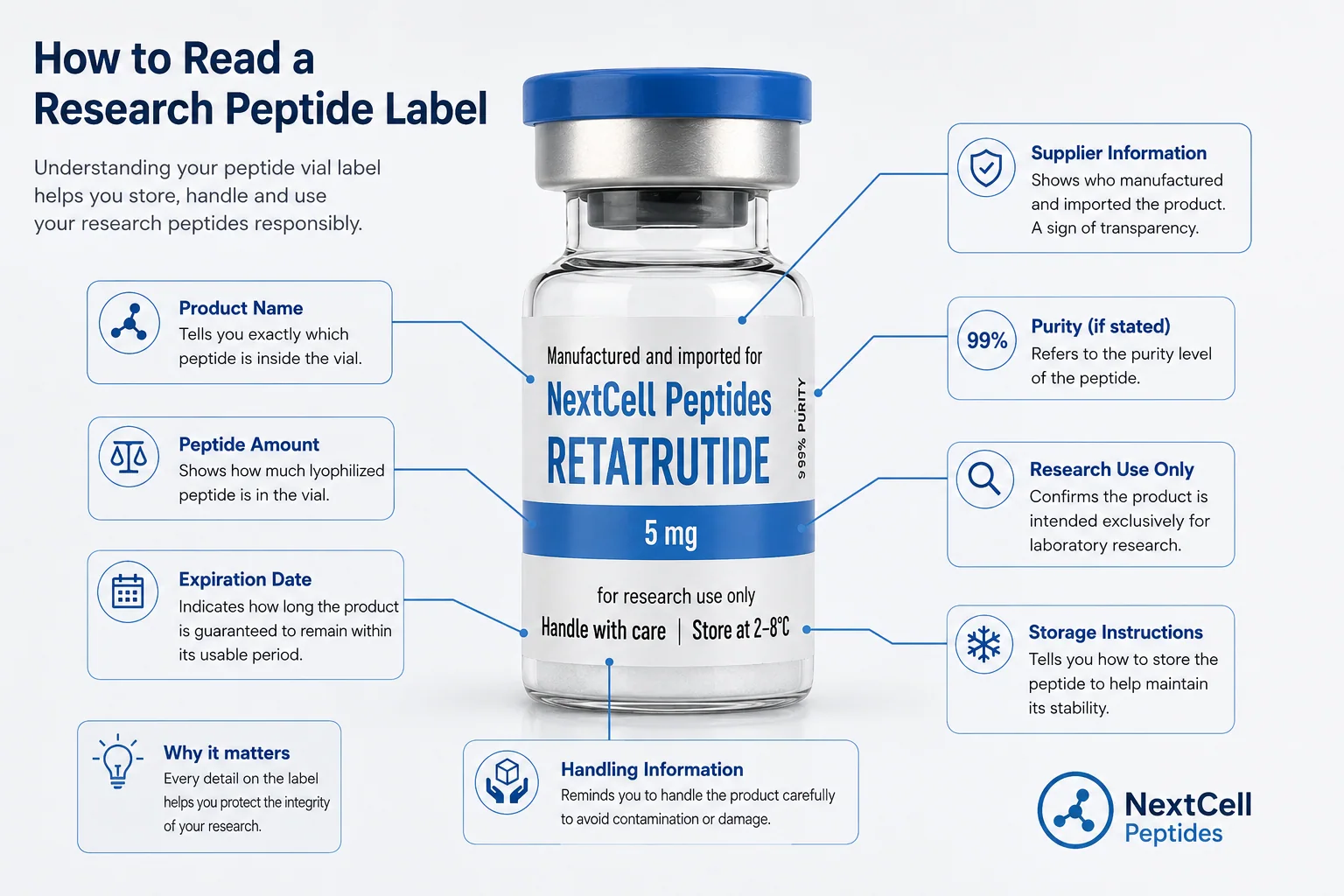
At first glance, most research peptide labels look similar. They usually display a product name, a peptide amount and a few lines of additional information. However, a well-designed label communicates much more than what's inside the vial.
For researchers and informed buyers, a professional peptide label provides valuable insight into product identification, storage guidance, handling recommendations and supplier transparency. While a label alone cannot determine product quality, it often reflects the level of care a supplier invests in manufacturing, packaging and customer education.
Understanding how to read a research peptide label makes it easier to compare products objectively, recognize professional suppliers and avoid common purchasing mistakes.
This guide explains every part of a research peptide label, what each element means and which details experienced buyers typically look for before making a purchasing decision.
Why Peptide Labels Matter
A research peptide label is far more than a legal requirement or a branding element.
It serves as the primary source of product identification and helps ensure that researchers receive the correct peptide, understand how it should be handled and can distinguish one product from another.
A professional label should make important information easy to locate at a glance without unnecessary clutter or confusing terminology.
Although labels vary between suppliers, buyers generally expect clear identification, readable typography and practical information that supports proper storage and handling.
Well-designed labeling also reflects consistency throughout a supplier's product range, making it easier for customers to navigate different peptides with confidence.
The Anatomy of a Professional Research Peptide Label
A professionally designed peptide label should present information in a logical, consistent and easy-to-read format.
Rather than overwhelming the user with excessive technical details, the goal is to communicate the essential information required to identify and handle the product correctly.
The following elements are commonly found on professional research peptide labels.
Product Name
The product name should immediately identify the peptide contained inside the vial.
Clear naming reduces confusion, particularly when suppliers offer a large catalogue of research peptides with similar packaging.
Professional suppliers maintain consistent naming conventions across all products to simplify identification.
Peptide Amount
The peptide amount indicates how much lyophilized peptide is contained within the vial.
Common quantities include:
5 mg
10 mg
20 mg
50 mg
100 mg
500 mg
This value represents the amount of peptide supplied before preparation.
It should not be confused with dosage recommendations or biological potency.
Storage Recommendation
Storage guidance helps researchers preserve product stability before use.
Depending on the specific peptide, suppliers may recommend refrigeration or other storage conditions to help maintain product integrity during storage.
Providing clear storage information demonstrates attention to detail and reduces uncertainty for buyers.
Research Use Only
Most professional research peptide labels include a statement indicating that the product is intended exclusively for laboratory research.
This wording helps distinguish research materials from products intended for therapeutic or veterinary use and reflects standard practice within the research chemicals industry.
Expiration Date
An expiration date helps laboratories manage inventory and rotate stock efficiently.
It also indicates that the supplier has established storage guidance and product lifecycle management practices.
Professional labeling should display expiration information clearly and consistently.
Batch or Lot Number
Many professional suppliers assign a batch or lot number to products for internal traceability.
Batch identification supports inventory management and allows individual production runs to be distinguished from one another if required.
Although not every supplier displays batch information in the same way, traceability is generally regarded as an important aspect of professional manufacturing practices.
Handling Information
Research peptides are sensitive laboratory materials that should be handled carefully.
Simple handling instructions such as protecting the vial from unnecessary exposure or following storage recommendations help reduce avoidable handling errors after delivery.
Although brief, these instructions contribute to a more complete product presentation.
What Does the Peptide Amount Actually Mean?
One of the most common misunderstandings among first-time buyers concerns the number printed on the front of the vial.
A label marked 5 mg does not mean the peptide is "weaker" than a product labeled 10 mg.
Instead, it simply indicates the quantity of lyophilized peptide contained inside the vial before reconstitution.
Different research projects require different quantities depending on laboratory protocols.
Understanding this distinction helps buyers compare products accurately rather than assuming that a higher number automatically represents better quality.
Why Storage Information Matters
Storage recommendations are one of the most overlooked elements on a research peptide label, yet they play an important role in helping researchers handle products correctly.
Different peptides may require different storage conditions depending on their characteristics and whether they remain in their lyophilized form or have been reconstituted. A professional supplier should clearly communicate storage guidance rather than assuming buyers already know how the product should be handled.
Providing storage information demonstrates attention to detail and helps reduce uncertainty after delivery. Buyers should be cautious of products that provide little or no guidance regarding storage or handling.
What Does "Research Use Only" Mean?
One of the most recognizable statements on research peptide packaging is "Research Use Only."
This statement indicates that the product is supplied for laboratory research applications and is not intended for human or veterinary use.
Professional suppliers typically include this information as part of standard product labeling. While the wording does not indicate product quality, its presence reflects appropriate labeling practices within the research chemicals industry.
Buyers should understand that this statement describes the intended purpose of the product rather than its manufacturing quality or purity.
Why Batch Numbers Matter
Many professional suppliers include a batch number or lot number on their products.
A batch number helps identify a specific production run and supports traceability throughout manufacturing and inventory management.
If questions arise regarding a particular batch, traceability allows suppliers to identify exactly which products were produced together.
Although not every supplier displays batch information in the same format, clear product identification and consistent labeling are generally positive indicators of professional manufacturing practices.
What Professional Peptide Packaging Looks Like
Packaging does more than protect the product during transportation.
It also reflects the supplier's attention to detail, consistency and commitment to providing researchers with clear product information.
Professional peptide packaging is typically characterized by:
Clear product identification
Easy-to-read typography
Consistent branding across the product range
Storage recommendations
Research use statements where appropriate
Accurate peptide amount
Durable labels that remain readable during storage
Clean, professional presentation
Good packaging cannot guarantee product quality on its own, but it often reflects a supplier's overall approach to professionalism and transparency.
Common Labeling Mistakes Buyers Should Watch For
While every supplier has its own branding, certain labeling issues should encourage buyers to look more carefully before purchasing.
Examples include:
Missing product information
Inconsistent branding across products
Difficult-to-read text
Poor print quality
Missing storage recommendations
Spelling mistakes
Missing peptide amount
Confusing or incomplete product identification
These issues do not automatically indicate poor product quality, but they may suggest that less attention has been given to presentation and documentation.
Experienced buyers often evaluate these details alongside other quality indicators before choosing a supplier.
How Experienced Buyers Compare Peptide Labels
Rather than focusing on appearance alone, experienced buyers evaluate labels as part of a broader assessment of supplier professionalism.
Questions they often consider include:
Is the peptide clearly identified?
Is the peptide amount easy to find?
Are storage recommendations provided?
Does the supplier explain how the product should be handled?
Is the branding consistent across all products?
Does the packaging appear professionally designed?
Is important information easy to understand?
Looking at these factors together provides a more balanced way to compare suppliers than relying on a single specification or marketing claim.
Buyer Checklist
Before purchasing research peptides, use this checklist to evaluate the information presented on the label.
✓ Product name is clearly displayed
✓ Peptide amount is easy to identify
✓ Storage recommendations are provided
✓ Research use statement is included where appropriate
✓ Expiration information is available
✓ Batch or lot identification is present when applicable
✓ Packaging appears consistent and professionally designed
✓ Product information is easy to read
✓ The supplier provides educational resources alongside product information
The more complete and transparent the labeling, the easier it becomes to compare suppliers with confidence.
Frequently Asked Questions
Does a professional label guarantee product quality?
No. A professional label alone cannot verify the quality or purity of a research peptide. However, clear and consistent labeling often reflects a supplier's attention to detail, product presentation and commitment to transparency. Buyers should evaluate labels alongside other factors such as manufacturing information, storage guidance and educational resources.
Why is the peptide amount displayed in milligrams?
The amount shown on the label indicates the quantity of lyophilized peptide contained in the vial before reconstitution. It is a measurement of content, not a measure of biological activity or effectiveness.
What does "Research Use Only" actually mean?
This statement indicates that the product is supplied for laboratory research purposes. It is commonly used throughout the research chemicals industry and helps distinguish research materials from products intended for human or veterinary use.
Why do some peptide labels look more professional than others?
Every supplier has its own branding, but professional labels usually prioritize clarity, consistency and readability. Clear product identification, storage recommendations and accurate information are all signs of thoughtful product presentation.
Should every peptide label include storage instructions?
Storage recommendations are considered good practice because different peptides may have different handling requirements. Clear guidance helps researchers store products correctly and reduces unnecessary uncertainty.
Why are batch numbers important?
Batch numbers improve traceability by identifying a specific production run. They support inventory management and make it easier to distinguish products manufactured at different times.
Can I compare suppliers based only on the label?
No. The label is only one part of the overall picture. Buyers should also consider supplier transparency, educational content, product information, storage guidance and the professionalism of the company's overall presentation.
Red Flags Every Buyer Should Know
Not every poorly designed label indicates a poor product, but certain warning signs deserve closer attention.
Watch for:
Missing product identification
Missing peptide amount
No storage recommendations
Poor print quality
Spelling or formatting mistakes
Inconsistent branding across products
Difficult-to-read labels
Missing handling information
Generic packaging with little product information
Product descriptions that make unrealistic or unsupported claims
Professional suppliers typically present products in a consistent and transparent manner that makes important information easy to find.
What Experienced Buyers Look For
Experienced buyers rarely make purchasing decisions based on price alone.
Instead, they evaluate how professionally a supplier presents its products and whether sufficient information is available to make an informed decision.
Common indicators include:
Clear product identification
Consistent packaging across the product range
Practical storage guidance
Transparent educational resources
Easy-to-understand product descriptions
Professional branding
Reliable customer support
Well-organized website and product information
Suppliers that invest in educating their customers often make it easier to compare products objectively rather than relying on marketing alone.
Continue Learning
Understanding a research peptide label is only one part of choosing a reliable supplier.
To build a broader understanding of research peptide quality, continue with these guides:
Research Peptides Explained: The Complete Beginner's Guide
How Research Peptides Are Manufactured: From Peptide Synthesis to Lyophilization
What Is Peptide Purity? Everything Buyers Should Know
How to Store Lyophilized Peptides Correctly
How to Choose a High-Quality Research Peptide Supplier
How to Spot Fake Research Peptides: 10 Red Flags Every Buyer Should Know
Reading these guides together provides a practical framework for evaluating research peptides, understanding supplier standards and making more informed purchasing decisions.
Summary
A research peptide label does much more than identify the contents of a vial.
It reflects how clearly a supplier communicates essential product information, from peptide identification and storage recommendations to handling guidance and product presentation.
While a label alone cannot determine product quality, it can provide valuable insight into a supplier's professionalism, consistency and commitment to transparency.
Understanding what each element means allows buyers to move beyond marketing claims and compare research peptide suppliers using practical, objective criteria.
As the research peptide industry continues to evolve, buyers who understand how to interpret product labels are better equipped to identify professional suppliers, evaluate products with greater confidence and make informed purchasing decisions based on clear information rather than assumptions.