
Guides
How to Identify High-Quality BPC-157: A Buyer's Checklist (2026)
Learn how to evaluate BPC-157 research peptides beyond purity percentages. Discover the documentation, quality indicators and supplier standards experienced buyers use to compare products objectively.
FutureCell Research Team · 15 min read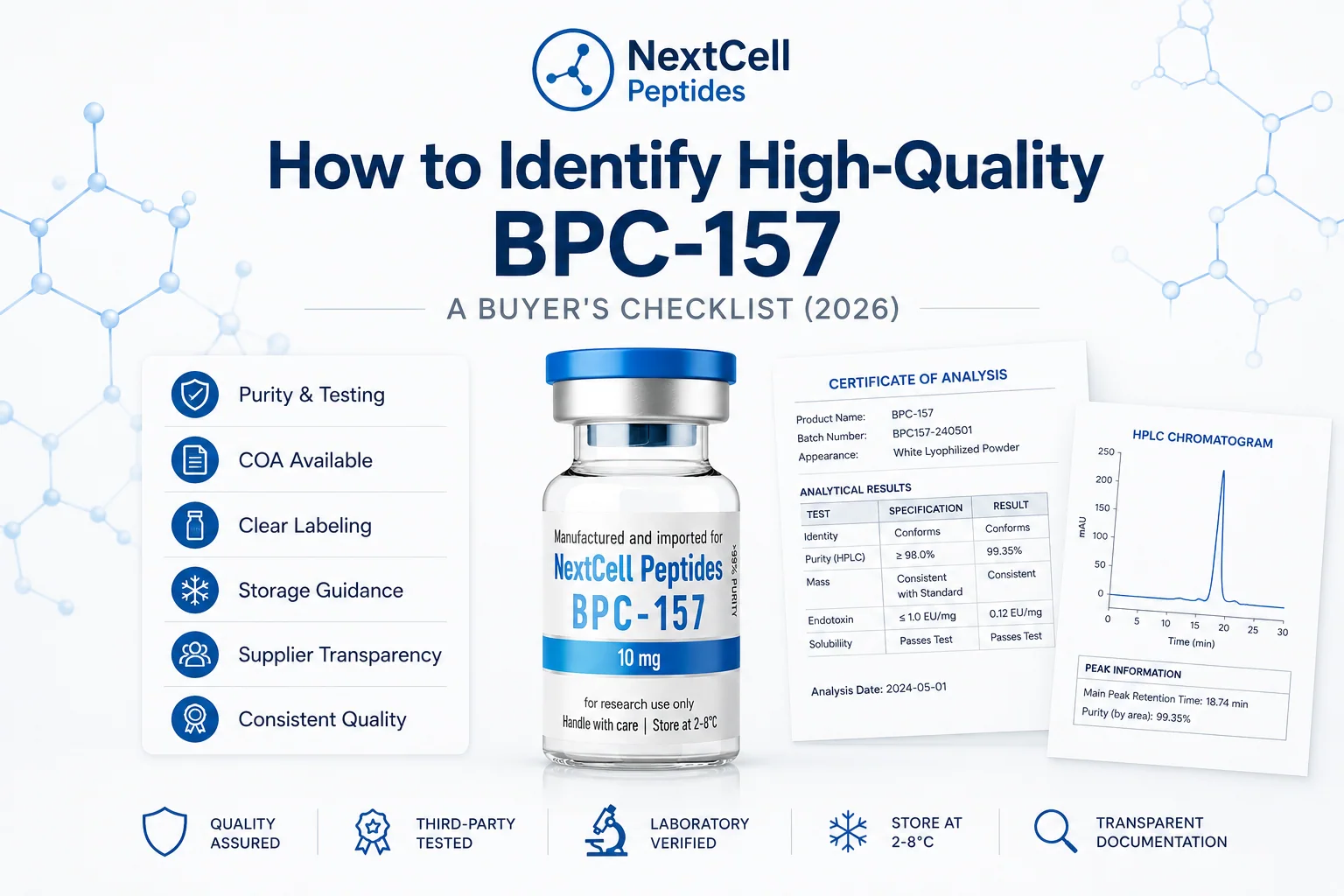
Introduction
Choosing a high-quality BPC-157 research peptide involves much more than comparing purity percentages or product images.
Many suppliers advertise impressive specifications, professional packaging or laboratory testing, making it difficult for buyers to determine which quality indicators genuinely matter.
Experienced buyers take a broader approach.
Rather than focusing on a single specification, they evaluate the complete quality system behind the product. This includes manufacturing transparency, analytical documentation, storage guidance, labeling consistency and the educational resources provided by the supplier.
No single document or specification can determine overall product quality on its own.
Instead, confidence is built by reviewing multiple indicators together and understanding how they contribute to a transparent purchasing experience.
This guide explains how experienced buyers evaluate BPC-157 research peptides objectively.
Instead of relying on marketing claims or assumptions, we'll examine the practical factors that help distinguish professional suppliers from those providing only limited information.
Whether you are purchasing BPC-157 for the first time or comparing several research peptide suppliers, this checklist provides a structured framework for making more informed decisions.
Table of Contents
What Does "High-Quality" Actually Mean?
Why Purity Is Only One Part of Quality
Documentation Every Professional Supplier Should Provide
Evaluating Product Labels
Storage Information Matters More Than Many Buyers Realize
Understanding Supplier Transparency
Red Flags to Watch For
The FutureCell Buyer's Checklist
Frequently Asked Questions
Related Guides
Summary
What Does "High-Quality" Actually Mean?
The phrase "high quality" is frequently used throughout the research peptide industry.
However, the term has no universally accepted marketing definition.
For this reason, buyers should avoid evaluating products based solely on promotional language.
Instead, product quality should be assessed through objective indicators that can be reviewed before a purchase is made.
Professional suppliers generally demonstrate quality by providing clear product information, transparent documentation and educational resources that help buyers understand what they are purchasing.
Rather than asking whether a supplier claims to offer high-quality products, experienced buyers ask whether the supplier provides sufficient information to support those claims.
Quality, therefore, is best viewed as a combination of measurable factors rather than a single specification.
Why Purity Is Only One Part of Quality
Purity is often one of the first specifications buyers notice when comparing research peptides.
While analytical purity is an important characteristic, it should never be interpreted in isolation.
A reported purity percentage does not explain:
How the product was analyzed.
Which analytical method was used.
Whether supporting documentation is available.
How consistently products are presented across different batches.
Whether storage guidance is clearly communicated.
How transparent the supplier is about quality control.
Professional buyers evaluate purity alongside several additional indicators to build a more complete understanding of product quality.
This broader perspective helps reduce the risk of making purchasing decisions based on incomplete information.
Professional Buyers Look Beyond the Product Page
One of the biggest differences between first-time buyers and experienced buyers is where they look for information.
New buyers often focus only on the specifications displayed on the product page.
Experienced buyers typically continue researching beyond the initial listing.
They review the supplier's educational resources, documentation standards and overall commitment to transparency before making a purchasing decision.
Questions experienced buyers often ask include:
Does the supplier explain laboratory terminology?
Are Certificates of Analysis available where appropriate?
Are HPLC reports explained in plain language?
Are storage recommendations easy to find before purchase?
Is product information consistent across the website?
Does the supplier invest in educating buyers?
These questions provide valuable context that product specifications alone cannot offer.
Why Documentation Builds Confidence
Professional documentation serves an important purpose beyond regulatory or technical requirements.
It helps buyers understand how products are presented, documented and evaluated.
Examples of useful documentation include:
Product specifications.
Certificates of Analysis (COAs).
HPLC reports.
Storage recommendations.
Product labels.
Batch identification information.
Educational buying guides.
Each document contributes a different piece of information.
Viewed together, they provide a clearer picture of the supplier's commitment to transparency and quality management.
Expert Insight
Experienced research peptide buyers rarely evaluate products using a single metric.
Instead, they compare suppliers by examining the consistency of product presentation, the availability of documentation, the clarity of educational resources and the transparency of the overall purchasing experience.
The strongest suppliers are often those that make it easiest for buyers to understand exactly what they are purchasing before placing an order.
Documentation Every Professional Supplier Should Provide
Reliable documentation is one of the strongest indicators of a transparent research peptide supplier.
While documentation alone cannot guarantee product quality, it provides buyers with the information needed to evaluate products using objective criteria rather than assumptions.
Professional suppliers typically make important product information available before a purchase is made, allowing buyers to compare products with greater confidence.
Depending on the supplier, this documentation may include:
Product specifications
Certificates of Analysis (COAs)
Information about analytical testing
Storage recommendations
Product labels
Educational resources
Frequently Asked Questions
The goal of documentation is not to overwhelm buyers with technical information, but to explain products clearly and consistently throughout the purchasing journey.
Certificates of Analysis Should Be Easy to Understand
A Certificate of Analysis (COA) is one of the most valuable documents a supplier can provide.
It summarizes analytical information relating to a specific production batch and helps buyers understand how laboratory testing has been documented.
However, making a COA available is only part of the process.
Professional suppliers also explain what buyers are looking at.
For example, buyers should understand:
What the batch number represents.
Which analytical method was used.
What the reported results indicate.
Why analytical documentation is useful.
How a COA fits into the broader quality evaluation process.
Providing educational guidance alongside technical documentation helps buyers interpret information accurately rather than relying on assumptions.
Understanding Analytical Testing
Research peptide suppliers frequently reference analytical testing, but not all explain what these tests actually measure.
Analytical techniques such as High-Performance Liquid Chromatography (HPLC) are commonly used to evaluate characteristics of peptide samples.
While the technical details may vary between laboratories, buyers benefit from understanding the purpose of analytical testing rather than focusing only on reported values.
Analytical documentation should be viewed as one component of a broader quality assessment that also considers manufacturing practices, documentation standards and supplier transparency.
Storage Guidance Should Never Be an Afterthought
Proper storage recommendations help buyers understand how research peptides should be handled after purchase.
Professional suppliers provide storage information before the order is placed rather than requiring customers to request it later.
Storage guidance should be:
Easy to locate.
Clearly written.
Consistent across products.
Appropriate for the product presentation.
Providing clear storage information demonstrates attention to detail and reduces uncertainty for buyers comparing multiple suppliers.
Product Labels Communicate More Than Product Names
A professionally designed label does much more than identify a product.
It communicates important information in a consistent and easy-to-understand format.
Buyers should expect labels to include information such as:
Product name.
Peptide quantity.
Batch identification where applicable.
Storage recommendations.
Supplier branding.
Research Use Only statement where appropriate.
Clear labeling improves product identification and reflects an organized approach to product presentation.
Evaluating Supplier Transparency
Transparency is one of the most important characteristics experienced buyers consider when comparing research peptide suppliers.
Rather than relying on promotional claims, transparent suppliers provide information that allows buyers to evaluate products independently.
Questions worth asking include:
Is important product information available before purchase?
Does the supplier explain technical terminology?
Are educational resources regularly updated?
Is documentation presented consistently across products?
Can buyers easily understand how products are documented?
Suppliers that answer these questions openly often create greater confidence than those relying primarily on marketing language.
Comparison Framework: Marketing vs Transparency
When evaluating research peptide suppliers, buyers often encounter different approaches to product presentation and customer communication.
Some suppliers primarily emphasize promotional messaging, while others focus on providing clear, educational information that helps buyers understand the products being offered.
A transparency-focused supplier typically explains product specifications, laboratory documentation and technical terminology in plain language. Rather than assuming buyers already understand analytical concepts, they provide educational resources that make complex information easier to interpret.
Comprehensive product documentation, detailed product specifications and clear storage recommendations further support objective product evaluation. These resources help buyers compare products using consistent information instead of relying solely on marketing language.
Transparent suppliers also tend to invest in product-specific educational content that explains topics such as analytical testing, product labeling, storage conditions and documentation. This additional context enables buyers to make more informed comparisons before purchasing.
By contrast, suppliers that provide only limited product information or rely heavily on promotional claims may leave buyers with fewer objective criteria for evaluating products. Without clear explanations or supporting educational resources, comparing suppliers can become significantly more difficult.
This comparison is not intended to classify individual companies or suggest that one approach automatically reflects product quality. Instead, it illustrates how different communication styles can influence a buyer's ability to evaluate research peptides using objective information rather than assumptions or marketing claims.
Expert Insight
The strongest suppliers rarely rely on marketing alone.
Instead, they reduce uncertainty by providing consistent documentation, accessible educational resources and clear explanations that help buyers understand the information presented.
When evaluating BPC-157 research peptides, transparency is often a more meaningful quality indicator than promotional language.
Red Flags to Watch For
Not every supplier presents information with the same level of transparency.
While no single warning sign automatically indicates poor product quality, certain patterns may suggest that buyers should take a closer look before making a purchasing decision.
Examples include:
Limited or inconsistent product information.
Missing storage recommendations.
Generic product descriptions used across multiple peptides.
Technical terminology presented without explanation.
Little or no educational content.
Inconsistent branding or product presentation.
No explanation of available documentation.
Product images that do not match the information provided.
These observations do not necessarily indicate poor quality, but they can make it more difficult for buyers to evaluate products objectively.
Professional suppliers generally aim to reduce uncertainty by providing complete, consistent and easy-to-understand information throughout the purchasing process.
Professional Buyer's Checklist
Rather than relying on marketing claims alone, experienced buyers often evaluate research peptide suppliers using a structured checklist.
Instead of focusing on a single factor such as price, purity or packaging, they review multiple aspects of the product and the supplier to build a more complete understanding before making a purchasing decision.
When comparing suppliers, consider the following questions:
Are the product specifications complete and accurate?
Detailed specifications make it easier to compare products consistently and understand exactly what is being offered.Are product labels clear and professionally presented?
Consistent labeling supports product identification, traceability and overall professionalism.Are storage recommendations easy to find?
Clear storage guidance demonstrates attention to proper product handling and helps buyers understand how products should be stored.Is supporting documentation available where appropriate?
Product documentation, including Certificates of Analysis (COAs) and explanations of analytical testing, contributes to greater transparency.Does the supplier provide educational resources?
Product-specific buying guides and technical explanations help buyers understand complex concepts and make more informed comparisons.Is the website consistent and well organized?
Uniform branding, terminology and product presentation reflect attention to detail throughout the purchasing experience.Are product images accurate and consistent?
Professional product photography allows buyers to identify products more easily and compare listings with greater confidence.Does the supplier prioritize transparency over promotional language?
Clear explanations, objective information and educational content help buyers evaluate products based on evidence rather than marketing claims.
Using multiple evaluation criteria provides a far more objective framework than relying on a single specification such as purity, packaging or price. Professional buyers recognize that meaningful comparisons are built on transparency, documentation and consistency rather than any individual product characteristic.
Decision Framework: How Experienced Buyers Compare Suppliers
When evaluating several BPC-157 suppliers, experienced buyers often move through a series of practical questions rather than making decisions based on price or marketing alone.
A structured approach may look like this:
Step 1 – Review Product Information
Is the product page complete, accurate and easy to understand?
↓
Step 2 – Check Documentation
Does the supplier explain available documentation and analytical testing?
↓
Step 3 – Evaluate Transparency
Are storage recommendations, labeling information and educational resources available before purchase?
↓
Step 4 – Compare Consistency
Are products presented consistently across the website?
↓
Step 5 – Make an Informed Decision
Choose the supplier that provides the clearest information, the strongest transparency and the most complete educational resources.
This framework encourages buyers to evaluate products systematically instead of relying on isolated specifications or promotional messaging.
Why Transparency Creates Long-Term Confidence
Confidence is rarely built through advertising alone.
Instead, buyers gain confidence when suppliers explain products clearly, provide supporting documentation and make technical information accessible.
Professional suppliers reduce uncertainty by investing in education rather than relying on bold claims.
This includes:
Clearly written product pages.
Comprehensive buying guides.
Transparent explanations of documentation.
Consistent labeling.
Practical storage guidance.
Educational articles answering common buyer questions.
Over time, this approach creates trust because buyers can evaluate products independently rather than depending on marketing language.
Expert Insight
One of the biggest differences between experienced buyers and first-time buyers is the way information is evaluated.
New buyers often compare only visible specifications such as purity percentages or product images.
Experienced buyers look for consistency across the entire purchasing experience.
They evaluate whether documentation is available, whether technical concepts are explained clearly and whether the supplier demonstrates transparency through education rather than promotion.
This broader perspective makes it easier to distinguish professional suppliers from those offering only limited information.
Quick Buyer's Checklist
Before purchasing a BPC-157 research peptide, ask yourself:
✓ Are product specifications complete?
✓ Is storage guidance available before purchase?
✓ Are Certificates of Analysis explained clearly?
✓ Does the supplier provide educational resources?
✓ Is technical terminology easy to understand?
✓ Is branding consistent across products?
✓ Are product labels professionally presented?
✓ Is supporting documentation available where appropriate?
✓ Does the supplier explain quality indicators rather than simply listing them?
✓ Can you understand exactly what you are purchasing before placing an order?
If the answer to most of these questions is yes, buyers generally have a stronger foundation for comparing products objectively.
Key Takeaway
Evaluating high-quality BPC-157 involves much more than reviewing a single specification.
Experienced buyers compare suppliers using a combination of product information, documentation, storage guidance, educational resources and overall transparency.
Rather than relying on promotional language, they build confidence by reviewing objective quality indicators that help explain how products are presented and documented.
This structured approach makes it easier to compare suppliers consistently while reducing uncertainty throughout the purchasing process.
Frequently Asked Questions
What is the most important factor when evaluating BPC-157?
There is no single factor that determines the overall quality of a research peptide.
Experienced buyers evaluate multiple indicators together, including product documentation, analytical testing, storage guidance, product labeling and supplier transparency.
A balanced assessment provides a more reliable understanding than focusing on one specification alone.
Is purity enough to determine product quality?
No.
Analytical purity is an important characteristic, but it represents only one part of a broader quality evaluation.
Buyers should also consider supporting documentation, manufacturing transparency, storage recommendations and the consistency of the supplier's product information.
Why is supplier transparency important?
Transparent suppliers make it easier for buyers to understand exactly what they are purchasing.
Clear explanations of documentation, laboratory testing and product specifications reduce uncertainty and help buyers compare products objectively.
Transparency supports informed purchasing decisions without relying on marketing claims.
What documents should buyers expect?
Depending on the supplier, buyers may have access to:
Product specifications.
Certificates of Analysis (COAs).
Information about analytical testing.
Storage recommendations.
Product labels.
Educational resources explaining technical concepts.
Professional suppliers present this information in a way that is easy to understand before purchase.
What should a professional BPC-157 product page include?
A comprehensive product page should provide:
Accurate product specifications.
Storage guidance.
Clear product images.
Consistent labeling.
Educational resources.
Supporting documentation where appropriate.
These elements help buyers evaluate products using objective information rather than assumptions.
Can product packaging indicate quality?
Packaging alone cannot determine product quality.
However, consistent branding, professional labeling and well-organized product presentation often reflect attention to detail throughout the purchasing process.
Packaging should be considered alongside documentation and supplier transparency rather than as an independent quality indicator.
Why are educational resources valuable?
Educational resources help buyers understand technical concepts such as Certificates of Analysis, HPLC reports, storage recommendations and product labeling.
Well-developed educational content reduces uncertainty and enables buyers to compare suppliers using objective information.
Related Guides
To build a more complete understanding of research peptide quality, explore these additional resources:
BPC-157: The Complete Research Peptide Buyer's Guide (2026) – A comprehensive introduction to BPC-157, product quality and supplier evaluation.
BPC-157 5 mg vs 10 mg: A Complete Buyer's Guide – Compare the two most common product presentations and learn what experienced buyers evaluate beyond vial size.
What Is a Certificate of Analysis (COA)? – Learn how analytical documentation supports product transparency.
How to Read an HPLC Chromatogram – Understand laboratory reports and analytical testing.
Understanding Research Peptide Purity – Learn what purity measurements represent and how they should be interpreted.
How to Read a Research Peptide Label – Discover what information professional product labels should contain.
How to Store Lyophilized Research Peptides – Best practices for storing freeze-dried research peptides.
How to Store Reconstituted Research Peptides – Learn how proper storage supports product handling after reconstitution.
Together, these guides form a structured knowledge base designed to help buyers evaluate research peptides with greater confidence and transparency.
Explore Our BPC-157 Research Peptide
If you'd like to learn more about our BPC-157 10 mg Research Peptide, explore the product page for detailed product specifications, storage recommendations and additional educational resources.
→ View the BPC-157 10 mg product page
If you're looking for a broader introduction to the product, you can also explore our Complete BPC-157 Buyer's Guide, which covers manufacturing, documentation, quality indicators and supplier evaluation in greater detail.
Summary
Identifying a high-quality BPC-157 research peptide involves much more than comparing purity percentages or reviewing product images.
Experienced buyers evaluate the complete purchasing experience by considering documentation, analytical testing, storage recommendations, product labeling and supplier transparency together.
Rather than relying on promotional language, professional suppliers build confidence through education and clear communication. Comprehensive product information, accessible documentation and well-structured educational resources allow buyers to make informed decisions based on objective criteria rather than assumptions.
No single quality indicator can provide a complete picture on its own.
Instead, the strongest purchasing decisions are made by reviewing multiple factors, understanding how they relate to one another and selecting suppliers that prioritize transparency throughout the buying process.
As the research peptide industry continues to evolve, buyers increasingly benefit from suppliers who invest in education alongside product presentation. Companies that clearly explain documentation, laboratory testing and quality processes help reduce uncertainty while making it easier to compare products objectively.
By using the evaluation framework and buyer's checklist presented in this guide, readers can move beyond marketing claims and develop a more structured approach to assessing BPC-157 research peptides.
Ultimately, informed purchasing decisions begin with reliable information, thoughtful evaluation and a supplier committed to transparency rather than promotion.