
Guides
Lyophilized vs Reconstituted Peptides: What's the Difference?
Learn the differences between lyophilized and reconstituted research peptides, how each form affects storage and stability, and what buyers should consider before choosing a research peptide supplier.
FutureCell Research Team · 15 min read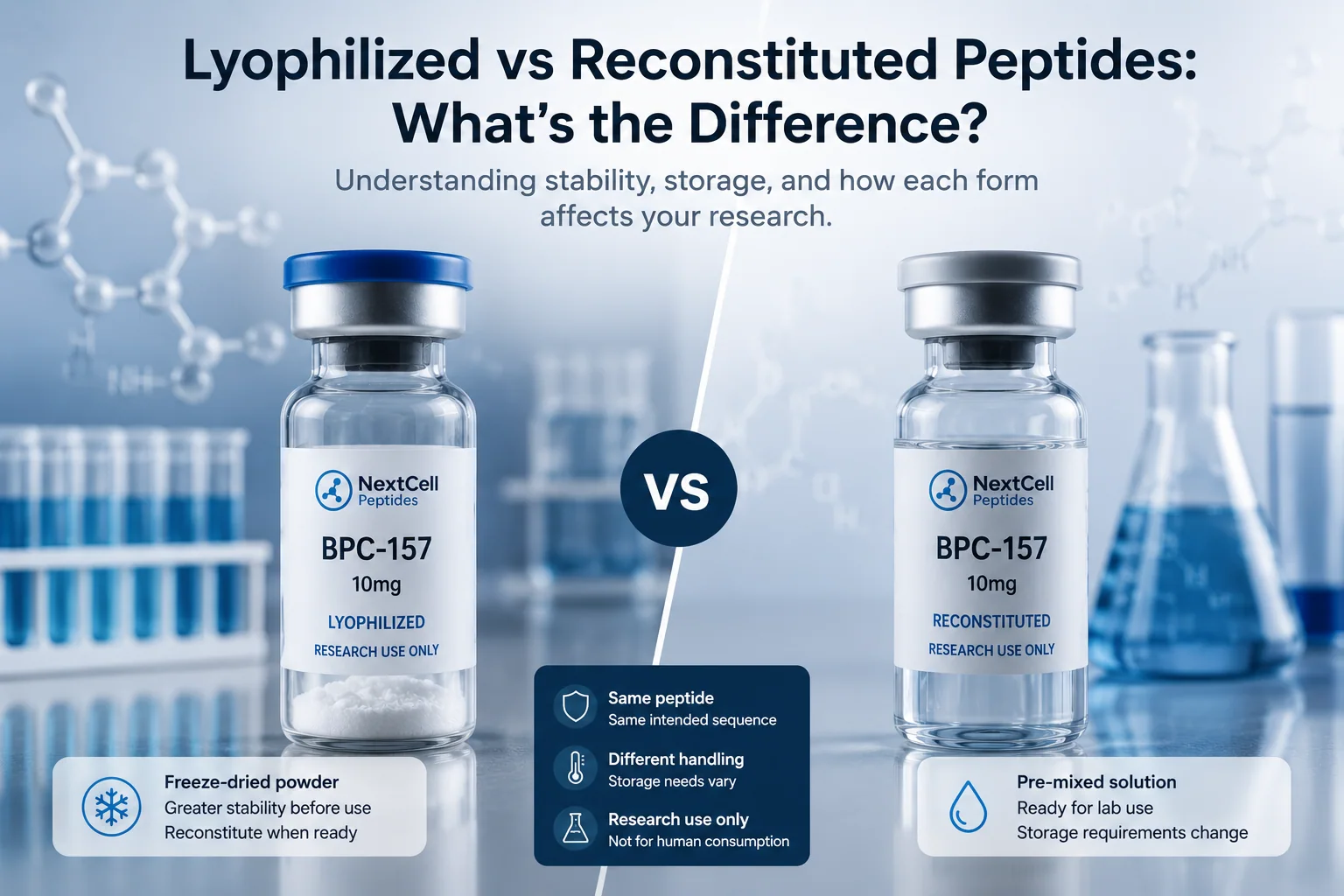
Introduction
Research peptides are commonly supplied in one of two forms: lyophilized (freeze-dried) powder or reconstituted solution. Although both contain the same intended peptide, they differ significantly in how they are manufactured, stored, transported and prepared for laboratory research.
For many first-time buyers, these terms can be confusing. Some assume one form is inherently better than the other, while others believe that a peptide's quality changes once it has been reconstituted. In reality, the differences are more nuanced.
Understanding how each form is used can help researchers make more informed purchasing decisions, evaluate suppliers more effectively and reduce common storage mistakes that may affect product stability.
This guide explains the differences between lyophilized and reconstituted research peptides, why most professional suppliers distribute peptides as lyophilized powder, and what buyers should consider before choosing a supplier.
Key Takeaways
Lyophilized peptides are freeze-dried to improve storage stability before use.
Reconstituted peptides have been mixed with an appropriate laboratory solvent.
Most research peptide suppliers distribute peptides in lyophilized form.
Lyophilization generally provides greater flexibility during storage and transportation.
Reconstitution changes how peptides should be stored and handled.
Understanding both forms helps buyers evaluate suppliers with greater confidence.
Table of Contents
What Is a Lyophilized Peptide?
What Is a Reconstituted Peptide?
Why Are Most Research Peptides Sold Lyophilized?
How Does Reconstitution Change Storage?
Lyophilized vs Reconstituted: Key Differences
Which Form Should Buyers Choose?
Common Misconceptions
Frequently Asked Questions
Summary
What Is a Lyophilized Peptide?
A lyophilized peptide is a research peptide that has undergone freeze-drying, a manufacturing process designed to remove water while helping preserve the material before laboratory use.
After peptide synthesis and purification, the peptide is dissolved in solution and frozen under carefully controlled conditions. During lyophilization, water is removed through sublimation under reduced pressure, leaving behind a dry powder inside the vial.
This process helps improve storage flexibility, simplifies transportation and reduces the amount of moisture surrounding the peptide during distribution.
Because the peptide remains in a dry state until preparation, lyophilized products are widely used throughout scientific research and biotechnology.
When stored according to the supplier's recommendations, lyophilized peptides generally provide greater flexibility before reconstitution than peptides already prepared in solution.
What Is a Reconstituted Peptide?
A reconstituted peptide is a peptide that has been mixed with an appropriate laboratory solvent before research use.
Reconstitution returns the freeze-dried peptide to liquid form, allowing it to be prepared for laboratory applications.
Although the peptide itself does not change, introducing a solvent changes how the material should be stored and handled.
Once reconstituted, storage recommendations often become more important because the peptide is no longer in its original freeze-dried state.
For this reason, most professional suppliers distribute research peptides as lyophilized powder rather than pre-mixed solutions, allowing researchers to prepare the peptide when appropriate for their specific laboratory workflow.
Why Are Most Research Peptides Sold Lyophilized?
Lyophilization has become the industry standard because it provides practical advantages for manufacturers, suppliers and laboratory researchers.
Removing water from the finished product helps improve transportation and allows peptides to remain in their intended form until preparation.
Professional suppliers generally prefer distributing peptides as lyophilized powder because it allows researchers to control the timing of reconstitution while following their own laboratory protocols.
Compared with pre-mixed solutions, freeze-dried peptides also simplify packaging, shipping and inventory management.
Although storage recommendations vary depending on the specific peptide, the dry format generally offers greater flexibility before preparation.
Why Doesn't Every Supplier Sell Liquid Peptides?
New buyers sometimes assume that receiving a peptide already mixed into solution would be more convenient.
However, convenience is not always the primary consideration in research environments.
Most laboratories prefer receiving lyophilized peptides because preparation can be performed immediately before the peptide is needed, following established laboratory procedures.
This approach also reduces unnecessary handling during transportation and provides researchers with greater control over preparation.
For these reasons, the majority of reputable research peptide suppliers continue to distribute their products as freeze-dried powders rather than ready-to-use liquids.
How Does Reconstitution Affect Storage?
One of the biggest differences between lyophilized and reconstituted peptides involves storage.
Before reconstitution, peptides remain in their freeze-dried state and should be stored according to the supplier's recommendations.
After a peptide has been mixed with a laboratory solvent, storage requirements may change depending on the characteristics of the peptide and the preparation used.
Because stability varies between different peptides, researchers should always follow the supplier's storage guidance rather than relying on general advice found online.
Proper storage helps preserve product quality throughout the intended research period.
Lyophilized vs Reconstituted Peptides: Key Differences
Although lyophilized and reconstituted peptides contain the same intended molecule, they differ in several practical ways that influence storage, handling and laboratory preparation.
Understanding these differences helps buyers choose products that best fit their research workflow while avoiding common misconceptions.
FeatureLyophilized PeptideReconstituted PeptidePhysical formDry freeze-dried powderLiquid solutionPreparationRequires reconstitution before useReady after preparationTransportationGenerally easier to transportMay require stricter temperature controlStorage before preparationGreater flexibility when stored correctlyStorage requirements change after reconstitutionLaboratory workflowPrepared when neededAlready prepared for use
Neither form is inherently "better." Instead, each serves a different purpose depending on laboratory procedures and handling requirements.
Does Reconstitution Change the Peptide?
One of the most common misconceptions is that reconstitution somehow changes the peptide itself.
In reality, reconstitution does not alter the intended amino acid sequence.
Instead, it changes the physical state of the material by dissolving the lyophilized powder into an appropriate laboratory solvent.
The peptide remains the same molecule, but the way it should be stored, handled and used within laboratory procedures changes after preparation.
Understanding this distinction helps buyers avoid confusing product chemistry with product handling.
Why Professional Suppliers Usually Sell Lyophilized Peptides
Professional research peptide suppliers rarely distribute peptides as pre-mixed liquid solutions.
This decision is based on practical considerations rather than marketing.
Providing peptides in lyophilized form allows researchers to prepare the product when appropriate for their own laboratory protocols.
It also helps reduce unnecessary exposure during transportation while simplifying packaging and inventory management.
For buyers, this generally means receiving a product that remains in its original freeze-dried state until preparation is required.
How Storage Recommendations Differ
Storage is one of the most important differences between the two forms.
Lyophilized peptides are typically stored according to the supplier's recommendations before preparation.
After reconstitution, storage recommendations may differ because the peptide is no longer in its freeze-dried state.
Temperature, light exposure and handling become increasingly important depending on the specific peptide and the solvent used during preparation.
Rather than relying on generalized advice found online, buyers should always follow the storage guidance provided for the individual product.
Which Form Is Better for Long-Term Storage?
For most research applications, lyophilized peptides are preferred when products will not be prepared immediately.
Because moisture has been removed during manufacturing, freeze-dried products generally provide greater flexibility before preparation when stored appropriately.
This is one of the primary reasons most manufacturers and suppliers distribute peptides in lyophilized form instead of ready-made liquid solutions.
Once reconstituted, researchers typically prepare only the material needed for planned laboratory work while following appropriate storage recommendations for the remaining solution.
Common Misconceptions
Several misconceptions continue to appear in online discussions regarding peptide storage and preparation.
Understanding the facts helps buyers make better purchasing decisions.
"Liquid peptides are always higher quality."
The physical form does not determine manufacturing quality. Quality depends on factors such as synthesis, purification, manufacturing consistency and supplier transparency.
"Freeze-dried peptides last forever."
Lyophilization improves storage flexibility, but proper storage remains essential. Every product should be stored according to the supplier's recommendations.
"Reconstitution damages the peptide."
Reconstitution does not change the intended peptide sequence. It simply changes the material from a dry powder into a prepared solution.
"Every peptide has the same storage requirements."
Different peptides may have different characteristics. Storage recommendations should always be followed on a product-by-product basis.
What Buyers Should Look For
When comparing research peptide suppliers, the product format is only one part of the overall evaluation.
Experienced buyers often consider several additional factors before making a purchasing decision.
Look for suppliers that provide:
Clear storage recommendations
Transparent educational resources
Professional product labeling
Consistent product presentation
Accurate product descriptions
Responsive customer support
Reliable packaging
Comprehensive documentation where appropriate
Suppliers that invest in educating buyers often make it easier to understand how products should be stored and handled throughout the research process.
Why Education Matters Before Purchasing
Many purchasing mistakes happen because buyers focus only on price or product availability.
Professional suppliers help reduce uncertainty by providing educational resources that explain manufacturing, storage, preparation and product quality in language that is accessible without oversimplifying the science.
Taking time to understand these concepts before purchasing allows buyers to compare suppliers more confidently and select products that align with their research needs rather than relying solely on marketing claims.
Frequently Asked Questions
Are lyophilized peptides better than reconstituted peptides?
Neither form is inherently superior. Lyophilized peptides are generally preferred for storage and transportation before preparation, while reconstituted peptides are prepared for immediate laboratory use. The most appropriate format depends on the intended research workflow and storage requirements.
Why are research peptides usually sold as lyophilized powder?
Lyophilization removes water while helping preserve the peptide before use. This simplifies transportation, provides greater storage flexibility before preparation and allows researchers to reconstitute the peptide according to their own laboratory protocols.
Does reconstitution change the peptide?
No. Reconstitution changes the physical form of the product by dissolving the freeze-dried powder in a suitable laboratory solvent. It does not change the intended amino acid sequence of the peptide.
Which form generally offers greater storage flexibility?
For most research applications, lyophilized peptides provide greater flexibility before preparation because they remain in a dry state until reconstituted. Storage recommendations should always follow the guidance provided for the specific product.
Should I compare suppliers based only on whether products are lyophilized?
No. Product format is only one quality indicator. Manufacturing standards, purification, supplier transparency, educational resources, storage guidance and professional documentation all contribute to a more complete evaluation.
Why don't reputable suppliers sell every peptide already mixed?
Many laboratories prefer preparing peptides immediately before use, following their own protocols. Supplying peptides in lyophilized form provides greater flexibility while reducing unnecessary handling during transportation and storage.
Buyer Checklist
Before purchasing research peptides, consider the following questions:
✔ Does the supplier clearly explain how products should be stored?
✔ Are product descriptions accurate, detailed and scientifically written?
✔ Does the supplier publish educational content that helps buyers understand peptide quality?
✔ Is the packaging professional and consistent?
✔ Are storage recommendations easy to find?
✔ Does the supplier explain how peptides are manufactured?
✔ Is information presented transparently without exaggerated claims?
The more confidently you can answer these questions, the easier it becomes to compare suppliers objectively rather than relying solely on marketing claims.
Continue Learning
Understanding the difference between lyophilized and reconstituted peptides is one step toward making informed purchasing decisions.
To build a broader understanding of research peptide quality, continue with these guides:
Research Peptides Explained: The Complete Beginner's Guide
How Research Peptides Are Manufactured: From Peptide Synthesis to Lyophilization
What Is Peptide Purity? Everything Buyers Should Know
How to Store Lyophilized Peptides Correctly
How to Choose a High-Quality Research Peptide Supplier
How to Spot Fake Research Peptides: 10 Red Flags Every Buyer Should Know
Together, these resources provide a comprehensive foundation for evaluating research peptides, understanding manufacturing quality and comparing suppliers with greater confidence.
Final Thoughts
The choice between lyophilized and reconstituted peptides is not about determining which form is universally "better." Instead, it is about understanding how each form fits into the broader lifecycle of a research peptide—from manufacturing and storage to preparation and laboratory use.
Most professional suppliers distribute peptides in lyophilized form because it provides greater flexibility before preparation and supports standardized handling throughout storage and transportation. Once reconstituted, the focus shifts toward following appropriate storage recommendations and laboratory protocols to maintain product integrity.
For informed buyers, the most valuable takeaway is that product format should never be evaluated in isolation. Manufacturing quality, purification, storage guidance, supplier transparency and educational resources all contribute to a more complete understanding of product quality.
As the research peptide market continues to evolve, buyers who understand these principles are better equipped to evaluate products objectively, compare suppliers with confidence and make purchasing decisions based on evidence rather than assumptions.