
Guides
What Is a Certificate of Analysis (COA)? Everything Research Peptide Buyers Should Know
Learn what a Certificate of Analysis (COA) is, what information it should contain, how to interpret laboratory documentation and how to compare research peptide suppliers with greater confidence.
FutureCell Research Team · 16 min read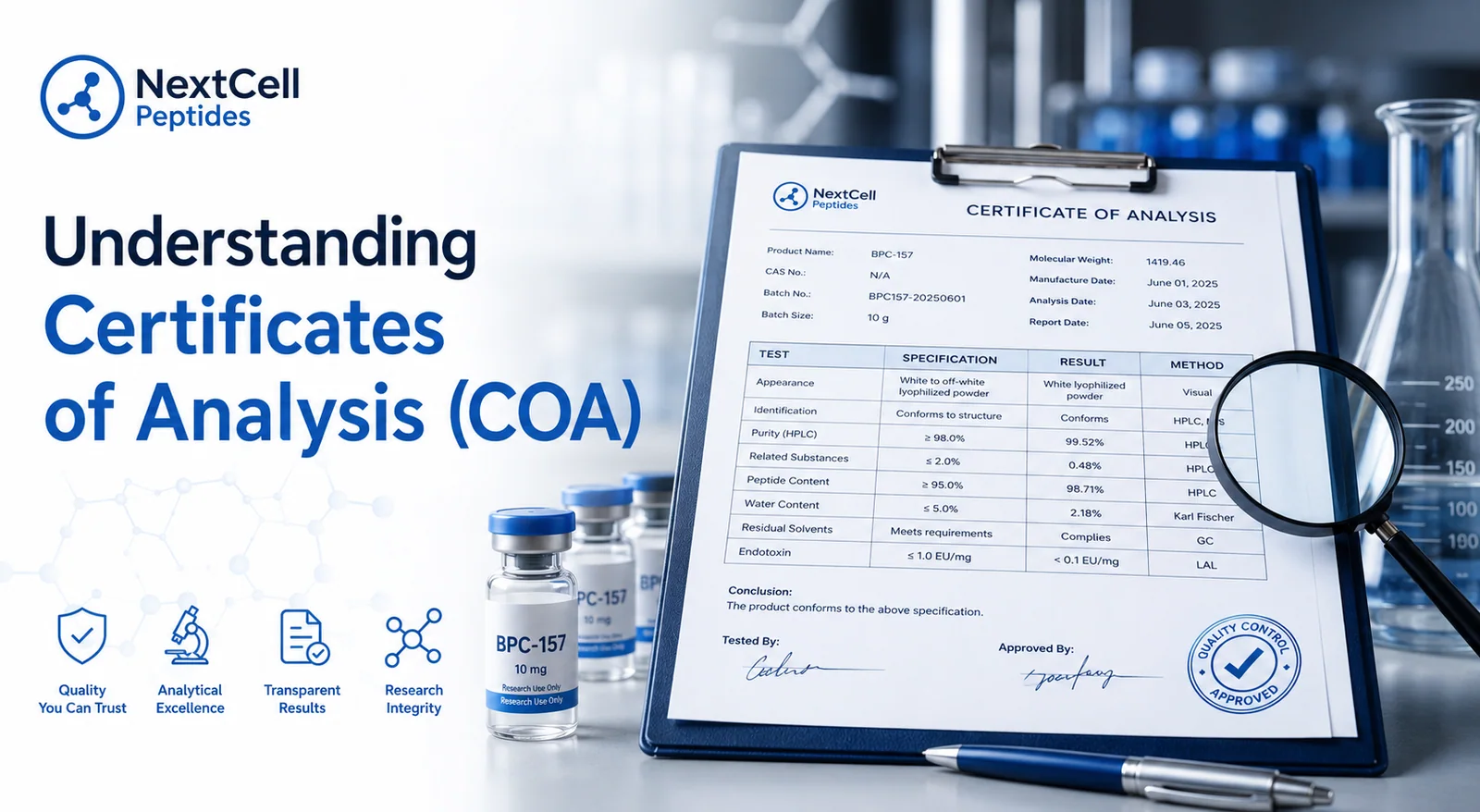
When evaluating research peptide suppliers, few documents receive as much attention as the Certificate of Analysis (COA).
Many buyers have heard that a COA is an important indicator of product quality, yet relatively few understand what the document actually represents or how to interpret the information it contains.
Some suppliers prominently advertise that they provide Certificates of Analysis, while others mention laboratory testing without offering additional context. As a result, buyers are often left wondering what information truly matters and what they should expect from a professional supplier.
Understanding how to read a Certificate of Analysis helps buyers compare products more objectively, evaluate supplier transparency and make more informed purchasing decisions.
This guide explains what a COA is, why it matters, what information is commonly included and how experienced buyers use these documents when comparing research peptide suppliers.
What Is a Certificate of Analysis?
A Certificate of Analysis (COA) is a document that summarizes analytical information for a specific product or production batch.
Depending on the supplier and laboratory, a COA may include information about identity testing, purity analysis, physical appearance and other analytical results generated during quality evaluation.
Rather than functioning as a marketing document, a Certificate of Analysis serves as technical documentation intended to communicate analytical findings in a structured and consistent format.
Because different laboratories use different analytical methods and reporting formats, no two Certificates of Analysis are necessarily identical.
However, professionally prepared COAs generally follow similar principles and contain comparable categories of information.
Why Certificates of Analysis Matter
Research peptides are technical products.
For this reason, buyers often want more than a product description before making a purchasing decision.
A Certificate of Analysis provides additional transparency by presenting analytical information that complements the product page.
Although a COA should never be viewed as the only indicator of product quality, it represents one important component of a broader quality documentation process.
Experienced buyers typically evaluate Certificates of Analysis alongside:
Product specifications
Storage recommendations
Analytical testing methods
Supplier transparency
Educational resources
Manufacturing information
Product labeling
Looking at these factors together provides a more complete understanding than relying on any single document alone.
What Information Is Commonly Included on a COA?
While formats vary between laboratories, most Certificates of Analysis contain similar categories of information.
Common sections include:
Product name
Batch or lot identification
Analytical methods
Purity results
Physical appearance
Testing date
Laboratory reference information
Product specifications
Acceptance criteria
Test results
Some suppliers also include chromatograms, laboratory signatures or additional analytical documentation alongside the Certificate of Analysis.
The level of detail often reflects the supplier's overall commitment to transparency.
Product Identification
One of the first sections buyers should review is product identification.
This confirms which product the Certificate of Analysis applies to.
Depending on the format, this section may include:
Product name
Peptide designation
Product code
Batch number
Lot number
Date of analysis
Clear identification helps ensure that the documentation corresponds to the product being evaluated.
Professional suppliers generally present this information consistently across product pages, labels and accompanying documentation.
Why Batch Numbers Are Important
Batch numbers allow analytical documentation to be associated with a specific production batch.
Rather than representing the product in general, a Certificate of Analysis typically relates to one identifiable batch that underwent analytical evaluation.
For buyers, batch identification improves traceability and helps organize technical documentation.
When suppliers make batch information available where appropriate, it demonstrates a structured approach to quality management and documentation.
Understanding Product Specifications
Most Certificates of Analysis compare analytical findings against predefined product specifications.
These specifications describe the expected characteristics that are evaluated during testing.
Examples may include:
Appearance
Purity criteria
Identity requirements
Analytical method
Physical characteristics
The reported analytical results are then presented alongside these specifications, allowing the laboratory to document whether the measured values meet the defined acceptance criteria.
Understanding this relationship helps buyers interpret the report more effectively rather than focusing only on individual numbers.
Why Transparency Matters More Than Marketing Claims
Many websites advertise phrases such as "high purity" or "laboratory tested."
While these statements may sound reassuring, experienced buyers often look for supporting documentation rather than relying solely on marketing language.
Suppliers that explain their quality processes, provide educational resources and make technical documentation available help buyers evaluate products with greater confidence.
Transparency reduces uncertainty.
Rather than asking customers to simply trust promotional claims, professional suppliers allow buyers to understand the information behind the product.
How to Read a Certificate of Analysis
Many buyers download a Certificate of Analysis, glance at the purity percentage and assume they have seen everything that matters.
In reality, a COA should be interpreted as a complete document rather than a collection of individual numbers.
Each section contributes to the overall understanding of the product and provides context that helps buyers evaluate both the analytical results and the supplier's level of transparency.
Reading the document from beginning to end provides a far more balanced assessment than focusing on a single value.
Understanding the Analytical Method
Most Certificates of Analysis specify the analytical method used during testing.
This information helps explain how the reported results were generated.
For research peptides, analytical methods commonly referenced on a COA may include High-Performance Liquid Chromatography (HPLC) for purity analysis and, depending on the laboratory, additional methods used to confirm product identity.
The analytical method provides important context because test results should always be interpreted according to the procedure used to obtain them.
Professional suppliers typically identify the analytical method rather than presenting results without explanation.
Purity Results Explained
One of the most closely examined sections of a Certificate of Analysis is the reported purity.
Purity describes the proportion of the detected material that corresponds to the primary compound under the analytical conditions used during testing.
While this value is important, experienced buyers understand that it should never be interpreted in isolation.
A reported purity percentage should always be considered together with:
The analytical method used.
Supporting chromatographic data where available.
Product specifications.
Acceptance criteria.
Overall supplier documentation.
Looking at the complete analytical package provides a more meaningful understanding than relying solely on a single percentage.
Acceptance Criteria vs. Test Results
Many Certificates of Analysis include two separate columns that are sometimes confused.
The first describes the predefined acceptance criteria, while the second presents the actual analytical results obtained during testing.
Acceptance criteria define the expected characteristics that the product should meet.
The reported test results show how the analyzed batch performed against those predefined specifications.
This comparison allows buyers to understand not only the measured values but also whether the laboratory determined that the batch met its established quality requirements.
Why Batch Numbers Improve Traceability
Professional documentation should make it clear which production batch was analyzed.
Batch identification allows analytical results to be linked to a specific manufacturing lot rather than being presented as general product information.
For buyers, this improves documentation consistency and supports better traceability throughout the quality process.
Suppliers that organize analytical documentation around identifiable batches often demonstrate a more structured approach to quality management.
Understanding Appearance
Many buyers overlook the appearance section because it seems straightforward.
However, documenting physical appearance forms an important part of product identification and quality documentation.
Depending on the product, appearance descriptions may include characteristics such as:
White powder
Off-white powder
Lyophilized powder
Physical state
Although appearance alone does not determine product quality, it contributes to the overall analytical record and complements the laboratory findings.
Why Dates Matter
Certificates of Analysis commonly include one or more dates relating to the analytical process.
These may include the testing date, report date or batch release date, depending on the reporting format used.
Including these dates improves documentation transparency and helps place the analytical results within the context of a specific production batch.
Buyers should expect documentation that is organized, clearly presented and easy to understand.
Should Every Supplier Provide a COA?
Not every supplier publishes Certificates of Analysis publicly.
Some provide them upon request, while others include them with individual batches or make them available through customer accounts.
The approach varies between companies.
Regardless of how documentation is delivered, buyers benefit when suppliers communicate clearly about the availability of analytical information.
Professional suppliers generally explain what documentation is available, how it relates to the product and what each document is intended to show.
Common Mistakes Buyers Make
When reviewing Certificates of Analysis, several common mistakes appear repeatedly.
These include:
Looking only at the reported purity percentage.
Ignoring the analytical method.
Overlooking batch identification.
Comparing reports from different laboratories without considering the testing methods used.
Assuming all COAs follow the same reporting format.
Focusing on marketing claims instead of technical documentation.
Avoiding these mistakes allows buyers to evaluate products more objectively and compare suppliers using a broader range of quality indicators.
How to Compare Certificates of Analysis from Different Suppliers
When comparing research peptide suppliers, it is rarely enough to ask whether a Certificate of Analysis is available. The quality of the documentation itself is often more informative than simply having a COA.
Instead of focusing on a single number, evaluate the document as a whole.
Ask yourself:
Is the product clearly identified?
Is the batch number included?
Is the analytical method specified?
Are the test results presented clearly?
Are acceptance criteria shown?
Does the documentation appear complete and professionally organized?
Does the supplier explain what the results actually mean?
Suppliers that invest in clear documentation often demonstrate a broader commitment to transparency throughout their quality process.
What a Professional Supplier Should Provide
A Certificate of Analysis should be viewed as one part of a comprehensive quality system rather than the only indicator of product quality.
Professional suppliers often complement their analytical documentation with additional information that helps buyers make informed decisions.
Examples include:
Clear product specifications
Storage recommendations
Batch identification
Educational resources
Transparent manufacturing information
Product labeling guidance
Explanations of analytical testing methods
Consistent documentation across product pages
The more context a supplier provides, the easier it becomes for buyers to understand the information behind the product instead of relying solely on marketing claims.
Frequently Asked Questions
Does every research peptide come with a Certificate of Analysis?
Not necessarily. Some suppliers publish Certificates of Analysis for every batch, while others provide them upon request or only for selected products. Availability varies between suppliers and laboratories.
Is a higher purity percentage always better?
Purity is an important analytical measurement, but it should never be evaluated without considering the testing method, laboratory documentation and the overall quality information provided by the supplier.
Can two laboratories produce different COAs for the same product?
Yes. Different laboratories may use different analytical methods, reporting formats and instrumentation. As a result, Certificates of Analysis can vary while still describing the same product.
Does a COA guarantee product quality?
A Certificate of Analysis provides valuable analytical information, but it represents only one part of a complete quality assessment. Manufacturing standards, storage conditions, supplier transparency and quality control procedures should also be considered.
Should buyers request additional documentation?
Depending on the intended evaluation, buyers may also wish to review supporting analytical information, product specifications or additional quality documentation where available.
Related Guides
To develop a broader understanding of research peptide quality, these guides may also be helpful:
Together, these resources provide a more complete picture of how research peptides are manufactured, analyzed, documented and evaluated before purchase.
Summary
A Certificate of Analysis is much more than a document displaying a purity percentage.
When interpreted correctly, it provides valuable insight into analytical testing, batch identification, product specifications and supplier transparency.
Experienced buyers rarely evaluate a COA in isolation. Instead, they consider it alongside manufacturing information, analytical methods, product labeling, storage recommendations and the supplier's overall commitment to quality documentation.
Understanding how to interpret Certificates of Analysis allows buyers to compare suppliers more objectively, ask better questions and make purchasing decisions with greater confidence.
Key Takeaways
A Certificate of Analysis summarizes analytical information for a specific production batch.
Product identification and batch numbers improve documentation traceability.
Purity results should always be interpreted alongside the analytical method used.
Acceptance criteria help place laboratory results into context.
Professional suppliers support COAs with clear educational resources and transparent documentation.
Evaluating multiple quality indicators provides a more balanced assessment than relying on a single number.
Well-documented products help buyers compare research peptide suppliers with greater confidence.