Guides
CJC-1295 + Ipamorelin: The Complete Research Peptide Buyer's Guide (2026)
Learn how to evaluate CJC-1295 + Ipamorelin research peptides using manufacturing standards, HPLC purity testing, Certificates of Analysis (COAs), batch traceability, storage guidance, and supplier transparency. This comprehensive buyer's guide explains the key quality indicators researchers should consider before purchasing research-grade peptides.
FutureCell Research Team · 17 min read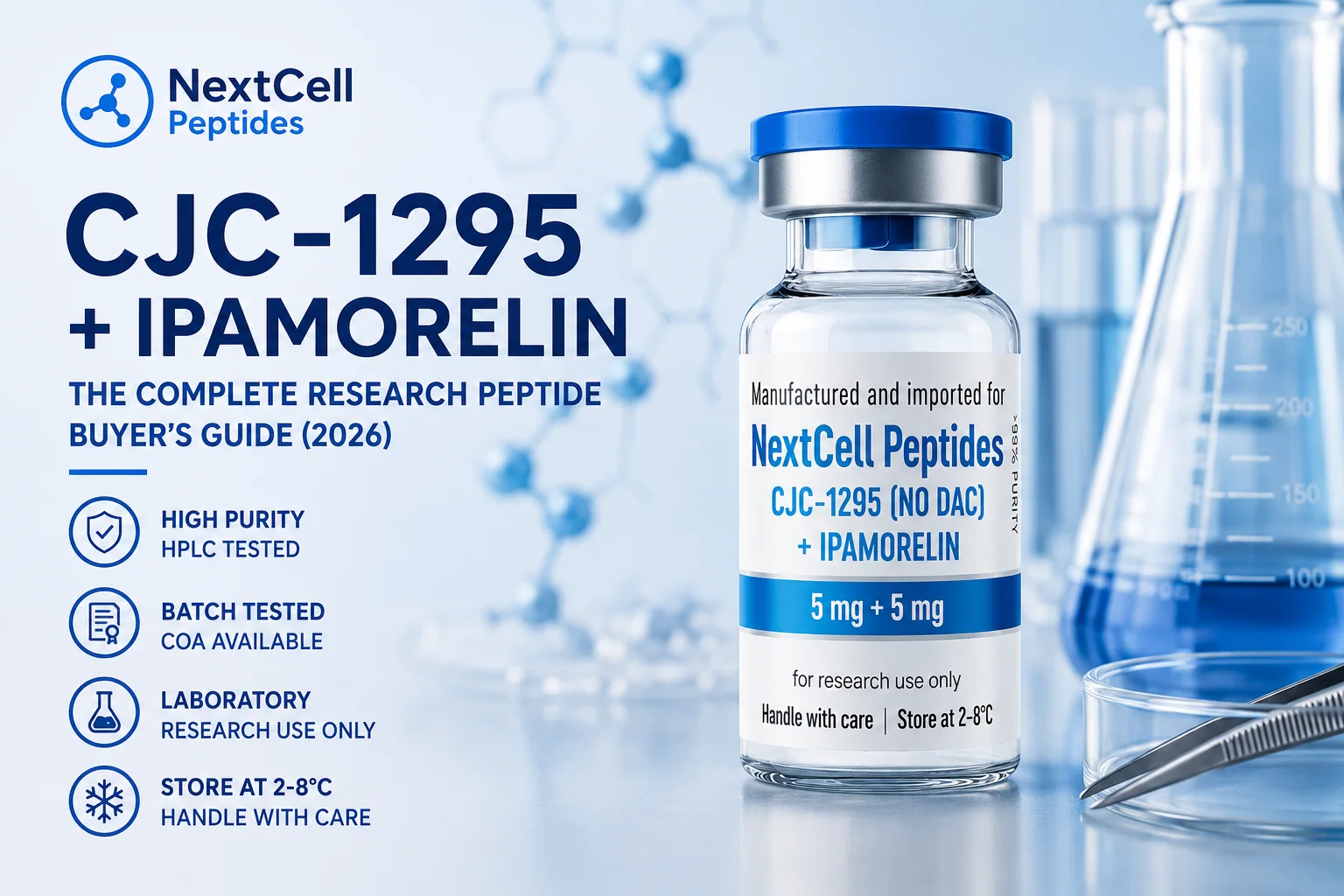
Introduction
CJC-1295 + Ipamorelin is one of the most widely recognized peptide combinations in laboratory research, bringing together two distinct research peptides that are frequently investigated in the same experimental settings. Researchers looking for current product specifications can also visit the CJC-1295 + Ipamorelin Product Page.
Researchers comparing suppliers are often presented with products that appear nearly identical. Many advertise high purity, research-grade manufacturing, or laboratory testing, yet the quality of manufacturing, analytical documentation, batch consistency, and supplier transparency can vary significantly between suppliers.
Understanding these differences is essential when evaluating any research peptide combination. Product quality extends beyond the peptide itself and includes manufacturing standards, independent analytical testing, Certificates of Analysis (COAs), storage recommendations, batch traceability, and the supplier's commitment to transparent quality assurance.
This guide provides a comprehensive educational overview of CJC-1295 + Ipamorelin for laboratory research. Rather than focusing on marketing claims, it explains the quality indicators, documentation, and evaluation frameworks experienced research buyers use when comparing suppliers. Readers looking for current product specifications can also visit the CJC-1295 + Ipamorelin Product Page, while those interested in broader peptide quality concepts may wish to explore Research Peptides Explained before continuing.
Table of Contents
What Is CJC-1295 + Ipamorelin?
Why Are These Peptides Combined?
Manufacturing Standards
How Quality Is Verified
Understanding HPLC Purity Testing
Certificates of Analysis (COAs)
Batch Identification and Traceability
Storage and Stability
Choosing a High-Quality CJC-1295 + Ipamorelin Supplier
Frequently Asked Questions
Related Research Guides
Summary
What Is CJC-1295 + Ipamorelin?
CJC-1295 + Ipamorelin is a combination of two synthetic research peptides that are frequently supplied together for laboratory investigation. Although each peptide has distinct structural characteristics, they are commonly included within the same research protocols, making combination products increasingly common among research peptide suppliers.
CJC-1295 is a synthetic peptide designed for research involving growth hormone-releasing hormone (GHRH) pathways. Depending on the formulation, CJC-1295 may be supplied with or without Drug Affinity Complex (DAC). Products labeled CJC-1295 (No DAC) contain the modified peptide without the extended half-life technology associated with DAC formulations.
Ipamorelin is a separate synthetic research peptide that has its own molecular structure and laboratory applications. Unlike CJC-1295, it belongs to a different peptide class and is studied independently before being evaluated in combination research.
Because two individual peptides are present within a single vial, evaluating quality involves more than verifying the identity of one ingredient. Researchers should confirm that both peptide components are manufactured under appropriate quality standards and supported by reliable analytical documentation, including Certificates of Analysis (COAs) and HPLC purity testing.
Rather than viewing CJC-1295 + Ipamorelin as a single compound, it is more accurate to consider it a combination research product containing two individually manufactured peptides that are supplied together for laboratory use.
Why Are CJC-1295 and Ipamorelin Commonly Supplied Together?
Many research peptide suppliers offer CJC-1295 (No DAC) and Ipamorelin as a combined research product because both peptides are frequently investigated within similar laboratory research areas. Supplying both peptides together provides researchers with a standardized combination that simplifies product selection and inventory management compared with sourcing each peptide separately.
From a manufacturing perspective, however, combination products introduce additional quality considerations. Each peptide must first be produced individually before formulation into the final product, meaning the quality of the finished vial depends on the consistency of both peptide components rather than only one.
This makes supplier transparency particularly important. Researchers evaluating CJC-1295 + Ipamorelin should consider whether the manufacturer provides batch-specific analytical documentation, clear product labeling, manufacturing information, and appropriate storage recommendations alongside the finished product.
High-quality combination products are typically evaluated using the same objective criteria applied to individual research peptides, including manufacturing standards, analytical testing, batch traceability, and documentation quality. Buyers who understand these factors are better equipped to compare suppliers using measurable quality indicators instead of relying solely on advertised purity percentages or marketing claims.
Manufacturing Standards
The overall quality of a CJC-1295 + Ipamorelin research product begins long before analytical testing or final packaging. Manufacturing processes influence product consistency, purity, stability, and the reliability of the documentation supplied with each production batch.
Unlike single-peptide products, combination formulations require two individual peptide components to be manufactured under controlled conditions before being formulated into the finished research product. Consistency throughout each manufacturing stage helps reduce variability between production batches and supports reliable laboratory research.
Reputable manufacturers typically follow standardized production procedures, including raw material verification, peptide synthesis, purification, lyophilization, quality control, and final packaging. These processes are designed to maintain product consistency while minimizing the risk of contamination or manufacturing variability.
Researchers evaluating CJC-1295 + Ipamorelin should look beyond advertised purity percentages and consider whether the supplier provides clear information about manufacturing standards, quality assurance procedures, and supporting analytical documentation. Understanding how research peptides are manufactured provides valuable context when comparing suppliers that appear similar at first glance.
How CJC-1295 + Ipamorelin Quality Is Verified
Quality verification involves confirming that the finished research product matches its documented specifications using objective analytical methods rather than marketing claims. Reliable suppliers typically evaluate multiple aspects of product quality before releasing a production batch.
Analytical verification commonly includes identity confirmation, purity assessment, appearance, and batch-specific documentation. Because CJC-1295 + Ipamorelin contains two peptide components, researchers should ensure that the accompanying documentation clearly identifies the finished combination product rather than referring only to a single peptide.
Quality verification also extends beyond laboratory testing. Accurate product labeling, batch identification, manufacturing consistency, storage recommendations, and transparent documentation all contribute to the overall confidence researchers can place in a supplier.
Rather than relying on one quality indicator alone, experienced buyers evaluate the complete quality framework, including manufacturing standards, analytical testing, documentation, and supplier transparency. Understanding research peptide purity and Certificates of Analysis (COAs) helps researchers interpret this information more effectively when comparing different suppliers.
Understanding HPLC Purity Testing
High-Performance Liquid Chromatography (HPLC) is one of the most widely used analytical techniques for evaluating research peptide purity. The method separates compounds within a sample and generates a chromatogram that helps laboratories assess the composition of the finished product.
For combination products such as CJC-1295 + Ipamorelin, HPLC testing provides valuable analytical information regarding the purity of the formulated product supplied for research purposes. While purity percentages are often highlighted by suppliers, researchers should remember that HPLC results represent only one component of a broader quality assessment.
Analytical reports become significantly more valuable when they are linked to a specific production batch through batch numbers and supporting documentation. This allows researchers to verify that the analytical results correspond directly to the product they have received.
Researchers who are unfamiliar with chromatograms may benefit from learning how to read an HPLC chromatogram before comparing different suppliers or reviewing laboratory reports.
Certificates of Analysis (COAs)
A Certificate of Analysis (COA) is one of the most valuable documents researchers can use when evaluating a CJC-1295 + Ipamorelin research product. Rather than relying solely on marketing claims or advertised purity percentages, a batch-specific COA provides documented analytical information relating to the product supplied.
A comprehensive COA typically includes the product name, batch or lot number, analytical method, testing date, and purity results obtained during laboratory analysis. When available, additional information such as appearance, molecular identity, storage recommendations, and manufacturing references may also be included.
For combination products, researchers should verify that the COA specifically refers to the finished CJC-1295 + Ipamorelin formulation rather than documentation prepared for only one peptide component. Matching the batch number shown on the product label with the batch number listed on the COA helps confirm that the documentation corresponds to the product received.
A COA should be considered alongside other quality indicators—including manufacturing standards, analytical testing, and supplier transparency—rather than viewed as the only measure of product quality.
Batch Identification and Traceability
Batch identification is an essential component of quality assurance for combination research peptides. Every production batch should be assigned a unique batch or lot number that links the finished product to its corresponding analytical documentation.
Traceability allows researchers to verify that Certificates of Analysis (COAs), HPLC reports, and other supporting laboratory documentation relate to the exact batch they have received. This improves transparency and reduces uncertainty when comparing products from different suppliers.
For combination formulations such as CJC-1295 + Ipamorelin, accurate batch identification becomes even more important because multiple peptide components are involved in the manufacturing process. Consistent documentation demonstrates that quality control procedures extend throughout production, formulation, packaging, and final release.
Reliable suppliers treat batch traceability as part of a broader quality management system that supports analytical consistency, documentation accuracy, and long-term manufacturing reliability.
Storage and Stability
Proper storage helps preserve the quality and stability of lyophilized research peptides before laboratory use. Most CJC-1295 + Ipamorelin products are supplied as a lyophilized peptide, a freeze-drying process designed to improve stability during storage and transportation.
Researchers should always follow the manufacturer's storage recommendations, as storage conditions may vary depending on the formulation, packaging, and intended laboratory application. Factors such as temperature, humidity, direct light, and repeated handling can all influence long-term product stability.
Storage guidance provided by the supplier should be supported by clear documentation rather than general assumptions. Reviewing storage recommendations together with analytical documentation provides a more complete understanding of how product quality is maintained from manufacturing through laboratory use.
Researchers unfamiliar with peptide storage principles may benefit from reviewing How to Store Lyophilized Peptides Correctly for a more detailed explanation of recommended handling practices.
Choosing a High-Quality CJC-1295 + Ipamorelin Supplier
Comparing suppliers involves evaluating far more than advertised purity or price. Experienced research buyers assess the complete quality framework surrounding a product before making purchasing decisions.
A reliable supplier should provide:
Batch-specific Certificates of Analysis
Transparent HPLC purity documentation
Clear batch identification and traceability
Consistent manufacturing standards
Appropriate storage recommendations
Accurate product labeling
Professional customer support
Transparent quality assurance procedures
Rather than focusing on a single specification, researchers should evaluate how these quality indicators work together. Suppliers that provide comprehensive documentation and maintain consistent quality practices generally offer greater confidence than those relying primarily on marketing claims.
Researchers comparing multiple vendors may also find it useful to review How to Compare Research Peptide Suppliers before evaluating individual products.
Frequently Asked Questions
What is CJC-1295 + Ipamorelin?
CJC-1295 + Ipamorelin is a combination of two research peptides frequently studied together in laboratory research. This guide focuses on evaluating product quality, documentation, manufacturing transparency, and supplier standards rather than discussing experimental outcomes or human use.
Why are Certificates of Analysis (COAs) important?
A Certificate of Analysis (COA) provides laboratory documentation relating to a specific production batch. Researchers often review COAs to verify analytical testing, purity results, batch identification, and manufacturing transparency before selecting a supplier.
Is HPLC testing enough to evaluate quality?
HPLC purity testing is an important quality indicator, but it should not be considered in isolation. Researchers should also evaluate batch traceability, manufacturing standards, supplier transparency, storage recommendations, and supporting analytical documentation.
Why do different suppliers charge different prices?
Price differences may reflect variations in manufacturing quality systems, independent analytical testing, documentation standards, production scale, packaging quality, and customer support. The lowest advertised price does not necessarily represent the strongest overall value.
How should lyophilized CJC-1295 + Ipamorelin be stored?
Storage recommendations vary depending on the manufacturer and formulation. Researchers should always follow the supplier's documented storage guidance to help preserve the integrity of lyophilized research peptides during storage and laboratory handling.
Proper temperature control, protection from moisture, and careful handling all contribute to maintaining product stability before laboratory use. Researchers should always follow the storage recommendations provided by the manufacturer and any accompanying analytical documentation.
What should I compare before purchasing?
Researchers often compare:
Batch-specific COAs
HPLC purity documentation
Batch traceability
Manufacturing consistency
Storage guidance
Supplier transparency
Product labeling
Customer support
Educational resources
Evaluating these factors together provides a more complete picture than comparing purity percentages alone.
Related Research Guides
Readers interested in learning more about research peptide quality may also find these guides helpful:
Summary
Choosing a CJC-1295 + Ipamorelin research product involves evaluating far more than the advertised purity or product description. High-quality suppliers demonstrate transparency through batch-specific documentation, analytical testing, manufacturing consistency, clear storage guidance, and reliable quality assurance procedures.
Throughout this guide, we explored the importance of HPLC testing, Certificates of Analysis, batch traceability, storage practices, supplier evaluation, and the factors researchers commonly consider when comparing products.
Rather than relying on a single quality indicator, experienced research buyers evaluate the complete quality framework supporting each product. This comprehensive approach helps reduce uncertainty and promotes more informed purchasing decisions.
Researchers wishing to continue their evaluation can explore the CJC-1295 + Ipamorelin Product Page, review Understanding Certificates of Analysis (COAs), or browse additional educational resources available throughout the FutureCell Peptides Research Library.