
Research
Peptide Reconstitution Protocol for Research Quality
Build a reliable peptide reconstitution protocol for research: solvent selection, aseptic handling, documentation, storage, and quality controls that most matter.
FutureCell Research Team · 7 min read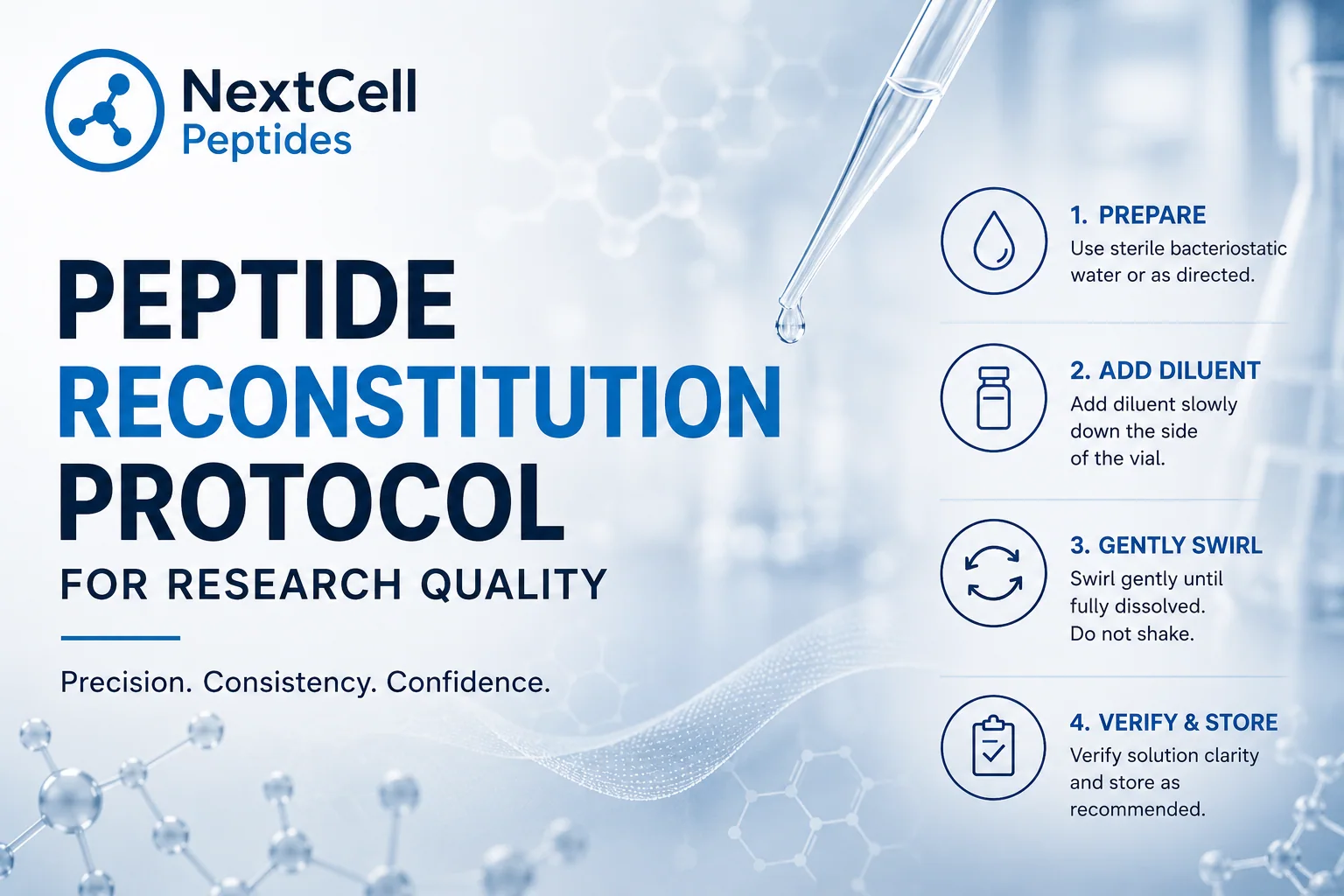
A lyophilized peptide vial may look straightforward, but the quality of the resulting research solution depends on more than adding liquid to powder. A sound peptide reconstitution protocol protects traceability, supports repeatable experimental conditions, and helps researchers avoid mistaking handling issues for meaningful experimental observations.
For research customers, the starting point is not a generic solvent or a copied protocol from another peptide. It is the product specification, the peptide’s known physicochemical characteristics, and the requirements of the intended experimental system. Reconstitution should remain a documented laboratory preparation process, not a human-use or administration protocol.
What peptide reconstitution means in a research setting
Reconstitution is the controlled return of a lyophilized peptide to solution using a suitable solvent. Lyophilization removes water under controlled conditions, producing a dry material that can offer improved stability during transport and storage. Once a peptide is placed in solution, however, its stability can change substantially depending on pH, solvent composition, concentration, temperature, light exposure, and repeated handling.
That distinction matters. A vial can meet a high purity specification at the point of testing while an improperly prepared solution may develop issues such as incomplete dissolution, aggregation, adsorption to surfaces, or degradation over time. A dependable protocol therefore considers the material before, during, and after reconstitution.
For compounds such as BPC-157, GHK-Cu, TB-500, Semax, Epitalon, MOTS-c, or CJC-1295 with Ipamorelin, researchers should not assume that one preparation approach applies equally to every product. Sequence length, charge distribution, hydrophobicity, formulation, and intended assay conditions all influence solvent compatibility.
Start with the product documentation
Before opening a vial, review the label, product specification, and Certificate of Analysis. These documents establish the product identity, stated quantity, batch reference, purity result, and analytical information available for that lot. HPLC is commonly used to assess purity profiles, while mass spectrometry may be used to confirm molecular identity. Together, these data provide a meaningful quality baseline for research material.
A Certificate of Analysis does not replace proper handling after delivery. It documents the tested batch, not every condition a reconstituted solution may encounter in an individual laboratory or research environment. For that reason, record the batch number alongside the preparation date, solvent used, final concentration, storage condition, and any observed changes in appearance.
At FutureCell Peptides, transparent batch documentation and independent laboratory verification are part of the quality framework that supports informed research purchasing. The same attention to detail should continue through preparation and storage.
Check the vial before preparation
Inspect the vial without making assumptions based on appearance alone. Lyophilized peptide may present as a compact cake, powder, film, or small amount of material at the base of the vial. Differences in appearance can result from the peptide, fill volume, and freeze-drying process, and do not automatically indicate a quality concern.
The more useful checks are practical: confirm that the vial label matches the intended product, verify the batch reference, inspect the closure for damage, and make sure the material has been stored according to the supplier’s stated conditions. If the label, documentation, or vial integrity is unclear, pause the preparation process and resolve that question before proceeding.
Building a peptide reconstitution protocol
A useful peptide reconstitution protocol is a controlled framework rather than a one-size-fits-all recipe. Its purpose is to produce a solution that is suitable for the defined research application and can be reproduced later.
1. Define the experimental requirement first
Choose the intended working concentration and experimental matrix before selecting a solvent. A peptide prepared for an analytical assay may require a different approach from one prepared for cell-based, biochemical, or stability research. The final matrix must be compatible with the downstream method, including its pH range, salt tolerance, detection technique, and potential sensitivity to organic components.
This planning step prevents a common error: preparing a highly concentrated stock that appears convenient but proves difficult to dissolve, unstable, or incompatible with the final assay. Lower concentration is not always better, and higher concentration is not always more efficient. The appropriate choice depends on the peptide and the research design.
2. Select a compatible solvent system
Solvent selection is one of the most consequential decisions in peptide preparation. Depending on the peptide and research method, a laboratory may consider purified water, aqueous buffers, acidic or basic modifiers, saline-based systems, or a limited proportion of an organic co-solvent. The correct option depends on peptide solubility and downstream compatibility, not on a universal preference.
Highly hydrophobic sequences may require a different solvent strategy than short, readily water-soluble peptides. Charged peptides can be sensitive to pH and ionic strength. Copper-containing peptides such as GHK-Cu also warrant particular care because metal complex stability and interactions with buffers can affect research results.
Use the supplier’s available technical guidance where provided, and validate the selected solvent within the relevant research setting. If a solvent is necessary to dissolve the material but is unsuitable for the final assay, a controlled dilution plan may be required. Document both stages rather than treating them as one step.
3. Use clean, controlled handling practices
The preparation environment should reduce avoidable contamination and mix-ups. Use suitable clean laboratory equipment, clearly identified containers, and an appropriate aseptic workflow for the research application. Confirm solvent identity before use, especially when several buffers or modifiers are present in the workspace.
Introduce the solvent carefully and allow the lyophilized material time to hydrate. Excessive agitation can create foam or place unnecessary stress on some peptide solutions. Gentle mixing is generally preferable to vigorous shaking, but the appropriate handling method should always reflect the peptide’s characteristics and the laboratory’s validated procedure.
Visual clarity can be helpful, but it is not proof of identity, purity, or stability. A clear solution may still require analytical confirmation for critical studies, while a transiently cloudy solution may indicate an incompatibility that should be investigated rather than ignored.
4. Record the preparation in a usable format
A protocol is only repeatable if another researcher can understand what happened. At minimum, record the peptide name, batch number, labeled amount, solvent identity, preparation date, concentration, container type, storage condition, and preparer. Add observations such as dissolution time, visible particulates, color changes, or unexpected precipitation.
For higher-value or method-development work, consider assigning the preparation its own internal sample identifier. This makes it easier to link experimental results back to the original vial and the exact solution used. It also supports more meaningful troubleshooting if results vary between runs.
Storage, aliquoting, and stability considerations
Once reconstituted, a peptide solution is usually more vulnerable to environmental exposure than the original lyophilized material. Temperature cycling, repeated vial access, light, oxygen, and contact with certain surfaces can all influence stability. The degree of risk depends on the peptide, solvent system, concentration, and duration of storage.
Aliquoting can reduce repeated freeze-thaw exposure when a research plan requires multiple uses of the same prepared material. The trade-off is that every additional transfer creates another opportunity for loss, contamination, or labeling error. For small-scale work, the best approach is often the simplest validated approach that minimizes handling.
Use storage conditions supported by product guidance and the needs of the study. For time-sensitive or high-precision work, do not rely solely on general stability assumptions. Confirm stability through an appropriate analytical approach, such as comparing chromatographic profiles at defined time points, when the research question warrants it.
Recognize signs that need investigation
Unexpected precipitation, persistent turbidity, a new color change, damaged container closure, or inconsistency with prior preparations should be documented and assessed. These observations do not diagnose a cause by themselves. They may reflect solvent incompatibility, concentration effects, temperature exposure, contamination, or physical interaction with the container.
When a prepared solution is central to a study, analytical verification is more informative than visual inspection. A repeat HPLC assessment, where available and appropriate, can help determine whether the observed issue is associated with a changed purity profile or whether the cause lies elsewhere in the workflow.
Common protocol errors that affect research quality
The most frequent failures are procedural rather than dramatic. Using an unverified solvent, overlooking batch documentation, preparing a concentration that exceeds practical solubility, and failing to label a newly prepared solution can all compromise the usefulness of the material.
Another common issue is treating supplier purity as a guarantee of performance in every assay. High-purity, batch-tested peptide is an essential foundation, but research suitability also depends on correct storage, preparation, experimental controls, and method compatibility. Product quality and handling quality work together.
Researchers comparing peptide suppliers should therefore look beyond a stated purity percentage. Clear labeling, a batch-specific Certificate of Analysis, transparent analytical methods, appropriate packaging, and reliable EU-based fulfillment all contribute to a more controlled starting point for research work.
Make the protocol fit the peptide and the study
A well-designed reconstitution process does not need to be unnecessarily complicated. It needs to be specific: specific to the peptide, the solvent, the final research matrix, and the level of confidence required by the project. Standardizing those details turns a basic preparation task into a more reliable part of the research workflow.
When the material, documentation, and handling process are aligned, reconstitution becomes easier to reproduce, easier to troubleshoot, and more useful for generating interpretable research data.