
Guides
TB-500: The Complete Research Peptide Buyer's Guide (2026)
Discover everything researchers should know about TB-500, from peptide structure and biological research to manufacturing, HPLC purity, Certificates of Analysis (COAs), storage, and how to evaluate research-grade quality.
FutureCell Research Team · 18 min read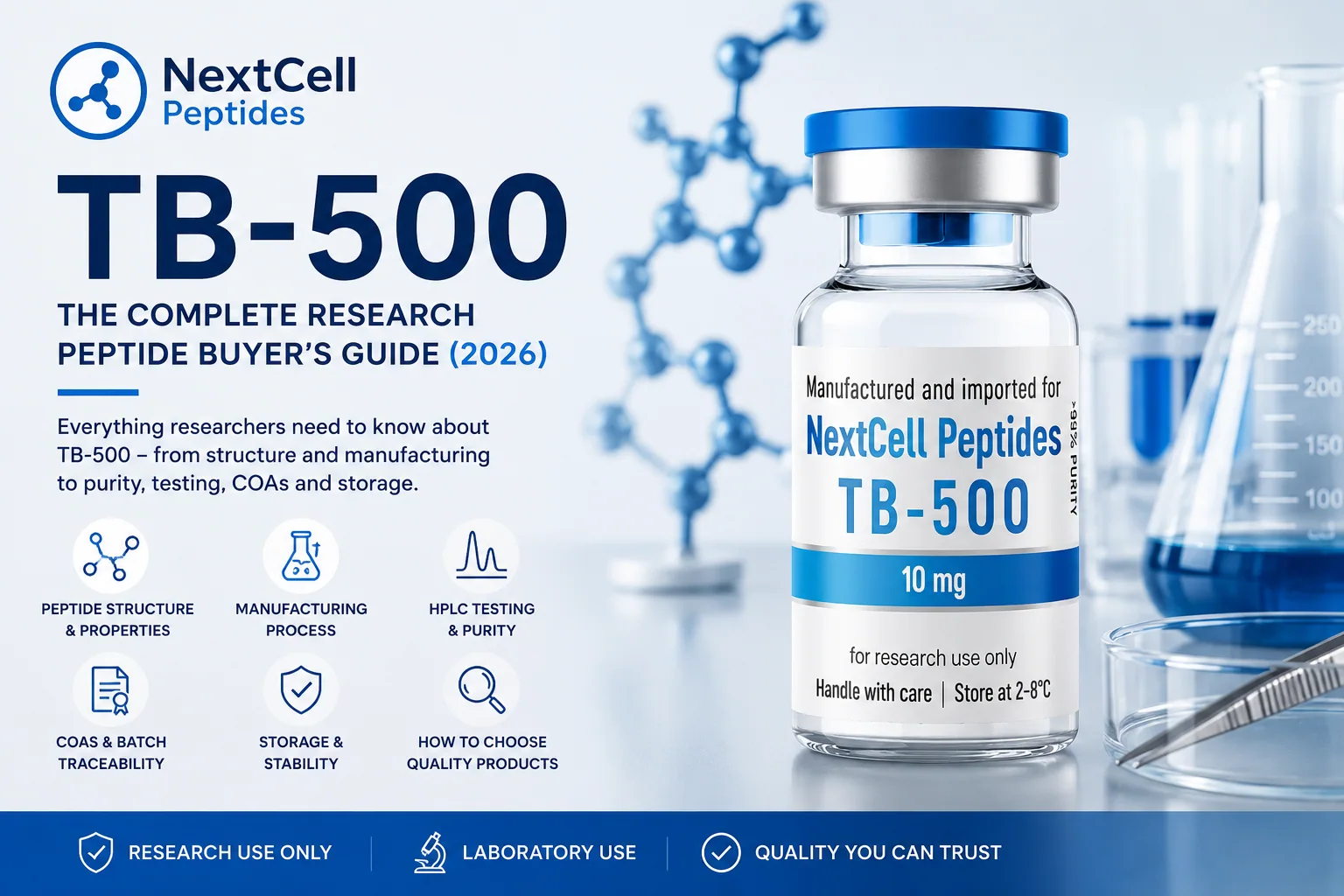
Introduction
TB-500 has become one of the most widely discussed research peptides within laboratory studies focusing on connective tissue biology, cellular migration, angiogenesis, and regenerative processes. Although frequently mentioned alongside other research peptides such as BPC-157, TB-500 represents a distinct molecule with different biological characteristics, research applications, and quality considerations.
For researchers and buyers, understanding these differences is essential. Choosing a research-grade peptide involves far more than comparing purity percentages or price. Manufacturing quality, analytical testing, batch consistency, storage conditions, and supplier transparency all contribute to the overall reliability of a research product.
This guide provides a comprehensive overview of TB-500 from a research perspective. It explains what TB-500 is, how it is manufactured, why it is supplied as a lyophilized powder, how quality is evaluated, and what experienced buyers consider before selecting a supplier.
Throughout this guide, all information is presented for educational and laboratory research purposes only. No medical claims, treatment recommendations, or human use guidance are provided.
Researchers looking for a laboratory-grade TB-500 may also wish to review the documentation available for the TB-500 product page before comparing suppliers.
Table of Contents
What Is TB-500?
TB-500 vs Thymosin Beta-4
How TB-500 Works in Laboratory Research
Why Researchers Study TB-500
Common Areas of Scientific Investigation
Manufacturing and Lyophilization
How Research-Grade Quality Is Evaluated
Understanding HPLC Purity
Certificates of Analysis (COAs)
Storage and Stability
How to Choose a High-Quality Supplier
Frequently Asked Questions
Summary
What Is TB-500?
TB-500 is a synthetic peptide that represents an active region of the naturally occurring protein Thymosin Beta-4 (Tβ4). Rather than using the complete protein, laboratory researchers often investigate TB-500 because it contains the sequence believed to participate in several biological interactions associated with cellular movement and tissue organization.
Unlike full-length Thymosin Beta-4, TB-500 is considerably smaller, making it easier to manufacture through modern peptide synthesis techniques while maintaining a consistent molecular structure suitable for laboratory investigation.
Scientific interest in TB-500 has expanded because Thymosin Beta-4 itself has been associated with numerous biological processes, including:
Cell migration
Cytoskeletal organization
Connective tissue remodeling
Angiogenesis
Cellular differentiation
Wound-healing biology
It is important to distinguish between observations made in laboratory and preclinical research and conclusions regarding clinical use. Current interest in TB-500 primarily stems from its value as a research compound for investigating biological mechanisms rather than approved therapeutic applications.
TB-500 vs Thymosin Beta-4
Although the names are often used interchangeably online, TB-500 and Thymosin Beta-4 are not the same molecule.
TB-500
Synthetic peptide fragment
Represents the biologically active region of Thymosin Beta-4
Produced using peptide synthesis
Widely available for laboratory research
Commonly investigated in tissue biology and cellular migration studies
Thymosin Beta-4
Naturally occurring protein
Full-length biological molecule
Present in many tissues throughout the body
Investigated in basic biological research
Contains multiple functional regions beyond the TB-500 sequence
Understanding this distinction helps researchers interpret published literature more accurately. Some studies investigate the complete Thymosin Beta-4 protein, while others specifically examine the synthetic TB-500 fragment. Although related, these are not interchangeable experimental models.
How TB-500 Works in Laboratory Research
Current laboratory research suggests that TB-500 interacts with biological pathways involved in cellular movement and cytoskeletal dynamics.
The cytoskeleton is an internal structural framework that allows cells to maintain shape, migrate, divide, and respond to their surrounding environment. Many biological processes—including tissue development, wound repair, and angiogenesis—depend on coordinated cytoskeletal organization.
Because of this relationship, TB-500 has attracted attention in research investigating:
Cell migration
Actin regulation
Tissue remodeling
Connective tissue biology
Angiogenesis
Cellular repair mechanisms
Researchers continue exploring these mechanisms to better understand how complex biological systems respond during regeneration and tissue organization.
Importantly, these investigations remain focused on laboratory and experimental settings rather than approved medical applications.
Why Researchers Study TB-500
Interest in TB-500 extends across multiple scientific disciplines because tissue remodeling involves numerous interconnected biological systems.
Examples include:
Connective Tissue Research
Laboratory models often investigate how connective tissues respond during remodeling and recovery processes. This includes studies involving tendons, ligaments, fascia, and extracellular matrix organization.
Cell Migration
Cell migration plays an essential role in embryonic development, immune function, tissue remodeling, and wound-healing biology. TB-500 is frequently studied because of its relationship with proteins involved in cellular movement.
Angiogenesis Research
Angiogenesis refers to the formation of new blood vessels. Researchers investigate this process in many areas of biology, including tissue engineering and regenerative science.
Cytoskeletal Organization
Proper organization of actin filaments allows cells to move efficiently, communicate with neighboring cells, and respond to injury. TB-500 remains an active topic within studies examining these molecular interactions.
Common Areas of Scientific Investigation
Published laboratory literature has explored TB-500 across a wide variety of research fields.
Common examples include:
Connective tissue biology
Tendon research
Ligament research
Skeletal muscle biology
Cellular migration
Extracellular matrix remodeling
Angiogenesis
Fibroblast activity
Cytoskeletal regulation
Experimental wound-healing models
The breadth of these research areas illustrates why TB-500 continues to receive significant scientific attention.
However, the existence of ongoing research should not be interpreted as evidence of established clinical efficacy.
Manufacturing and Lyophilization
Research-grade TB-500 is typically manufactured using solid-phase peptide synthesis (SPPS), a well-established laboratory technique capable of producing highly purified peptide chains with precise amino acid sequences.
Following synthesis, the peptide undergoes purification, commonly through High-Performance Liquid Chromatography (HPLC), before analytical testing confirms identity and purity.
Most suppliers then convert the purified peptide into a lyophilized powder.
Lyophilization—also known as freeze-drying—removes water under carefully controlled temperature and vacuum conditions. This process offers several advantages:
Improved long-term stability
Easier transportation
Reduced degradation during storage
Better preservation of peptide integrity
Simplified laboratory handling before preparation
For these reasons, nearly all high-quality research peptides are supplied in lyophilized form rather than as pre-mixed solutions.
How Research-Grade TB-500 Quality Is Evaluated
Evaluating a research peptide involves considerably more than reviewing a purity percentage or comparing prices between suppliers. Experienced researchers assess the complete manufacturing and documentation process to determine whether a product demonstrates consistent quality standards.
A comprehensive evaluation typically includes:
High-Performance Liquid Chromatography (HPLC) purity testing
Batch traceability
Manufacturing consistency
Professional product labeling
Supplier transparency
Independent analytical documentation
No single characteristic determines overall product quality. Instead, researchers benefit from evaluating all available information before selecting a research peptide supplier.
Understanding HPLC Purity
One of the most important analytical tools used during peptide manufacturing is High-Performance Liquid Chromatography (HPLC).
HPLC is an analytical laboratory technique used to separate and quantify chemical components within a sample. During peptide manufacturing, HPLC allows laboratories to estimate the proportion of the desired peptide relative to synthesis-related impurities.
Many suppliers advertise purity percentages such as 98% or 99%. While these values provide useful analytical information, they should always be interpreted alongside other quality indicators.
HPLC does not evaluate every aspect of product quality. Instead, it represents one component within a broader quality assurance process that also includes manufacturing controls, batch documentation and appropriate storage.
Researchers should therefore avoid relying solely on purity percentages when comparing suppliers.
Why Batch-Specific Certificates of Analysis Matter
A Certificate of Analysis (COA) is one of the most valuable documents available when evaluating research peptides.
Rather than describing a product in general terms, a batch-specific COA provides analytical information relating to the individual production batch.
Depending on the manufacturer, a COA may include:
Product identity
Batch or lot number
Analytical purity results
Testing methodology
Date of analysis
Laboratory identification
Product appearance
Batch-specific documentation improves transparency by allowing researchers to review analytical information before purchasing or beginning laboratory work.
When available, COAs should correspond to the same batch number displayed on the product label.
Storage and Stability
TB-500 is most commonly supplied as a lyophilized (freeze-dried) powder because this presentation helps maintain physical stability during storage.
After manufacturing, maintaining appropriate storage conditions becomes an important part of preserving product quality.
Researchers generally recommend protecting lyophilized peptides from:
Excess moisture
Elevated temperatures
Direct sunlight
Frequent temperature fluctuations
For long-term storage, refrigeration between 2–8°C is commonly recommended.
Although lyophilization supports product stability, appropriate storage practices remain essential throughout the product's lifecycle.
The FutureCell Research Quality Framework™
When comparing TB-500 suppliers, focusing on a single specification rarely provides a complete picture of product quality.
The FutureCell Research Quality Framework™ encourages researchers to evaluate several independent factors together before making a purchasing decision.
Documentation
Batch-specific Certificate of Analysis available
Clearly identified batch number
Transparent analytical information
Analytical Testing
HPLC purity testing performed
Batch-specific analytical results
Consistent laboratory documentation
Manufacturing
Professional peptide synthesis
Controlled purification
Proper lyophilization procedures
Consistent manufacturing standards
Storage & Packaging
Appropriate storage recommendations
Secure vial sealing
Professional labeling
Batch traceability
Considering all of these factors together provides a far more meaningful assessment than purity percentage or price alone.
How to Choose a High-Quality TB-500 Supplier
The increasing popularity of research peptides has resulted in a growing number of suppliers worldwide. While many companies provide quality products, manufacturing standards and documentation practices can vary considerably.
Researchers who consider the complete quality framework rather than focusing on purity or price alone are generally better equipped to make informed purchasing decisions and interpret laboratory documentation with greater confidence.
Frequently Asked Questions
What is TB-500 used for in laboratory research?
TB-500 is investigated across multiple areas of biological research, particularly studies involving connective tissue biology, cellular migration, cytoskeletal organization, angiogenesis and regenerative mechanisms. Researchers use TB-500 to better understand how these complex biological processes function under experimental laboratory conditions.
Is TB-500 the same as Thymosin Beta-4?
No.
Although closely related, TB-500 and Thymosin Beta-4 are different molecules. TB-500 is a synthetic peptide representing an active region of the naturally occurring Thymosin Beta-4 protein. Many scientific publications distinguish between studies using the full-length protein and those investigating the synthetic peptide fragment.
Why is TB-500 supplied as a lyophilized powder?
Most research peptides are supplied as lyophilized (freeze-dried) powders because lyophilization removes water while helping preserve peptide stability during storage and transportation.
This manufacturing process allows peptides to remain stable for longer periods when stored appropriately and simplifies handling before laboratory preparation.
What does HPLC purity mean?
HPLC purity refers to analytical measurements obtained using High-Performance Liquid Chromatography (HPLC).
During manufacturing, HPLC separates the desired peptide from synthesis-related impurities, allowing laboratories to estimate the proportion of the target peptide within a sample.
Although HPLC purity is an important quality indicator, experienced researchers evaluate it alongside manufacturing consistency, analytical documentation and batch traceability.
What is a Certificate of Analysis (COA)?
A Certificate of Analysis (COA) is an analytical document that summarizes quality testing performed on a specific production batch.
Depending on the laboratory, a COA may include:
Product identification
Batch number
Analytical purity
Testing methodology
Date of analysis
Product appearance
Laboratory information
Batch-specific COAs improve transparency by allowing researchers to review documented analytical results before selecting a product.
Why is batch traceability important?
Batch traceability allows researchers to connect each product with its corresponding manufacturing and analytical documentation.
Clear batch identification improves transparency, supports reproducibility and helps ensure that Certificates of Analysis relate to the correct production batch.
How should lyophilized TB-500 be stored?
For long-term stability, lyophilized TB-500 is generally stored refrigerated between 2–8°C and protected from moisture, excessive heat and direct sunlight.
Maintaining appropriate storage conditions helps preserve the physical integrity of the peptide throughout its shelf life.
Is purity the most important quality indicator?
Not necessarily.
While analytical purity provides valuable information, experienced researchers typically evaluate multiple quality indicators together.
These include:
Manufacturing consistency
Independent analytical testing
Batch-specific documentation
Proper storage recommendations
Product labeling
Supplier transparency
Considering these factors together provides a more complete assessment of research-grade quality.
Why do experienced researchers request documentation?
Analytical documentation allows researchers to verify how a product has been evaluated before it reaches the laboratory.
Documents such as Certificates of Analysis, HPLC reports and batch identification improve transparency and help researchers compare products using objective quality information rather than marketing claims.
Is TB-500 intended for human use?
No.
TB-500 supplied by FutureCell Peptides is intended exclusively for laboratory and scientific research purposes. It is not intended for human consumption, therapeutic use or diagnostic applications.
Summary
TB-500 remains one of the most widely studied research peptides within laboratory investigations of connective tissue biology, cellular migration and regenerative mechanisms. As scientific interest continues to grow, understanding how research-grade quality is evaluated has become increasingly important.
Rather than relying on a single specification such as purity percentage, experienced researchers assess the complete quality profile of a peptide. Manufacturing consistency, analytical testing, Certificates of Analysis, batch traceability, proper storage and supplier transparency all contribute to understanding whether a product meets professional research standards.
Developing a structured approach to supplier evaluation not only improves purchasing decisions but also supports greater confidence in laboratory documentation and experimental reproducibility.
At FutureCell Peptides, our goal is to provide educational resources that help researchers understand how research peptides are manufactured, analyzed and documented, enabling informed decisions based on transparency rather than marketing claims.
Researcher's Quality Checklist Before Purchasing TB-500
Before selecting a research peptide supplier, experienced buyers typically evaluate far more than the advertised purity percentage.
Use the checklist below to compare products objectively.
Product Documentation
✔ Batch-specific Certificate of Analysis (COA)
✔ Clearly displayed batch or lot number
✔ Analytical testing performed on the production batch
✔ Transparent manufacturing information
Analytical Quality
✔ HPLC purity testing available
✔ Identity confirmed through analytical methods
✔ Batch-specific laboratory documentation
✔ Consistent analytical reporting
Manufacturing Standards
✔ Manufactured using solid-phase peptide synthesis (SPPS)
✔ Proper purification after synthesis
✔ Lyophilized under controlled conditions
✔ Consistent manufacturing procedures
Packaging & Storage
✔ Professional research-grade labeling
✔ Recommended storage conditions provided
✔ Secure vial packaging
✔ Batch traceability maintained
Supplier Transparency
✔ Educational resources available
✔ Manufacturing process explained
✔ Quality control procedures published
✔ Laboratory documentation accessible
Researchers who evaluate every category rather than focusing solely on purity or price are generally better positioned to identify consistently manufactured research peptides.
Common Mistakes When Buying Research Peptides
Not all purchasing decisions are based on objective quality indicators. Several common mistakes can make supplier comparisons more difficult.
These include:
Choosing the lowest price without reviewing analytical documentation.
Assuming a high purity percentage guarantees overall quality.
Ignoring storage recommendations before purchase.
Purchasing products without a batch-specific Certificate of Analysis.
Comparing suppliers without reviewing manufacturing transparency.
Focusing on marketing claims instead of laboratory documentation.
A structured evaluation process helps reduce uncertainty and encourages more informed purchasing decisions.
Why Transparency Matters
Transparency is one of the strongest indicators of a professional research peptide supplier.
Rather than relying on promotional language, reputable suppliers typically explain:
How peptides are manufactured.
Which analytical methods are used.
What quality control procedures are performed.
How products should be stored.
Which documentation accompanies each batch.
Providing educational information allows researchers to evaluate products independently and promotes greater confidence in laboratory purchasing decisions.
Understanding Research-Grade Quality
The phrase "research grade" is frequently used within the peptide industry, yet its meaning is often misunderstood.
Research-grade quality is not defined by a single specification.
Instead, it reflects the combination of multiple quality indicators working together, including:
Controlled manufacturing procedures
Analytical verification
Batch consistency
Professional documentation
Appropriate storage recommendations
Transparent supplier communication
Evaluating these elements together provides a more meaningful assessment than relying on individual specifications alone.
Building Confidence Through Documentation
Reliable laboratory documentation serves two important purposes.
First, it allows researchers to verify how a peptide has been manufactured and analyzed.
Second, it improves reproducibility by ensuring that future research can reference the same production batch and supporting analytical records.
For this reason, experienced buyers often prioritize suppliers that publish clear documentation rather than simply advertising product specifications.
Related Guides
Continue learning with these educational resources:
How to Identify High-Quality TB-500: A Buyer's Checklist (2026)
TB-500 Price Guide (2026): What Determines Research Peptide Cost?
What Is a Certificate of Analysis (COA)? Everything Research Peptide Buyers Should Know
How to Read an HPLC Chromatogram: The Complete Guide for Research Peptides
How Research Peptides Are Manufactured: From Peptide Synthesis to Lyophilization
How to Store Lyophilized Peptides Correctly: A Complete Guide
Final Thoughts
TB-500 continues to be one of the most extensively studied synthetic peptides within laboratory research involving connective tissue biology, cellular migration and regenerative mechanisms.
As research evolves, understanding how peptides are manufactured, tested and documented becomes increasingly valuable. Rather than focusing on isolated specifications such as purity percentage or price, experienced researchers evaluate the complete quality profile of a product.
Manufacturing consistency, analytical testing, Certificates of Analysis, batch traceability, lyophilization and appropriate storage all contribute to a more comprehensive understanding of research-grade quality.
By combining objective documentation with transparent supplier information, researchers can make better-informed purchasing decisions and interpret laboratory materials with greater confidence.
About FutureCell Peptides
FutureCell Peptides is committed to supporting the research community through transparent product documentation, educational resources and research-grade quality standards.
Our goal is to help researchers better understand peptide manufacturing, analytical testing and quality evaluation while providing professionally manufactured products intended exclusively for laboratory and scientific research.
Every batch is produced under controlled manufacturing standards and supported by analytical documentation to promote consistency, traceability and transparency.