
Guides
TB-500 Price Guide (2026): What Determines Research Peptide Cost?
Discover what determines the price of high-quality TB-500 research peptides, from manufacturing and HPLC testing to COAs, storage, supplier transparency and overall product quality.
FutureCell Research Team · 16 min read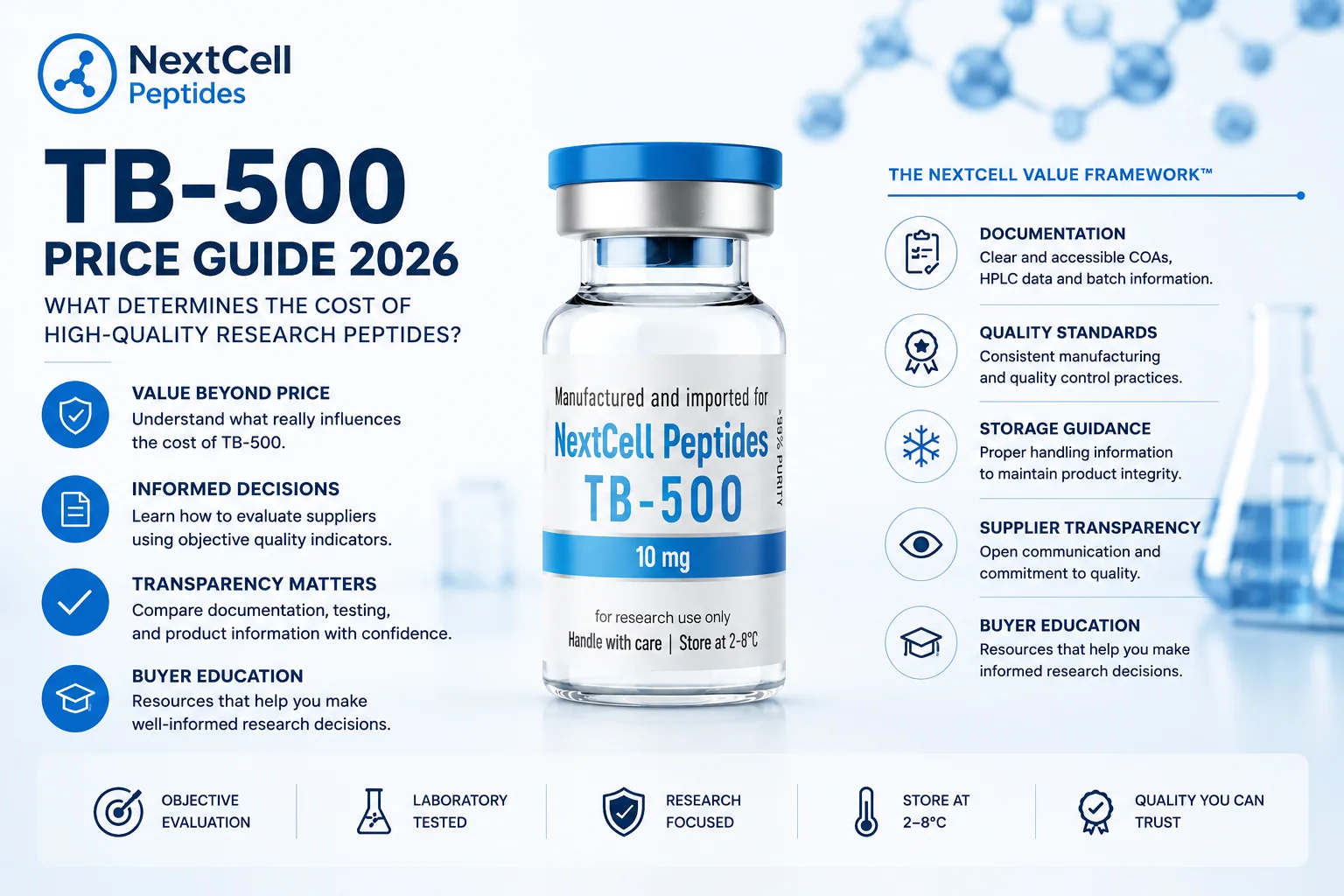
Introduction
The price of TB-500 research peptides varies considerably between suppliers, with products often appearing nearly identical despite substantial differences in price. For researchers entering the peptide market, this naturally raises an important question: what actually determines the cost of high-quality TB-500?
Many buyers assume that a higher price automatically reflects superior quality or that lower-priced products offer better value. Neither assumption is necessarily correct. While price can sometimes reflect manufacturing quality, analytical testing and documentation, it may also be influenced by factors such as supplier business models, production scale, distribution costs and the level of transparency provided throughout the manufacturing process.
Understanding why prices differ requires looking beyond the number displayed on a product page. Research-grade peptides are the result of a complex manufacturing process involving peptide synthesis, purification, lyophilization, analytical testing, quality control and documentation. Every stage contributes to the overall cost of producing a consistent, laboratory-grade product.
For researchers, the goal should not be to find the cheapest TB-500 available. Instead, the objective is to understand whether the price accurately reflects the quality assurance, documentation and manufacturing standards supporting the product.
This guide explains the major factors influencing TB-500 pricing, highlights the hidden costs associated with research peptide production and introduces a practical framework for evaluating value rather than price alone.
Researchers comparing available products may also wish to review the TB-500 product page for product specifications, storage guidance and available batch documentation.
Table of Contents
Why Do TB-500 Prices Vary So Much?
The Biggest Myth About Research Peptide Pricing
The Five Factors That Determine TB-500 Cost
Manufacturing Costs
Analytical Testing and Documentation
Does Higher Purity Increase Price?
Packaging, Storage and Logistics
Price vs Value
Frequently Asked Questions
Related Guides
Summary
Why Do TB-500 Prices Vary So Much?
One of the first observations researchers make when comparing suppliers is the significant variation in product pricing. Two vials containing the same stated quantity of TB-500 may differ in price by 30%, 50% or even more.
At first glance, these differences can be difficult to explain. Most suppliers advertise similar purity levels, comparable packaging and research-grade quality, leading many buyers to assume that all products are essentially equivalent.
In reality, price differences often reflect what cannot immediately be seen on a product page.
These hidden factors may include:
Manufacturing consistency
Purification efficiency
Analytical testing procedures
Batch-specific documentation
Quality control standards
Packaging quality
Storage and handling procedures
Customer support and technical documentation
Rather than comparing products using price alone, experienced researchers evaluate the complete quality system supporting each production batch.
The Biggest Myth About Research Peptide Pricing
Perhaps the most common misconception is that the most expensive TB-500 is automatically the highest quality.
This assumption is not always supported by objective evidence.
A higher price may reflect:
More comprehensive analytical testing.
Batch-specific Certificates of Analysis.
Greater manufacturing consistency.
Better documentation.
Higher operating costs.
Smaller production volumes.
However, price alone cannot confirm that these quality indicators are actually present.
Likewise, the lowest-priced product is not necessarily poor quality. Some manufacturers benefit from larger production volumes or more efficient supply chains, allowing them to offer competitive pricing while maintaining strong quality standards.
The key question is therefore not:
"Which product costs more?"
Instead, researchers should ask:
"What does this price actually include?"
That simple shift in perspective often leads to more informed purchasing decisions.
The Five Factors That Determine TB-500 Cost
Although every manufacturer operates differently, most TB-500 pricing can be explained by five primary cost drivers.
1. Manufacturing
Producing a research peptide requires specialised equipment, controlled manufacturing environments and experienced personnel.
Higher manufacturing standards generally require greater investment in production quality and process consistency.
2. Purification
Following peptide synthesis, impurities generated during production must be removed.
More rigorous purification procedures increase manufacturing costs but contribute to a cleaner final product suitable for laboratory research.
3. Analytical Testing
Independent analytical testing represents one of the largest quality-related costs associated with research peptides.
Testing commonly includes:
HPLC purity analysis
Identity verification
Batch-specific Certificates of Analysis
Quality control review
Comprehensive testing requires specialised laboratory equipment and trained analysts, increasing production costs while improving transparency.
4. Documentation
Preparing professional laboratory documentation also contributes to overall cost.
Researchers increasingly expect suppliers to provide:
Product specifications
Storage guidance
Batch numbers
Analytical reports
Certificates of Analysis
Maintaining accurate documentation requires additional quality management procedures beyond manufacturing alone.
5. Distribution and Storage
Research peptides require careful handling throughout storage and distribution.
Protective packaging, controlled storage conditions and reliable shipping procedures all contribute to the final retail price.
Although these factors may receive less attention than purity or manufacturing, they remain important components of maintaining product quality before laboratory use.
Expert Insight
Experienced researchers rarely ask whether a TB-500 product is cheap or expensive.
Instead, they ask a more meaningful question:
Does the documentation, manufacturing quality and analytical verification justify the price being charged?
This approach shifts the focus away from cost alone and towards overall value.
When viewed through this perspective, price becomes only one component of a much broader evaluation process—one that considers manufacturing standards, analytical transparency and supplier reliability together rather than in isolation.
What Are You Really Paying For?
When comparing TB-500 products, it is easy to focus on the price displayed on a product page. However, the purchase price represents far more than the peptide contained within a vial.
Every research-grade peptide passes through multiple stages before it reaches a laboratory. Each of these stages requires specialised equipment, quality control procedures and technical expertise, all of which contribute to the final cost of the product.
For this reason, two TB-500 products with the same stated concentration may have very different production costs depending on how they were manufactured, tested and documented.
Rather than asking whether one product is cheaper than another, researchers should consider what is actually included in the price.
A supplier investing in comprehensive quality assurance typically incurs higher costs throughout the production process than one providing only the finished peptide with minimal supporting documentation.
Understanding these differences helps researchers evaluate overall value rather than making decisions based solely on price.
The Cost of Manufacturing Quality
The manufacturing process is one of the largest contributors to the cost of a research peptide.
TB-500 is produced through peptide synthesis, followed by purification and lyophilization before undergoing analytical testing and final packaging.
Each stage requires specialised equipment, experienced personnel and controlled manufacturing conditions to maintain consistency between production batches.
Manufacturers that maintain stricter quality standards often invest more heavily in process control, documentation and quality assurance systems. While these investments increase production costs, they also help improve batch consistency and reduce manufacturing variability.
For researchers, manufacturing quality is rarely visible by simply looking at the finished vial. Instead, it is reflected in the documentation and analytical evidence accompanying the product.
Why Documentation Adds Value
One of the biggest differences between suppliers is not the peptide itself but the amount of information provided about it.
Professional laboratory documentation requires both time and resources to prepare. Batch records must be maintained, analytical reports reviewed and product specifications verified before they are released to customers.
Comprehensive documentation may include:
Product specifications
Storage recommendations
Batch identification
Manufacturing information
Laboratory handling guidance
While producing this documentation increases operational costs, it also provides researchers with objective information that can be reviewed before selecting a product.
Transparent documentation reduces uncertainty and allows quality to be assessed using measurable criteria rather than marketing claims.
Why Analytical Testing Influences Price
Analytical testing is another significant contributor to research peptide pricing.
High-quality suppliers typically verify their products using laboratory techniques such as High-Performance Liquid Chromatography (HPLC), which measures peptide purity and helps identify potential impurities generated during manufacturing.
Additional quality control procedures may include identity verification, batch review and documentation checks before products are released.
These analyses require specialised laboratory instruments, trained analysts and validated procedures, making analytical testing one of the more expensive parts of peptide production.
Although laboratory testing increases manufacturing costs, it also provides researchers with valuable evidence supporting the quality of each production batch.
Comparing Two Suppliers
Imagine two suppliers offering a 10 mg vial of TB-500.
The first product is noticeably less expensive but includes only basic product specifications and a short product description. No batch-specific Certificate of Analysis is available, analytical testing is not discussed and storage guidance is limited.
The second supplier charges a higher price but provides a batch-specific COA, HPLC purity documentation, detailed product specifications, comprehensive storage recommendations and clear information about manufacturing quality and analytical testing.
At first glance, the lower-priced product appears to offer better value. However, once the supporting documentation is considered, the comparison changes.
The additional cost is not simply paying for the peptide itself. It also reflects the quality systems, laboratory documentation and analytical transparency that allow researchers to evaluate the product more objectively before purchasing.
Price Alone Rarely Tells the Full Story
A low price is not automatically a warning sign, just as a high price is not proof of superior quality.
Large-scale manufacturing, efficient logistics and streamlined distribution can allow reputable suppliers to offer competitive pricing without compromising quality.
Likewise, some expensive products may provide little additional documentation despite costing considerably more than comparable alternatives.
For this reason, experienced researchers rarely compare products using price alone.
Instead, they evaluate whether the available documentation, manufacturing information and analytical testing justify the price being charged.
When viewed in this way, price becomes only one part of a much larger quality assessment rather than the deciding factor on its own.
Expert Insight
Professional laboratories do not typically select research materials solely because they are the least expensive. Instead, purchasing decisions are based on whether the available documentation, analytical verification and manufacturing transparency provide sufficient confidence in the product's quality.
Applying the same approach when evaluating TB-500 helps researchers move beyond simple price comparisons and make decisions based on objective information rather than assumptions.
How to Evaluate Whether a TB-500 Price Is Fair
Determining whether a TB-500 product offers good value requires more than comparing prices between suppliers.
A lower price may reflect efficient manufacturing and distribution, while a higher price may represent additional investment in analytical testing, documentation and quality assurance. Without understanding what supports the final price, researchers have little basis for comparison.
Rather than asking whether a product is expensive or inexpensive, experienced buyers evaluate whether the supplier provides sufficient evidence to justify the price being charged.
The following framework can help researchers assess overall value before making a purchasing decision.
Start with Transparency
Transparent suppliers make it easier for researchers to understand exactly what they are purchasing.
Instead of relying on broad quality claims, they explain how products are manufactured, tested and documented.
Useful information may include:
Product specifications
Batch identification
Storage recommendations
Manufacturing information
Laboratory documentation
Analytical reports
The more information a supplier willingly provides, the easier it becomes to independently evaluate product quality.
Transparency does not guarantee quality, but a lack of transparency often makes objective evaluation more difficult.
Review the Available Documentation
Documentation provides measurable information that extends beyond product descriptions and marketing language.
Before comparing prices, researchers should review whether supporting laboratory documentation is available.
Examples include:
Batch-specific Certificates of Analysis
HPLC purity reports
Product specifications
Batch numbers
Storage instructions
Handling recommendations
Comprehensive documentation demonstrates that the supplier has invested time and resources into recording and communicating information about each production batch.
Even when documentation does not answer every question, it provides a stronger foundation for evaluation than price alone.
Consider Manufacturing Standards
Manufacturing quality cannot usually be assessed simply by looking at the finished product.
Instead, researchers should consider how much information the supplier provides about the manufacturing process itself.
Questions worth considering include:
Is peptide synthesis discussed?
Is purification explained?
Are lyophilization procedures described?
Are manufacturing standards mentioned?
Is quality control explained?
Suppliers that openly describe these processes generally make it easier for researchers to understand how product quality is maintained throughout production.
Evaluate Analytical Testing
Analytical testing represents one of the most important quality indicators available to researchers.
Testing helps confirm that manufacturing processes have produced a product meeting the supplier's stated specifications.
Information that may be available includes:
HPLC purity analysis
Identity verification
Batch-specific analytical reports
Laboratory testing methods
Quality control procedures
While no single laboratory test provides a complete picture of product quality, analytical documentation contributes valuable objective evidence when comparing suppliers.
Look Beyond the Product Page
A well-developed supplier typically provides educational resources beyond individual product listings.
Researchers may benefit from reviewing whether the supplier also publishes information covering topics such as:
Peptide manufacturing
Analytical testing
Certificate of Analysis interpretation
Storage recommendations
Quality evaluation
Supplier selection
Educational resources demonstrate a commitment to transparency and help buyers better understand how research peptides are evaluated.
Rather than relying solely on promotional product descriptions, researchers can use these resources to make more informed comparisons between suppliers.
Ask the Right Questions
When evaluating TB-500 pricing, the most useful questions are often the simplest.
Instead of asking:
"Which supplier sells the cheapest TB-500?"
Consider asking:
What evidence supports this product's quality?
What documentation is available before purchase?
Is analytical testing clearly explained?
Can the production batch be identified?
Are storage recommendations provided?
Does the supplier explain how quality is maintained?
Answers to these questions often provide greater insight than price alone.
Expert Insight
Experienced researchers understand that price is only one component of product evaluation.
Manufacturing consistency, analytical testing, documentation and supplier transparency all contribute to determining whether a TB-500 product represents good overall value.
By evaluating these factors together rather than focusing solely on cost, researchers can compare products using objective information instead of assumptions.
Common Mistakes When Comparing TB-500 Prices
Choosing a research peptide based solely on price can lead to an incomplete evaluation of product quality.
While cost is naturally an important consideration, it represents only one part of a much broader assessment. Manufacturing standards, analytical testing, documentation and supplier transparency all contribute to determining whether a product offers good overall value.
Researchers who understand this are generally better equipped to compare suppliers using objective information rather than assumptions.
Below are some of the most common mistakes buyers make when evaluating TB-500 pricing.
Mistake 1: Assuming the Cheapest Product Offers the Best Value
A lower price may appear attractive at first glance, particularly when products advertise similar purity levels or identical quantities.
However, the purchase price alone provides little insight into how the peptide was manufactured, whether analytical testing has been performed or what documentation accompanies the product.
Without this information, it becomes difficult to determine whether two products are truly comparable.
Instead of focusing exclusively on cost, researchers should consider what information is available to support the product's stated quality.
Mistake 2: Assuming the Most Expensive Product Is Automatically Better
The opposite assumption can be equally misleading.
A higher price does not guarantee superior manufacturing standards or more comprehensive quality assurance.
Some suppliers invest heavily in analytical testing and documentation, while others may simply position themselves as premium products without providing additional supporting evidence.
Rather than using price as a shortcut for quality, researchers should look for objective indicators such as batch-specific documentation, analytical reports and transparent manufacturing information.
Mistake 3: Ignoring Available Documentation
Documentation is one of the most valuable resources available when comparing research peptides.
Certificates of Analysis, HPLC purity reports, product specifications and batch identification allow researchers to review measurable information rather than relying solely on marketing language.
Choosing a product without reviewing available documentation may result in purchasing decisions based on incomplete information.
Whenever possible, documentation should form part of the evaluation process before price comparisons are made.
Mistake 4: Comparing Products That Are Not Truly Comparable
Not every TB-500 product is supported by the same level of manufacturing information or quality control.
One supplier may provide detailed laboratory documentation, storage guidance and analytical reports, while another offers only a basic product description.
Although both products may appear similar, they are not necessarily equivalent from a quality assurance perspective.
Researchers should compare products that offer similar levels of documentation and transparency rather than comparing prices in isolation.
Mistake 5: Overlooking Long-Term Supplier Reliability
Price comparisons often focus on a single purchase.
However, laboratories and long-term research projects frequently require consistency across multiple production batches.
Reliable suppliers typically maintain consistent documentation, clear batch identification and transparent quality procedures over time.
Considering supplier reliability alongside product price can help reduce uncertainty when future purchases are required.
A Better Way to Compare TB-500 Products
Rather than asking which supplier offers the lowest price, experienced researchers often evaluate a broader range of quality indicators.
These may include:
Manufacturing transparency
Analytical testing
Batch-specific documentation
Product specifications
Storage guidance
Supplier consistency
Educational resources
Technical support
Assessing these factors together provides a more complete picture of overall value than price alone.
Expert Insight
Research peptide purchasing is ultimately a process of evaluating evidence.
Price is only one piece of that evidence and should always be considered alongside manufacturing quality, laboratory documentation, analytical verification and supplier transparency.
Researchers who want to understand these quality indicators in greater detail may also benefit from reading our How to Identify High-Quality TB-500: A Buyer's Checklist (2026) before comparing suppliers or products.
Suppliers that make this information readily available enable researchers to make more informed decisions and compare products with greater confidence.