
Research
Top Peptide Quality Indicators to Check First
Learn the top peptide quality indicators that support sound research purchasing, from batch identity and purity data to COAs, testing, and storage care.
FutureCell Research Team · 8 min read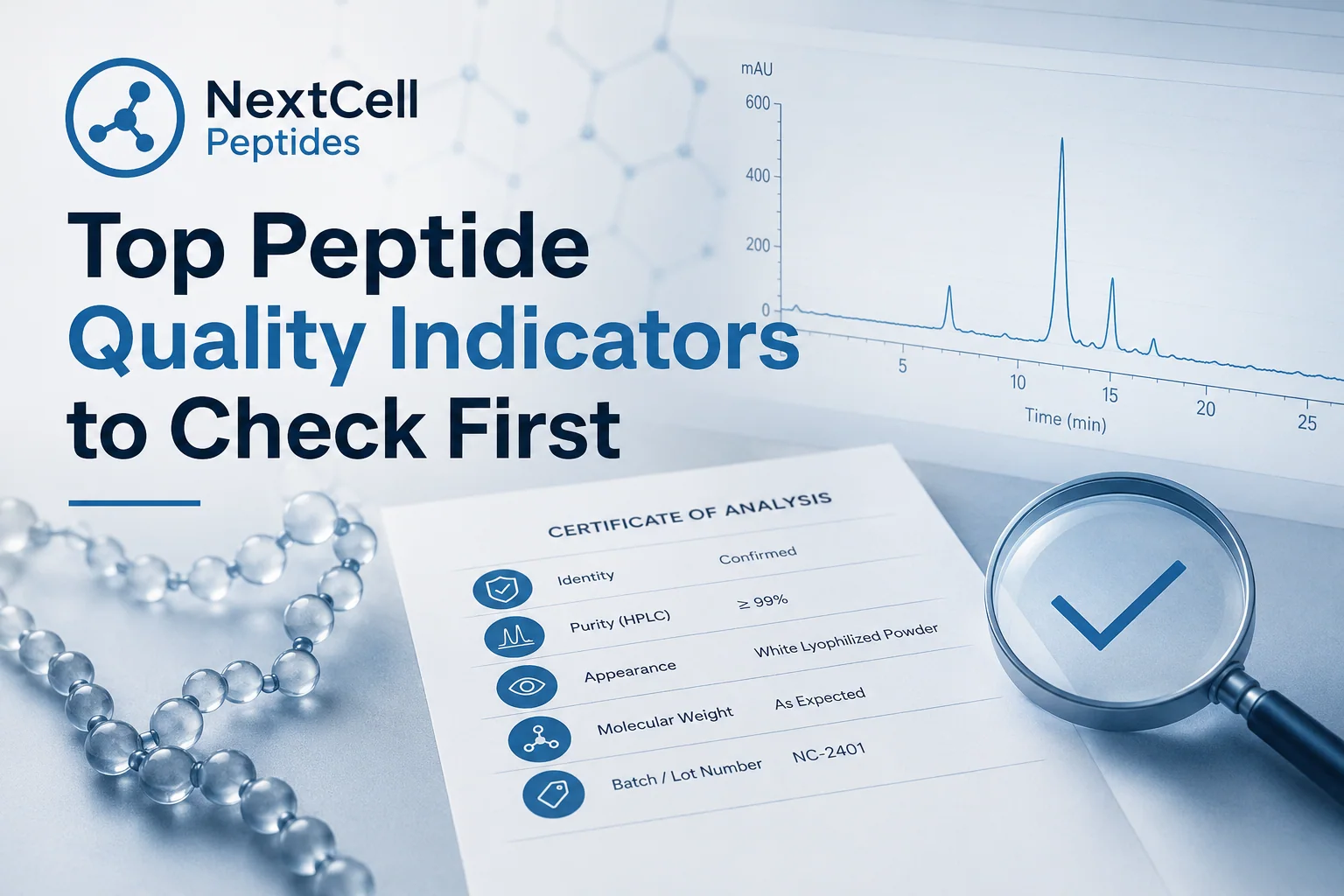
A peptide label may state a purity percentage, a sequence, and a net amount, yet those details only become meaningful when they can be traced to a specific batch and credible analytical evidence. The top peptide quality indicators are not a single number. They are a connected set of specifications, test results, documentation, and handling controls that help a buyer assess whether a research material is accurately represented.
For private customers comparing research peptides online, the practical question is simple: can the supplier show what the product is, how the stated quality was measured, and which lot the results apply to? A clear answer supports more confident research purchasing than broad claims of "high quality" ever can.
Top Peptide Quality Indicators Start With Identity
Purity does not confirm identity on its own. A chromatographic result may indicate that one dominant component is present, but it does not independently establish that the component is the peptide named on the label. Identity testing is therefore one of the first quality checks to review.
For synthetic peptides, mass spectrometry is commonly used to compare the observed molecular mass with the expected mass for the stated sequence. The result should be consistent with the product's molecular composition, including any declared modifications. This matters especially when comparing closely related materials, modified peptides, or compounds supplied as salts.
A useful Certificate of Analysis should identify the product clearly and associate the analytical result with a batch or lot number. The product label, product page, and COA should agree on the peptide name, quantity, and lot reference. If the documentation cannot be connected to the vial or batch being purchased, it has limited value as purchase evidence.
Identity assessment also has boundaries. A matching mass is a strong indicator, but it is not a full characterization program. Isomeric impurities, sequence-related variants, and certain formulation details may require additional analytical approaches. The relevant standard depends on the intended research context and the complexity of the compound.
Purity Data: Read the Method, Not Just the Percentage
Purity is often the most visible specification in a peptide catalog. It is valuable, but only when the method behind the figure is stated. High-performance liquid chromatography, usually abbreviated as HPLC, is widely used to assess the relative purity profile of peptide materials.
An HPLC chromatogram separates components based on their interaction with the analytical system. A major peak may support a reported purity value, while smaller peaks can indicate detectable related substances or other components. For many research purchasers, a stated HPLC purity threshold of 99% or higher is a useful starting point. It should not, however, be treated as a universal guarantee that every possible impurity has been excluded.
The quality of the information matters as much as the number. Look for a defined purity result, the analytical method or method reference where available, and a chromatogram or report associated with the relevant lot. A result that simply says "99% purity" without a batch reference, test date, or method context offers much less confidence.
HPLC also measures a particular analytical response under particular conditions. It may not quantify every non-peptide component equally, and it does not replace identity verification. That is why the strongest product documentation pairs chromatographic purity data with identity data rather than presenting either one in isolation.
What a Chromatogram Can and Cannot Tell You
A clean-looking chromatogram can be reassuring, but interpretation requires restraint. Peak area is typically used to estimate relative purity, and the reported value may depend on detector settings, sample preparation, integration parameters, and the method used. It is evidence of analytical control, not a reason to make assumptions beyond the scope of the test.
For a buyer, the practical standard is transparency. A supplier should make it clear that purity is HPLC-tested, avoid vague language that implies more than the data proves, and provide documentation that belongs to the product batch. This gives customers a realistic basis for comparing materials such as BPC-157, GHK-Cu, TB-500, Semax, or other research compounds.
A Batch-Specific Certificate of Analysis Is Essential
A Certificate of Analysis is one of the most useful documents in peptide selection, provided it is complete and batch-specific. It is not merely a marketing attachment. It is the record that connects a product's stated specifications with documented analytical results.
A clear COA commonly includes the product name, lot or batch number, date of analysis, stated purity result, identity result, and the test methods used. It may also record appearance, net content, molecular information, storage conditions, and the laboratory or quality function responsible for release.
The best documents are internally consistent. If a vial carries lot number NC-2401, for example, its COA should display that same lot number. A generic certificate that has no batch identification may describe a specification, but it does not demonstrate that the exact material supplied was tested against that specification.
Independent third-party testing adds another layer of confidence where applicable. It provides separation between the supplier and the analytical result, particularly when the lab report identifies the sample and methods clearly. Third-party testing is not a substitute for sound supplier controls, but it is a meaningful indicator of transparency when paired with batch records and accessible COAs.
Physical Form, Quantity, and Packaging Matter
Peptide quality is not limited to the analytical report. The delivered product should match its stated physical and commercial specifications. Many research peptides are supplied in lyophilized form, meaning the material has been freeze-dried for stability and handling. The label should identify the compound, net quantity, lot number, and relevant storage information in a legible, professional format.
Packaging should protect the material from avoidable exposure during storage and transport. A well-presented vial alone does not prove quality, but unclear labeling, missing lot data, or inconsistent quantities are legitimate reasons to pause before purchasing. Product integrity is built through small, verifiable details.
Quantity should also be communicated precisely. Milligrams, not ambiguous descriptions such as "one vial," allow buyers to compare products accurately. A supplier should distinguish between net peptide content, stated vial fill, and any declared salt or formulation basis where that distinction affects how the specification is understood.
Storage guidance should be specific but not overstated. Proper storage supports preservation of the supplied material's stated condition, while the appropriate conditions can vary by peptide and format. Buyers should follow the product documentation and assess materials for research purposes only.
Evaluate the Supplier's Quality System, Not One Product Page
A single COA can answer important questions, but purchasing confidence also depends on whether the supplier applies the same standards consistently. Look for evidence that product specifications, labels, COAs, and testing claims follow a repeatable process across the catalog.
Useful signals include batch-tested products, accessible quality documentation, clearly stated purity methodology, consistent product naming, and a direct way to ask questions about specifications. A supplier should be able to explain whether testing is conducted internally, independently, or through a combination of both, without turning routine quality questions into vague assurances.
For EU customers, fulfillment practices can also affect the buying experience. EU-based fulfillment may reduce avoidable transit complexity and make delivery more predictable, while it does not replace analytical quality controls. FutureCell Peptides combines EU fulfillment from the Netherlands with product documentation and independent testing practices designed to make quality information easier to review before purchase.
A Practical Order of Review
When comparing research peptides, start with the lot-specific COA and verify that it matches the product label. Then review identity evidence, HPLC purity data, stated net quantity, physical form, and storage information. Finally, consider whether the supplier communicates these details consistently across its range.
This order helps avoid a common mistake: choosing solely by a headline purity percentage. A lower-priced listing with an unsupported claim may be harder to evaluate than a clearly documented product with a defined batch, HPLC data, identity testing, and transparent specifications.
Quality assessment does not require laboratory expertise to begin. It requires asking whether the information is specific, traceable, and proportionate to the claim being made. The most useful peptide documentation gives researchers something concrete to examine before they add a product to cart, not simply a promise to take on trust.