Guides
What Is Peptide Purity? Everything Buyers Should Know
Understand what peptide purity really means, how it is evaluated, why purity percentages can be misleading without context, and what informed buyers should consider when comparing research peptide suppliers.
FutureCell Research Team · 14 min read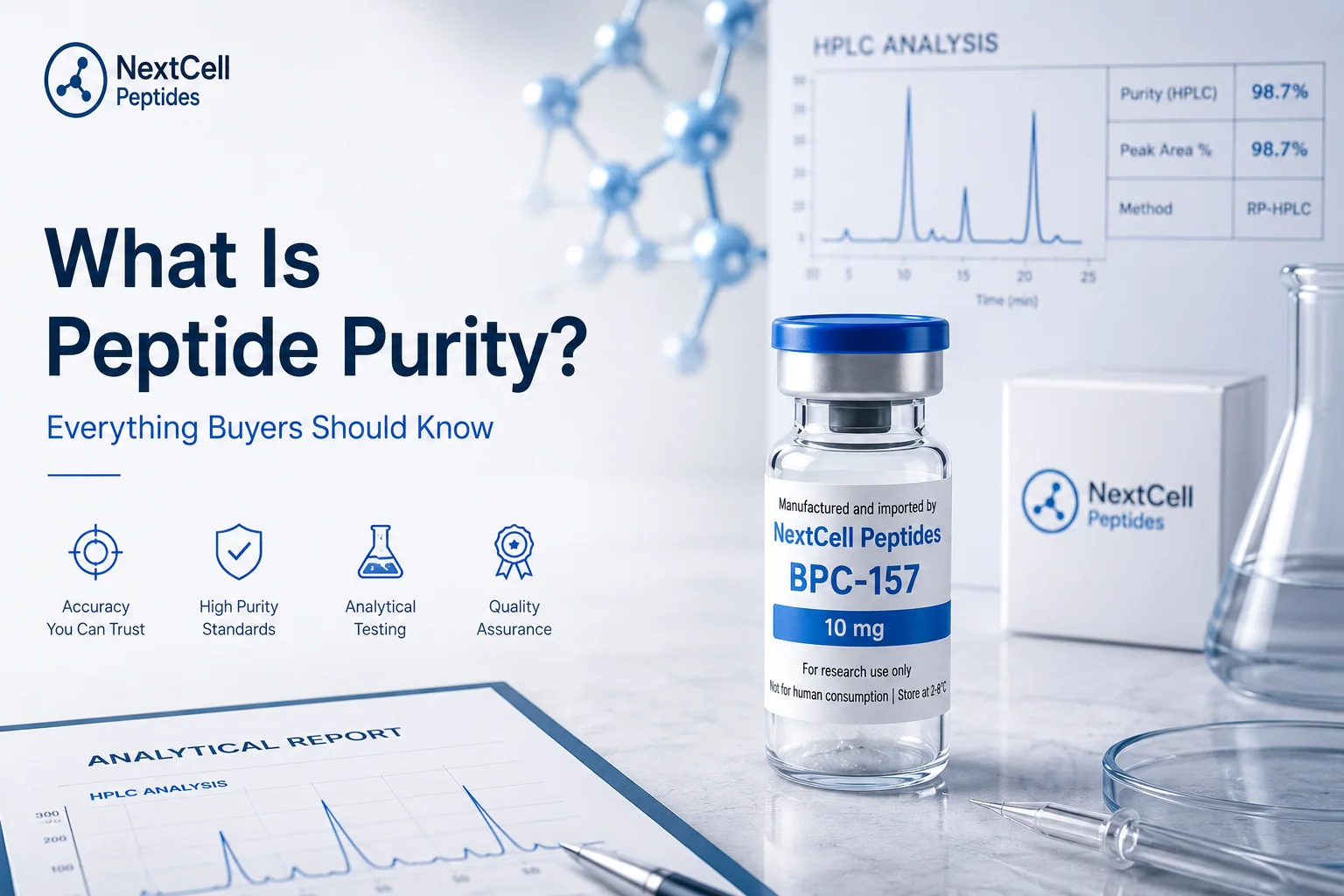
When comparing research peptides, one specification appears more frequently than almost any other: purity.
Many suppliers advertise purity percentages such as 95%, 98% or 99%, often suggesting that a higher number automatically represents a better product. While purity is undoubtedly an important quality indicator, it is only one part of a much broader picture.
For researchers and informed buyers, understanding what peptide purity actually represents—and equally important, what it does not represent—can make comparing products and suppliers significantly easier.
This guide explains how peptide purity is commonly understood, why it matters, how it relates to manufacturing quality and which additional factors should be considered before choosing a research peptide supplier.
Rather than focusing on marketing claims, the goal is to provide practical knowledge that helps readers evaluate research peptides with greater confidence.
Key Takeaways
Peptide purity describes how much of a sample consists of the intended peptide relative to detectable impurities.
A higher purity percentage is generally desirable, but it should never be evaluated in isolation.
Manufacturing quality, purification methods, storage recommendations and supplier transparency all contribute to overall product quality.
Purity alone does not confirm peptide identity, manufacturing consistency or long-term stability.
Understanding purity helps buyers ask better questions and compare suppliers more effectively.
Table of Contents
What Is Peptide Purity?
Why Does Purity Matter?
How Is Peptide Purity Commonly Evaluated?
Does 99% Purity Always Mean Better Quality?
Purity vs Identity vs Stability
Common Misconceptions
How Buyers Can Evaluate Quality Beyond Purity
Questions to Ask Before Buying
Frequently Asked Questions
Summary
What Is Peptide Purity?
Peptide purity refers to the proportion of a sample that consists of the intended peptide compared with detectable impurities that may remain after manufacturing.
During peptide synthesis, small amounts of by-products, incomplete peptide chains and other process-related compounds can be generated. Modern purification techniques are designed to remove as many of these unwanted components as possible before the finished product is packaged.
The reported purity percentage provides an estimate of how much of the final sample corresponds to the target peptide under the analytical conditions used during evaluation.
For example, a reported purity of 98% generally indicates that the vast majority of the detectable material in the sample corresponds to the intended peptide, while a smaller proportion consists of other detectable compounds.
However, this percentage should never be interpreted as the only indicator of overall product quality.
Why Does Peptide Purity Matter?
Purity matters because it contributes to the consistency and reliability of research materials.
Higher purity generally means that fewer detectable impurities remain following manufacturing and purification. This can improve confidence that the material being studied closely represents the intended peptide sequence.
For researchers, this is important because experimental reproducibility depends on working with well-characterized materials.
For buyers, understanding purity provides valuable context when comparing different suppliers. Rather than focusing solely on price or marketing claims, informed buyers can evaluate whether a supplier provides meaningful product information and communicates quality standards transparently.
Purity is therefore an important quality indicator—but not a complete quality assessment.
Awareness Stage: Understanding the Bigger Picture
One of the most common misunderstandings is assuming that purity alone determines whether one research peptide is "better" than another.
In reality, purity represents just one measurement within a much larger manufacturing process.
Other factors—including peptide synthesis, purification procedures, packaging, storage recommendations and overall supplier transparency—also contribute to the quality of the finished product.
Understanding this broader perspective helps buyers make more informed decisions instead of relying on a single specification.
Why Purity Should Never Be Viewed in Isolation
Imagine comparing two research peptide suppliers.
Supplier A prominently advertises a very high purity percentage but provides little additional information.
Supplier B offers a comparable purity specification while also providing detailed educational resources, clear storage recommendations, transparent product documentation and comprehensive product information.
Although both products may appear similar at first glance, many experienced buyers would consider the additional transparency valuable when evaluating the supplier as a whole.
Rather than focusing exclusively on one number, experienced researchers often consider the complete quality picture.
Quick Buyer Checklist
Before comparing purity percentages, ask yourself:
✔ Does the supplier clearly explain their products?
✔ Are storage recommendations provided?
✔ Is educational information available?
✔ Is the manufacturing process explained?
✔ Is product labeling clear and professional?
✔ Does the supplier demonstrate transparency throughout the website?
Evaluating multiple quality indicators together often provides a more balanced assessment than focusing on purity alone.
How Is Peptide Purity Commonly Evaluated?
After a research peptide has been synthesized and purified, manufacturers typically perform analytical testing to evaluate different characteristics of the finished material.
One of the most widely used analytical techniques within peptide manufacturing is High-Performance Liquid Chromatography (HPLC).
HPLC separates molecules based on their chemical properties, allowing laboratories to evaluate the relative proportion of the intended peptide compared with other detectable compounds under defined analytical conditions.
The resulting purity percentage is therefore an analytical measurement—not a marketing term.
However, it is important to understand that purity values should always be interpreted within the context of the analytical method used and should never be viewed as the sole indicator of product quality.
Does a Higher Purity Percentage Always Mean Better Quality?
Many buyers naturally assume that the peptide with the highest advertised purity percentage is automatically the best choice.
The reality is more nuanced.
A high purity value generally indicates that a large proportion of the detectable sample corresponds to the intended peptide. However, overall product quality also depends on factors such as manufacturing consistency, purification standards, storage conditions and supplier transparency.
Experienced researchers rarely evaluate products based on a single specification.
Instead, they consider multiple quality indicators together to form a more complete picture.
Looking Beyond the Number
Consider the following example.
Supplier ASupplier BAdvertises 99% purityAdvertises 98% purityLimited product informationDetailed educational resourcesMinimal storage guidanceClear storage recommendationsLittle manufacturing informationTransparent manufacturing explanationsBasic product pagesComprehensive product documentation
Both suppliers may advertise high purity levels, but many buyers would likely feel more confident purchasing from the supplier that provides greater transparency and educational value.
Purity is important—but confidence is built through the complete customer experience.
What Influences Peptide Purity?
Several stages of the manufacturing process can influence the purity of a finished peptide.
These include:
Peptide Synthesis
Accurate assembly of the amino acid sequence helps reduce unwanted by-products during manufacturing.
Purification
Effective purification removes synthesis-related impurities before packaging.
Manufacturing Consistency
Well-controlled manufacturing processes contribute to reproducible product quality between batches.
Storage Conditions
Proper storage helps preserve product integrity after manufacturing.
Product Handling
Appropriate packaging and transportation help protect sensitive research materials throughout distribution.
Each stage contributes to the overall quality of the finished product.
Peptide Purity vs Peptide Identity
These two concepts are frequently confused.
They describe different characteristics of a peptide.
Peptide PurityPeptide IdentityIndicates the proportion of detectable material corresponding to the intended peptideConfirms that the peptide sequence matches the intended moleculeFocuses on sample compositionFocuses on molecular identityOne quality indicatorA separate analytical consideration
Understanding the distinction helps buyers avoid assuming that one measurement automatically confirms every aspect of product quality.
Peptide Purity vs Stability
Purity and stability are also different concepts.
A peptide may have excellent analytical purity immediately after manufacturing while still requiring appropriate storage conditions to help preserve its quality over time.
Factors such as temperature, moisture and light exposure may influence stability depending on the characteristics of the peptide and its recommended storage conditions.
This is one reason why professional suppliers provide storage guidance alongside product specifications.
Common Misconceptions About Peptide Purity
Because purity percentages are widely discussed online, several misconceptions continue to circulate.
"99% purity guarantees the best product."
Not necessarily.
Purity represents one important measurement, but manufacturing quality involves many additional factors.
"Purity is the only number that matters."
Experienced buyers typically evaluate multiple indicators, including manufacturing standards, supplier transparency, storage guidance and educational resources.
"All suppliers measure purity in exactly the same way."
Analytical procedures may vary between laboratories and manufacturers.
Understanding how analytical testing fits into the broader quality process provides a more balanced perspective.
"Lower price means the same quality."
Price alone does not provide information about manufacturing processes, documentation, product handling or supplier transparency.
Many buyers prefer evaluating the complete quality picture rather than comparing products solely on cost.
Commercial Search Intent — How Experienced Buyers Evaluate Suppliers
Once buyers understand what peptide purity represents, their next question often becomes:
"How can I compare suppliers objectively?"
Rather than focusing on one specification, experienced buyers frequently evaluate several quality indicators together.
Practical Evaluation Framework
Consider whether a supplier provides:
✓ Clear product descriptions
✓ Transparent educational resources
✓ Professional product labeling
✓ Appropriate storage recommendations
✓ Detailed manufacturing information
✓ Responsive customer support
✓ Consistent branding and presentation
✓ Accurate scientific information
No single factor guarantees product quality.
However, suppliers that consistently communicate openly and provide comprehensive product information often make it easier for buyers to evaluate their offerings with confidence.
Key Takeaway
Peptide purity is an important quality indicator—but it represents only one part of the broader manufacturing and quality process.
Understanding how purity fits alongside manufacturing standards, purification, storage and supplier transparency allows buyers to make more informed decisions and avoid relying on a single specification when comparing research peptides.