Guides
Why Lyophilized GHK-Cu Is Preferred for Research: Quality, Stability & Freeze-Drying Explained
Learn why GHK-Cu is supplied as a lyophilized powder, how freeze-drying supports stability and quality, and what to look for when evaluating research-grade products.
FutureCell Research Team · 18 min read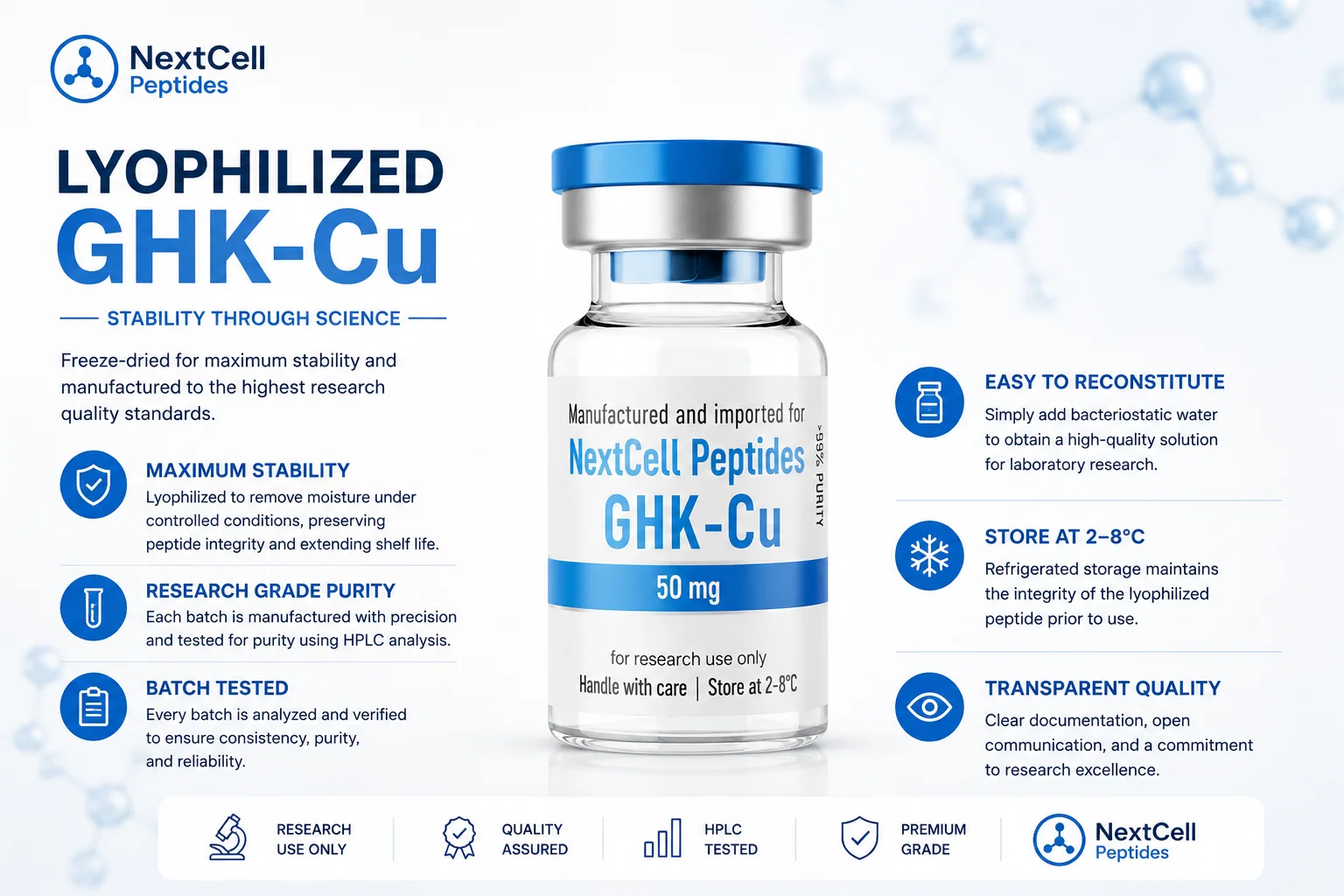
Introduction
When evaluating research-grade GHK-Cu, most discussions focus on analytical purity, manufacturing standards, or supplier documentation. An equally important characteristic, however, is the physical form in which the peptide is supplied.
Most high-quality GHK-Cu intended for laboratory research is distributed as a lyophilized (freeze-dried) powder rather than as a liquid solution. This is not simply a matter of convenience. Lyophilization is a carefully controlled manufacturing process designed to improve stability, protect sensitive peptide structures during storage and transport, and support long-term product integrity before laboratory preparation.
Understanding why GHK-Cu is lyophilized helps researchers interpret product quality more accurately. It also explains why reputable suppliers invest in specialized manufacturing equipment, validated freeze-drying cycles, and strict quality control procedures before a vial ever reaches the laboratory.
This guide explains:
What lyophilization is and why it is widely used for research peptides
How the freeze-drying process works
Why GHK-Cu is typically supplied as a lyophilized powder instead of a liquid
How lyophilization contributes to stability and product quality
What researchers should look for when evaluating a lyophilized GHK-Cu vial
Common misconceptions about freeze-dried peptides
Whether you are new to peptide research or comparing different suppliers, understanding the role of lyophilization provides valuable context when assessing research-grade GHK-Cu.
Table of Contents
What Does "Lyophilized" Mean?
Why Is GHK-Cu Usually Supplied as a Lyophilized Powder?
How the Lyophilization Process Works
How Freeze-Drying Helps Preserve Peptide Quality
What a High-Quality Lyophilized GHK-Cu Vial Should Look Like
Common Signs of Poor Lyophilization
Storage Considerations for Lyophilized GHK-Cu
Frequently Asked Questions
Final Thoughts
What Does "Lyophilized" Mean?
Lyophilization, commonly referred to as freeze-drying, is a preservation technique used throughout the biotechnology and pharmaceutical industries to remove water from temperature-sensitive materials while minimizing structural changes.
Unlike conventional drying methods, which rely on heat to evaporate moisture, lyophilization removes water under carefully controlled low-temperature and low-pressure conditions. This helps preserve delicate molecular structures that could otherwise be altered or degraded during traditional drying.
For research peptides such as GHK-Cu, maintaining molecular integrity throughout manufacturing is essential. Even minor changes in environmental conditions can influence the physical characteristics of peptide preparations, making controlled processing an important part of high-quality production.
The result of successful lyophilization is a dry, stable peptide powder that is significantly less susceptible to degradation than an equivalent aqueous solution when stored under appropriate conditions.
Because of these advantages, lyophilization has become the preferred manufacturing approach for many research peptides intended for laboratory use.
Why Is GHK-Cu Usually Supplied as a Lyophilized Powder?
GHK-Cu is a small copper-binding peptide whose physical and chemical properties make it well suited for lyophilized presentation.
Supplying GHK-Cu as a dry powder provides several practical advantages during manufacturing, transportation, storage, and laboratory handling.
Rather than remaining dissolved in water for extended periods, the peptide is freeze-dried shortly after production and quality testing. By removing moisture before packaging, manufacturers can reduce one of the primary factors that contributes to chemical instability in peptide solutions.
This approach also simplifies transportation and inventory management, as a properly manufactured lyophilized product is generally more robust during distribution than its liquid equivalent.
From a quality perspective, the objective is not simply to produce a dry powder. The goal is to preserve the peptide in a physical state that supports analytical consistency until the product is prepared for laboratory research.
For this reason, most reputable manufacturers incorporate lyophilization as a standard step within a broader quality-controlled production workflow that includes:
Peptide synthesis
Purification
Analytical verification
Sterile filtration
Lyophilization
Controlled vial filling
Vacuum sealing
Batch documentation
Final quality release
When evaluating research-grade GHK-Cu, the presence of a clean, well-formed lyophilized cake is one indicator that the manufacturing process has been carefully controlled, although it should always be considered alongside analytical documentation such as HPLC results and Certificates of Analysis (COAs).
How the Lyophilization Process Works
Lyophilization is a highly controlled preservation process designed to remove water from sensitive biological materials while minimizing structural changes. For research peptides such as GHK-Cu, freeze-drying is not simply a drying method—it is an integral part of manufacturing that helps preserve product integrity from production to laboratory use.
Unlike conventional drying, which relies on heat to evaporate moisture, lyophilization removes water through sublimation. During sublimation, ice transitions directly from a solid to a vapor under low pressure without passing through a liquid phase. This approach reduces thermal stress and helps maintain the physical characteristics of the peptide.
Although manufacturing parameters vary between facilities, the process generally consists of four carefully monitored stages.
Stage 1: Peptide Preparation
Before freeze-drying begins, GHK-Cu has already undergone multiple manufacturing and quality control steps.
These typically include:
Peptide synthesis
Purification to remove synthesis-related impurities
Analytical verification using techniques such as HPLC
Identity confirmation where applicable
Preparation in a controlled aqueous solution suitable for lyophilization
At this stage, the peptide remains in liquid form and has not yet been converted into the familiar white powder found inside research vials.
Maintaining strict control over solution composition is important because factors such as concentration, pH, and manufacturing consistency can influence the success of the freeze-drying cycle.
Stage 2: Rapid Freezing
The prepared peptide solution is then rapidly frozen under carefully controlled conditions.
Freezing converts the water within the solution into ice while preserving the distribution of dissolved peptide molecules throughout the vial.
The freezing phase is more important than many researchers realize. Ice crystal formation can influence the internal structure of the final lyophilized cake, affecting its appearance and physical consistency.
Well-controlled freezing helps create a uniform structure that supports efficient moisture removal during later stages of the process.
Stage 3: Primary Drying (Sublimation)
Once completely frozen, the vials are transferred into a lyophilization chamber.
The chamber pressure is significantly reduced while shelf temperatures are carefully adjusted.
Under these conditions, the frozen water does not melt. Instead, it sublimates directly into water vapor.
This phase removes the majority of moisture from the product while minimizing exposure to elevated temperatures that could otherwise affect sensitive peptide structures.
Primary drying is often the longest stage of the entire manufacturing process and requires continuous monitoring to maintain process consistency across production batches.
Stage 4: Secondary Drying
Even after visible ice has been removed, very small amounts of moisture remain bound to the material.
Secondary drying gradually reduces this residual moisture under tightly controlled conditions.
Removing excess moisture is important because residual water may influence long-term stability during storage.
The objective is not to eliminate every trace of water but to achieve an appropriate residual moisture level consistent with validated manufacturing specifications.
Once this stage is complete, the peptide has been transformed into the dry, porous material commonly referred to as the lyophilized cake.
Vacuum Sealing and Final Packaging
After freeze-drying has been completed, each vial is sealed under controlled manufacturing conditions.
Many research-grade peptide manufacturers use vacuum or inert gas environments during the sealing process to help minimize exposure to atmospheric moisture and oxygen before the product reaches the end user.
Each finished vial is then labeled with production information that may include:
Product identification
Batch or lot number
Manufacturing date
Storage recommendations
Quantity
Laboratory-use labeling where applicable
These identifiers support traceability throughout the product lifecycle and can be cross-referenced with analytical documentation such as Certificates of Analysis (COAs).
Why Manufacturing Consistency Matters
Lyophilization is an important stage in peptide manufacturing, but it represents only one part of a much broader quality system. The overall quality of a research peptide is established through a series of carefully controlled manufacturing and analytical processes that begin long before freeze-drying takes place.
A high-quality GHK-Cu product starts with controlled peptide synthesis, where the manufacturing process is designed to produce a consistent peptide sequence and composition from one production batch to the next. Consistency at this stage provides the foundation for every subsequent quality control step.
Following synthesis, the peptide undergoes purification to remove synthesis-related impurities and unwanted by-products. High-purity purification is essential because it helps ensure that the finished product more closely reflects the intended peptide composition before analytical testing is performed.
Once purification is complete, manufacturers typically perform analytical testing, most commonly using High-Performance Liquid Chromatography (HPLC). This analytical method verifies the purity of each production batch and provides objective laboratory data that can be documented in a batch-specific Certificate of Analysis.
Batch traceability is another important component of manufacturing quality. Clearly assigned batch or lot numbers allow analytical reports, production records, and quality documentation to be linked to individual manufacturing runs, supporting transparency throughout the product lifecycle.
Only after these quality control procedures have been completed does the peptide enter the lyophilization process. Freeze-drying helps preserve the physical integrity of the purified peptide by removing water under carefully controlled conditions, preparing the product for storage and transportation.
The final manufacturing step is controlled vial sealing and packaging. Proper sealing helps protect the lyophilized peptide from unnecessary exposure to moisture and environmental conditions before laboratory preparation, while professional labeling supports product identification and traceability.
Rather than relying on any single quality indicator, experienced researchers evaluate the complete manufacturing process. Controlled synthesis, effective purification, analytical verification, batch traceability, carefully executed lyophilization, and secure packaging each contribute to the overall quality of a research-grade GHK-Cu product. When considered together, these elements provide a far more meaningful assessment than visual appearance or a single laboratory result alone.
Expert Insight
One common misconception is that the appearance of a white lyophilized powder alone indicates a high-quality peptide.
In reality, visual appearance should be considered only one component of a broader quality assessment.
A clean, well-formed lyophilized cake may suggest that the freeze-drying process was carefully controlled, but it does not independently confirm purity, identity, or manufacturing standards. Those characteristics are evaluated through analytical documentation, validated production procedures, and batch-specific quality testing.
For this reason, experienced researchers typically consider both the physical presentation of the product and the supporting laboratory documentation when evaluating research-grade GHK-Cu.
Why Lyophilization Helps Preserve GHK-Cu Quality
The primary objective of lyophilization is to create a stable, dry product that maintains its physical characteristics until it is prepared for laboratory research.
Peptides are complex chains of amino acids whose stability can be influenced by environmental factors such as moisture, temperature, oxygen, and prolonged storage in solution. By removing water through freeze-drying, manufacturers reduce one of the factors that may contribute to degradation over time.
For this reason, lyophilization has become the preferred presentation for many research peptides, including GHK-Cu.
It is important to understand, however, that lyophilization does not improve the purity of a peptide or compensate for poor manufacturing practices. Instead, it helps preserve the quality already achieved during synthesis, purification, and analytical testing.
In other words, freeze-drying protects quality—it does not create it.
What Should a High-Quality Lyophilized GHK-Cu Vial Look Like?
While laboratory testing remains the most reliable method of evaluating a peptide, the physical appearance of a lyophilized vial can provide useful observations when considered alongside analytical documentation.
A properly manufactured GHK-Cu vial typically contains a dry, well-formed lyophilized cake that appears uniform and free from obvious visual defects.
Researchers often look for characteristics such as:
A consistent, intact lyophilized cake
A dry appearance without visible moisture
Minimal collapse or shrinkage
Uniform coloration appropriate for the product
A securely sealed vial with no signs of damage
Clearly printed product and batch information
Although these visual characteristics cannot confirm purity or identity, they may indicate that the freeze-drying and packaging processes were carefully controlled.
Common Visual Characteristics
Although analytical testing provides the most reliable assessment of a research peptide, the physical appearance of a lyophilized GHK-Cu vial can offer useful supporting information when interpreted alongside manufacturing documentation.
A uniform lyophilized cake is generally considered a positive visual indicator. It may suggest that the freeze-drying process was performed under carefully controlled conditions and that the product maintained its physical structure throughout manufacturing.
A dry, porous appearance is another characteristic commonly associated with properly lyophilized peptides. This texture is a normal result of the freeze-drying process and reflects the removal of water under controlled low-pressure conditions.
Researchers may also notice minor surface cracks within the lyophilized cake. In many cases, these are a natural consequence of moisture removal and do not necessarily indicate a manufacturing problem.
In contrast, a completely collapsed lyophilized cake may suggest that the freeze-drying cycle was not fully optimized or that the product experienced unfavorable conditions during manufacturing. While appearance alone cannot determine analytical quality, significant structural collapse may warrant closer evaluation of the accompanying documentation.
The presence of visible moisture inside a sealed vial should never be overlooked. Moisture may indicate that the product has been exposed to conditions capable of affecting its physical integrity and should always be considered alongside batch documentation and packaging condition.
Researchers should also inspect the vial closure and stopper. A damaged seal or compromised stopper may increase the likelihood of environmental exposure during storage or transportation, potentially affecting the condition of the lyophilized product.
Ultimately, visual inspection should be viewed as one component of a broader quality assessment. The appearance of a lyophilized peptide can provide valuable context, but it should always be interpreted alongside analytical testing, batch-specific Certificates of Analysis, manufacturing documentation, and supplier transparency when evaluating research-grade GHK-Cu.
Why Moisture Is the Enemy of Lyophilized Peptides
Water plays an important role in many chemical and biological processes.
For lyophilized peptides, unwanted moisture exposure during storage or transport may gradually affect the physical condition of the product.
This is one reason why reputable manufacturers place significant emphasis on:
Controlled freeze-drying cycles
Appropriate residual moisture specifications
Secure vial sealing
Suitable packaging materials
Recommended storage conditions
Protecting the product from unnecessary moisture exposure helps preserve its physical integrity throughout distribution and storage.
The Difference Between Product Appearance and Product Quality
One of the most common misconceptions among first-time buyers is that appearance alone determines quality.
In reality, quality is established long before the peptide reaches the freeze-dryer.
A visually attractive lyophilized cake cannot confirm:
Peptide identity
Analytical purity
Manufacturing consistency
Batch reproducibility
Laboratory testing standards
Likewise, a small cosmetic imperfection does not automatically indicate that a peptide fails to meet analytical specifications.
Experienced researchers therefore evaluate products using multiple sources of information rather than relying on appearance alone.
The FutureCell Research Quality Framework™
When evaluating a lyophilized GHK-Cu product, experienced researchers rarely rely on a single characteristic. Instead, they assess the product as part of a broader quality system that includes manufacturing standards, analytical testing, documentation, and supplier transparency.
A comprehensive evaluation begins with the Certificate of Analysis (COA). A batch-specific COA provides traceability and allows researchers to review analytical data associated with the exact production batch rather than relying on generic specifications.
HPLC purity data is another important consideration. High-performance liquid chromatography (HPLC) is widely used to assess analytical purity and helps verify that the batch meets the manufacturer's stated specifications.
Researchers should also look for a clearly labeled batch or lot number. Batch identification supports traceability throughout manufacturing and enables analytical documentation to be linked to a specific production run.
The physical appearance of the lyophilized cake can provide additional context. A uniform, well-formed cake may indicate that the freeze-drying process was carefully controlled, although appearance alone should never be used as proof of product quality.
Clear storage guidance is another sign of a quality-focused manufacturer. Providing appropriate handling and storage recommendations demonstrates attention to preserving product integrity after production.
Professional labeling and packaging also contribute to overall confidence. Clearly presented product information, consistent labeling, and secure packaging reflect a structured manufacturing process and help researchers identify products accurately.
Finally, supplier transparency remains one of the strongest indicators of quality. Manufacturers that openly provide analytical documentation, product specifications, and batch information allow researchers to evaluate products using objective evidence rather than marketing claims.
No single characteristic determines the overall quality of a research peptide. Instead, confidence is built by evaluating the complete picture—from manufacturing and analytical testing to documentation, packaging, and supplier transparency.
Why Transparency Matters More Than Marketing Claims
In the research peptide industry, marketing language is easy to publish. Objective documentation is considerably more valuable.
Rather than relying on broad quality claims, reputable suppliers typically provide information that researchers can independently evaluate.
Examples include:
Batch-specific analytical reports
Certificates of Analysis
Product specifications
Storage recommendations
Manufacturing information where appropriate
Consistent product labeling
Clear batch identification
Documentation allows researchers to assess quality using evidence rather than promotional language.
For this reason, transparency has become one of the strongest indicators of a supplier's commitment to quality.
Expert Insight
When comparing suppliers, many researchers focus first on purity percentages or pricing.
While both are important, they represent only part of the overall picture.
The combination of consistent manufacturing, controlled lyophilization, batch traceability, analytical testing, and transparent documentation provides a more complete basis for evaluating research-grade GHK-Cu than any individual specification alone.
Storage Considerations for Lyophilized GHK-Cu
Once a research peptide has been successfully manufactured and lyophilized, appropriate storage becomes an important part of preserving its physical integrity before laboratory use.
Although lyophilization significantly reduces moisture content, the resulting product is not completely immune to environmental influences. Temperature fluctuations, humidity, prolonged exposure to light, and compromised vial seals may affect the condition of the lyophilized powder over time.
For this reason, manufacturers typically provide storage recommendations based on product-specific stability data and validated manufacturing procedures.
Researchers should always follow the storage guidance supplied with the individual product and avoid exposing unopened vials to unnecessary environmental stress.
Storage Factors That Influence Product Integrity
Several environmental factors can influence the condition of a lyophilized GHK-Cu product during storage. Although freeze-drying significantly reduces moisture content, maintaining appropriate storage conditions remains an important part of preserving the product in the state established during manufacturing.
Temperature plays a key role in maintaining the physical stability of a lyophilized peptide. Following the manufacturer's recommended storage conditions helps minimize unnecessary environmental stress before laboratory preparation.
Moisture is one of the most important factors to avoid. Because lyophilized peptides are intentionally dried during manufacturing, exposure to excess humidity may compromise the physical condition of the lyophilized cake if the vial seal is damaged or the product is stored improperly.
Light exposure should also be considered. While storage recommendations may vary between products, protecting research peptides from prolonged exposure to light supports good laboratory storage practices and helps maintain product integrity.
Keeping GHK-Cu in its original packaging until it is needed for laboratory work provides an additional layer of protection against environmental exposure during storage and transportation. Original packaging is designed to help safeguard both the vial and its accompanying product information.
Finally, an intact vial seal is essential. A properly sealed vial helps reduce the risk of moisture entering the container before laboratory preparation and supports the overall integrity of the lyophilized product.
Taken together, these storage considerations help preserve the condition of GHK-Cu after manufacturing. While lyophilization provides an important foundation for product stability, appropriate storage and careful handling remain essential for maintaining the quality established during production.
Common Myths About Lyophilized GHK-Cu
Research peptides are often discussed in online communities where information may vary in quality and accuracy.
Below are several common misconceptions regarding lyophilized GHK-Cu.
Myth: Freeze-drying increases peptide purity.
Reality:
Lyophilization does not increase analytical purity. Purity is determined during peptide synthesis, purification, and quality testing. Freeze-drying helps preserve the material after these manufacturing stages have been completed.
Myth: A perfectly white powder always indicates a superior product.
Reality:
Appearance alone cannot verify purity, identity, or manufacturing quality. Laboratory documentation and batch-specific analytical testing remain the primary tools for evaluating research-grade peptides.
Myth: Every lyophilized peptide is manufactured to the same standard.
Reality:
Manufacturing processes, purification methods, quality control procedures, and documentation standards differ between suppliers. These differences can influence consistency and transparency.
Myth: Lyophilized peptides require no storage considerations.
Reality:
Although freeze-drying improves stability compared with liquid preparations, manufacturers still recommend appropriate storage conditions to help preserve product quality before laboratory use.
Frequently Asked Questions
Why is GHK-Cu supplied as a powder instead of a liquid?
Lyophilization removes water from the peptide under controlled conditions, creating a dry product that is generally better suited for storage and transportation than an equivalent aqueous solution.
Does lyophilization affect peptide purity?
No. Analytical purity is established before freeze-drying through synthesis, purification, and laboratory testing. Lyophilization is intended to preserve—not increase—that quality.
Can the appearance of a vial confirm quality?
Not on its own.
Visual inspection may provide useful observations regarding packaging or the condition of the lyophilized cake, but analytical documentation such as HPLC results and batch-specific Certificates of Analysis remains essential when evaluating research-grade products.
Why do reputable suppliers provide batch numbers?
Batch identification supports traceability throughout manufacturing and quality control. It allows analytical reports and product documentation to be linked to a specific production batch.
What documentation should researchers look for?
Depending on the supplier, useful documentation may include:
Certificate of Analysis (COA)
HPLC purity results
Batch or lot number
Product specifications
Storage guidance
Manufacturing information where available
Providing this information helps researchers evaluate products with greater transparency.
Related Guides
To build a more complete understanding of research-grade GHK-Cu, the following educational resources may also be useful:
GHK-Cu: The Complete Research Peptide Buyer's Guide – A comprehensive introduction to GHK-Cu, including structure, research background, and key considerations.
How to Identify High-Quality GHK-Cu – Learn how to evaluate analytical purity, Certificates of Analysis, HPLC testing, and supplier transparency.
GHK-Cu Price Guide (2026) – Understand the factors that influence pricing and why manufacturing standards can affect product cost.
GHK-Cu Product Page – Review product specifications, batch documentation, and available quality information.
Together, these resources provide a structured learning path covering the most important aspects of evaluating research-grade GHK-Cu.
Key Takeaways
Before choosing a research-grade GHK-Cu product, remember these core principles:
Lyophilization is a preservation process, not a purification method.
Freeze-drying helps maintain product integrity by removing water under controlled conditions.
Product quality is established through synthesis, purification, and analytical testing before lyophilization begins.
A well-formed lyophilized cake should be evaluated alongside documentation—not in isolation.
Batch-specific Certificates of Analysis, HPLC testing, and transparent manufacturing information provide a stronger basis for quality assessment than marketing claims alone.
Appropriate storage and handling help preserve the condition of a lyophilized peptide before laboratory preparation.
Final Thoughts
Lyophilization is one of the defining characteristics of modern research peptide manufacturing. By removing water through a carefully controlled freeze-drying process, manufacturers can produce GHK-Cu in a form that supports stability during storage, transportation, and laboratory handling.
However, freeze-drying represents only one component of a broader quality system.
A comprehensive evaluation of research-grade GHK-Cu should also consider analytical purity, manufacturing consistency, batch traceability, and the availability of clear supporting documentation. When these elements are viewed together, researchers are better equipped to make informed comparisons between suppliers and to understand the standards behind a well-manufactured product.
For those seeking to learn more, reviewing related guides on product quality, analytical testing, and pricing can provide additional context and help build a more complete understanding of the factors that distinguish high-quality research peptides.